Special Relativity | Lecture 2
TL;DR
Lorentz transformations relate the space and time coordinates assigned to the same event by stationary and moving observers while preserving their shared measurement of light speed. For motion along the x axis, x and t transform together, while y and z remain unchanged. Special Relativity Lecture 2 also explains reciprocal frames, restoring c through dimensional consistency, and chaining transformations for velocity addition, making the details worth reading.
Transcript
Stanford University. All right. We were last time we worked out basic Lorent transformations relating two frames of reference. Uh whether or not I said it, let me say it now. We were mainly dealing with problems in which all of the motion and in particular the relative motion of different observers is along one particular axis. We didn't uh try to ... Read More
Key Insights
- Shared light speed drives everything: The Lorentz transformations are not introduced as arbitrary coordinate formulas. They are the relationships required so that stationary and moving observers always agree on light speed. Space and time must therefore transform together, replacing the purely Newtonian treatment that would change position while leaving time universal.
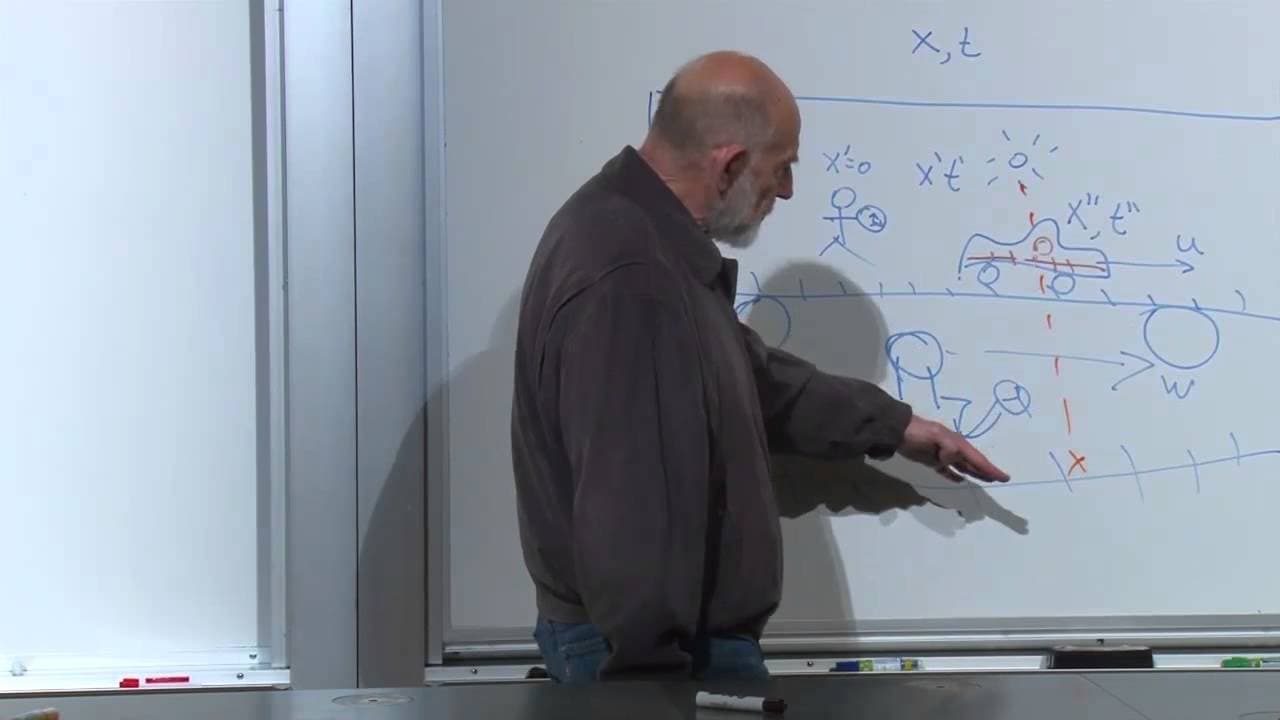
- The railroad model isolates motion: Placing one observer at a station and another aboard a train makes the relative velocity easy to identify. Their motion lies entirely along the tracks, designated as the x axis. This restriction lets the lecture focus on the coupled transformation of x and t before considering any additional spatial coordinates.
- One event receives two labels: The flash bulb example distinguishes a physical occurrence from the coordinates assigned to it. Both observers describe the same event, but the station observer records x and t while the train observer records x prime and t prime. Lorentz transformations translate between those coordinate descriptions rather than creating different events.
- Newton’s term remains visible: The transformed position begins with x minus vt, a form Newton would recognize. Special relativity adds division by the square root of 1 minus v squared when light speed is set to one. The familiar term survives, but the additional factor changes how moving frames relate at significant velocities.
- Time mixes with position: The transformed time is not merely another reading of a universal clock. It contains t minus vx and uses the same square-root denominator as the position transformation. Consequently, assigning a time to an event depends partly on where the event occurs in the other observer’s coordinate system.
- Low velocities hide the correction: Restoring c changes the denominator to the square root of 1 minus v squared over c squared. When v is small compared with light speed, the correction is described as terribly tiny. This explains why the extra Lorentz factor is difficult to notice in situations involving comparatively slow motion.
- Dimensional consistency restores c: Setting light speed equal to one can conceal the units carried by different terms. The lecture gives a direct method for reversing that simplification: insert factors of c until every equation is dimensionally consistent. This procedure uniquely determines where c belongs rather than relying on memorization.
- Reference frames are reciprocal: Neither the station nor the train receives a privileged status. Each observer can express the other observer’s coordinates using the same kind of Lorentz transformation. The mathematical difference on reversing the viewpoint is a sign change in velocity because each observer sees the other moving in the opposite direction.
- The moving origin reveals velocity: The train observer’s origin is defined by x prime equal to zero. Applying that condition to the position transformation gives x equal to vt, since the denominator does not affect where the numerator vanishes. The resulting path immediately identifies v as the train’s velocity in station coordinates.
- Transverse coordinates remain fixed: Motion along the x axis does not alter coordinates perpendicular to the tracks. The lecture therefore states that y prime equals y and z prime equals z. Only the coordinate parallel to the relative motion and the time coordinate participate in the displayed one-dimensional Lorentz transformation.
- Every frame needs measuring tools: The observers are described as having meter sticks laid out to form spatial grids and clocks to mark time. These tools clarify what coordinates mean operationally. Values such as x, t, x prime, and t prime are measurements assigned within particular frames, not labels detached from physical observers.
- Velocity addition uses composition: A kitty car moving inside the train introduces motion relative to an already moving frame. Rather than adding u and v directly, the lecture chains two Lorentz transformations through substitution. This composition relates the double-prime car frame to the unprimed station frame and yields the station-measured velocity W.
Install to Summarize YouTube Videos and Get Transcripts
Explore YouTube Video Summarizer or Get YouTube Transcript Extractor
Questions & Answers
Q: What are the Lorentz transformation equations in Special Relativity Lecture 2?
For relative motion at velocity v along the x axis, x prime equals (x minus vt) divided by the square root of 1 minus v squared when light speed is one. The corresponding time equation is t prime equals (t minus vx) divided by the same square root. These equations connect the coordinates assigned to one event by the station and train observers. Coordinates perpendicular to the motion remain unchanged, so y prime equals y and z prime equals z.
Q: Why do Lorentz transformations mix space and time?
They mix x and t so that every reference frame measures the same speed of light, which is Einstein’s basic hypothesis in the lecture. The position transformation contains x minus vt, while the time transformation contains t minus vx. Both expressions share the square root of 1 minus v squared in their denominator. This coupled structure lets moving observers assign different coordinates to an event while preserving their agreement about light speed.
Q: Why is the speed of light set equal to one?
Light speed is set equal to one by choosing compatible units for distance and time. The lecture gives years with light years and seconds with light seconds as examples. This convention removes repeated factors of c and makes the transformation equations simpler to write. It does not change the hypothesis that all reference frames measure exactly the same light speed.
Q: How is c restored in the Lorentz transformation equations?
Factors of c are inserted wherever necessary to make every term dimensionally consistent. The lecture says this restoration is unique because the units determine how c must appear. For example, 1 minus v squared becomes 1 minus v squared over c squared inside the square root. This makes the ratio dimensionless while allowing common experimental units to replace units in which light speed equals one.
Q: What does an event mean in special relativity?
An event is something that happens at a particular point in space and at a particular time. The lecture illustrates it with a flash bulb going off somewhere, whether inside or outside the train. The station observer assigns the event coordinates x and t using a spatial grid and clock. The moving observer assigns that same event x prime and t prime, and the Lorentz transformation relates the two assignments.
Q: How do you obtain the inverse Lorentz transformation?
The relationship is reciprocal because the station and train frames are treated as equally valid. When the station sees the train moving with positive velocity v, the train observer sees the station moving in the opposite direction. The inverse transformation therefore has the same form with the sign of v changed. Solving for x and t consequently replaces the minus signs in the forward formulas with plus signs.
Q: Why are y and z unchanged when the train moves along x?
The train and station have relative motion only along the railroad track’s x axis. Directions vertical to the track and out of the board are perpendicular to that motion. The lecture states that perpendicular directions do not change under a velocity change along a given axis. Therefore y prime equals y and z prime equals z, while x and t undergo the Lorentz transformation.
Q: How is the velocity of a kitty car inside a moving train found from the station?
The setup uses station coordinates, prime train coordinates, and double-prime coordinates for the kitty car. The car moves at velocity u relative to the train, while the train moves at velocity v relative to the station. A Lorentz transformation connects each adjacent pair of frames, and the train coordinates are substituted into the car transformation. Chaining the transformations produces the car’s station-measured velocity W in terms of u and v.
Summary
This video discusses basic Lorentz transformations in frames of reference and the concept of proper time or interval. It explains how the coordinates of one observer relate to the coordinates of another observer and introduces the notion of four-vectors, including four-velocity.
Questions & Answers
Q: What is the main concept discussed in this video?
The main concept discussed in this video is Lorentz transformations and the notion of proper time or interval.
Q: How are Lorentz transformations related to frames of reference?
Lorentz transformations relate the coordinates of one observer to the coordinates of another observer in different frames of reference. They account for the relative motion of observers and ensure that all reference frames see the speed of light the same way.
Q: What are the Lorentz transformations based on?
The Lorentz transformations are based on the hypothesis of Einstein that all reference frames see the speed of light exactly the same.
Q: How are the coordinates of one observer related to the coordinates of another observer?
The coordinates of one observer (stationary observer) can be related to the coordinates of another observer (moving observer) through Lorentz transformations. The coordinates depend on the relative velocity between the two observers.
Q: What if the motion of observers is not only along one axis?
In that case, Lorentz transformations can still be used to relate the coordinates of the stationary observer to the coordinates of the moving observer in multiple dimensions. The transformations for the additional axes are simpler and do not involve changes in velocity.
Q: What is the proper time or interval between two points in space-time?
The proper time or interval between two points in space-time is an invariant quantity that is the same in all reference frames. It is given by T^2 - X^2, where T is the time coordinate and X is the spatial coordinate.
Q: How are Lorentz transformations represented mathematically?
Lorentz transformations can be represented mathematically using matrices. For example, for the transformation in the x-direction, the matrix would be [[1, -V], [-V, 1]].
Q: What is a four-vector?
A four-vector is a four-dimensional object that includes both the space and time components. It is represented by coordinates X^(mu), where mu runs from 0 to 3 and corresponds to T, X, Y, and Z, respectively.
Q: How does four velocity differ from ordinary velocity?
Four velocity, represented by U^(mu), is a four-dimensional quantity that incorporates both space and time components. It is obtained by dividing the change in coordinates (Delta X^(mu)) by the invariant distance (Delta Tau) between two points in space-time.
Q: How is four velocity related to ordinary velocity?
Four velocity is related to ordinary velocity by dividing the space component of four velocity by the time component. This gives the velocity in three-dimensional space.
Takeaways
In this video, we learned about Lorentz transformations and their application in relating coordinates between different frames of reference. We also explored the concept of proper time or interval, which is an invariant quantity in all reference frames. Additionally, we discussed four-vectors and four velocity, which extend the notion of velocity to incorporate the space and time components in a four-dimensional framework. These concepts are crucial in understanding the motion and dynamics of particles in the context of relativity theory.
Summary & Key Takeaways
-
Restricting motion to one axis: The lecture returns to observers at a station and aboard a train, with their relative motion confined to the railroad track’s x axis. This one-dimensional setup avoids unnecessary complications from the other spatial directions. The central task is to relate the coordinates used by the stationary observer to those used by the moving observer. The relationship must satisfy Einstein’s basic hypothesis that every reference frame measures exactly the same speed of light.
-
Choosing units for light speed: Units such as years and light years, or seconds and light seconds, make the speed of light equal to one. This choice simplifies the Lorentz transformation equations without changing their physical meaning. When common experimental units are required, factors of c can be restored uniquely by demanding dimensional consistency. In particular, the denominator contains the dimensionless expression 1 minus v squared over c squared rather than simply 1 minus v squared.
-
Defining events and coordinates: Each observer has meter sticks forming a spatial grid and a clock for assigning times. An event is something occurring at a particular point in space and at a particular time, such as a flash bulb going off. The station observer assigns that event the coordinates x and t, while the train observer assigns the same event x prime and t prime. The transformation connects these two descriptions regardless of whether the event occurs inside or outside the train.
-
Writing reciprocal Lorentz transformations: For the train moving at velocity v, x prime equals x minus vt divided by the square root of 1 minus v squared, while t prime equals t minus vx divided by the same denominator when light speed is one. The inverse relationship has the same form with the velocity’s sign reversed. This reflects reciprocity: the station sees the train move in one direction, while the train observer sees the station move in the opposite direction.
-
Extending to velocity addition: The lecture introduces a third observer, a kid driving a kitty car at velocity u inside the moving train. Three coordinate systems are then used: station coordinates, train coordinates, and double-prime car coordinates. A Lorentz transformation connects the car to the train, while another connects the train to the station. Substituting one transformation into the other allows the stationary observer’s car velocity W to be expressed in terms of u and v.
Read in Other Languages (beta)
Share This Summary 📚
Summarize YouTube Videos and Get Video Transcripts with 1-Click
Try YouTube Summary with ChatGPT & Claude or YouTube Transcript Generator
Explore More Summaries from Stanford 📚



Summarize YouTube Videos and Get Video Transcripts with 1-Click
Try YouTube Summary with ChatGPT & Claude or YouTube Transcript Generator