Korean universities cut language places faster than applications fell

Nov 05, 2026
8 min read
2 views
Both numbers fell over the past decade. Places fell faster, so competition for what was left went up, and the measure everyone reaches for cannot answer the question everyone is asking.
Since late 2022 there has been a familiar line about language study: why would anyone spend four years on a degree in translation when a chatbot does it instantly and for free. Korea is a good place to check it, because the Ministry of Education publishes the number of places each department offered and the number of applications it received, every year, every university, department by department. We took the file for admission years 2016 to 2026 and looked at what happened around ChatGPT.
Both sides of the market shrank, and the supply side shrank faster. That is a less tidy story than either of the ones people tell, and it has one consequence worth keeping.
Both numbers fell
Foreign language departments offered 28,324 places for the 2016 intake and 16,466 for 2026, a fall of 42% across eleven admission years. Applications to them fell too, from 148,531 to 98,223, a fall of 34%.
One caution about the second number. Applications are not applicants: in Korea's early-admission round a person may apply to as many as six universities, so the count moves with application strategy as well as with interest.
Departments whose names contain the Korean words for interpretation and translation fell much further: 474 places in 2016 to 181 in 2026, a fall of 62%, with applications down 52%, from 5,309 to 2,563.
This is not only a language story. Other humanities departments cut places by about 36% over the same years, from 17,710 to 11,406. The humanities side of Korean higher education is shrinking, and interpretation and translation is shrinking faster than the humanities groups we measured.
Which is why competition went up, not down
The measure people reach for is applications per place. If students had turned away from language degrees after ChatGPT, it should have dropped relative to other humanities subjects. We take those subjects as the comparison on the assumption that they face broadly the same demographics and job market, which we did not test, but they are not in the machine translation firing line.
In raw numbers it went up. Foreign language departments took 5.24 applications per place for the 2016 intake and 5.97 for 2026. The reason is arithmetic: when places fall 42% and applications fall 34%, the ratio has to rise. Other humanities did the same thing, 4.98 to 6.01, for the same reason.
So the ratio is a poor instrument for this question. It is a fraction, and the number of places is set by the universities within the government's quota rules. A department can be in retreat and look more competitive each year on the way down. From the 2021 intake on, that is close to what the language figures look like.
We ran the pre-registered test anyway, because it was pre-registered. Comparing the average of admission years 2024 to 2026 against 2016 to 2022, foreign language departments moved by about 4.6% relative to other humanities, in the direction of less competition, with an uncertainty range running from about 18% down to about 23% up. That range contains a fall, no change and a rise, so this data cannot pin down either the size or the direction of the effect. It is not that the effect is small; it is that the measurement is too loose to say.
For a check we ran the same calculation pretending the change happened in 2019, three years before ChatGPT existed. The fake version gives about +2.0% where the real one gives -4.6%: the opposite sign and less than half the size, so the placebo did not void the real test. The reason we draw no conclusion is the width of the range, not the placebo.
When the places went
This is where the numbers are easiest to misread, so it is worth being exact.
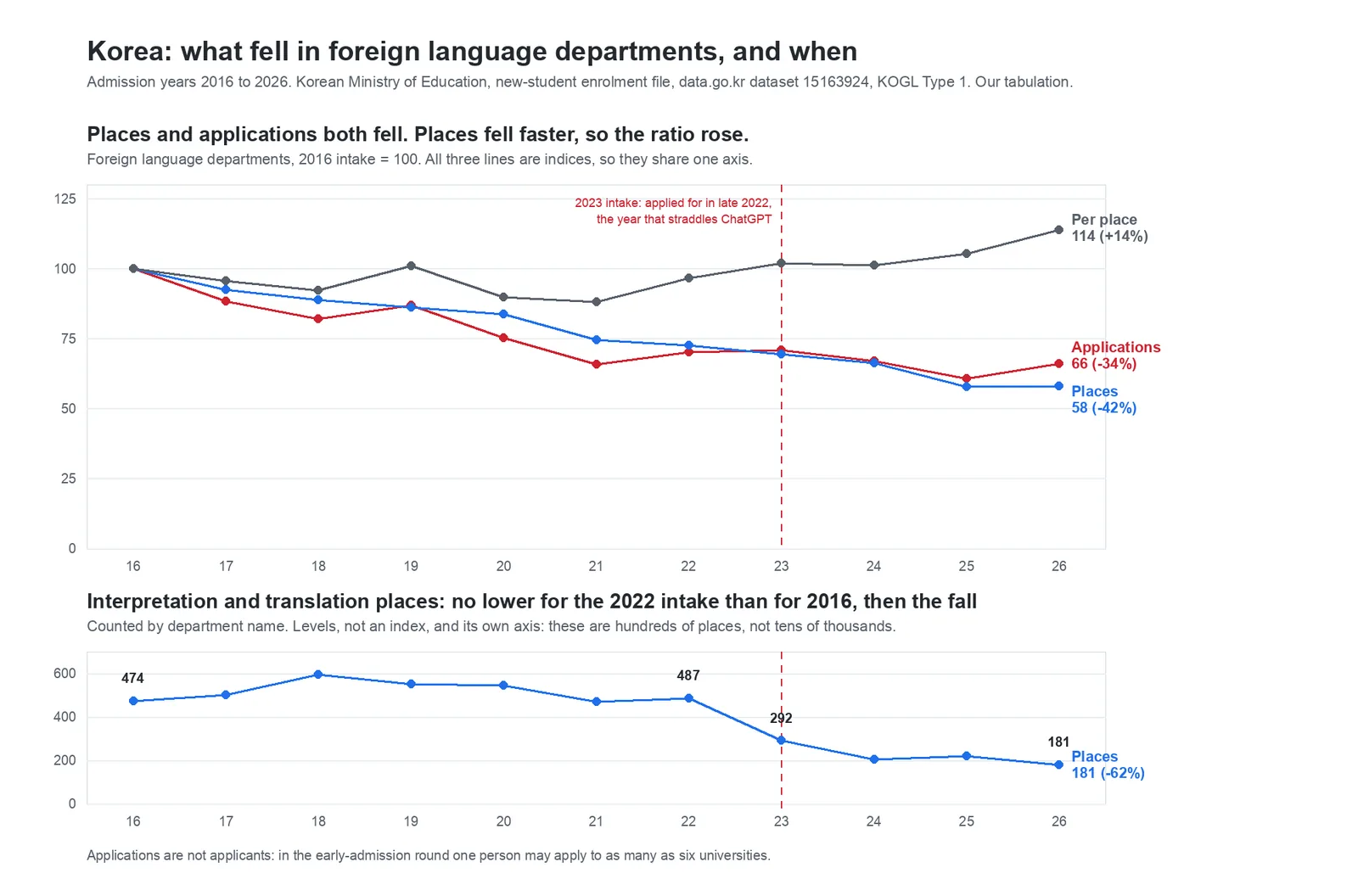
For foreign language departments as a whole, most of the cut is old. Of the 11,858 places that disappeared between the 2016 and 2026 intakes, 7,719 had already gone by the 2022 intake, the last intake before ChatGPT appeared. About two thirds of the decade's cut predates the chatbot.
For interpretation and translation, the opposite is true. Places there were 474 in 2016, rose to 594 by 2018, and were still 487 for the 2022 intake. Then they went 292 for 2023, 204 for 2024 and 181 for 2026. Almost the whole 62% fall happened from the 2023 intake onward, and the single largest step, 487 down to 292, lands on the 2023 intake, the admission year that straddles ChatGPT's release.
That step is the one piece of this data that lines up with the popular story, and there is a timing fact that cuts against reading it that way. Korean universities must publish each admission year's plan well in advance, one year and ten months ahead under the rule the admissions council applies, and the plan for the 2023 intake was published on 29 April 2021 for 198 universities, about nineteen months before ChatGPT was released. The plan for that intake was public before the thing it is being blamed on existed. That is a statement about when the plan was published, not a demonstration of why the places were cut. We have also not checked whether the 292 places in the file for the 2023 intake equal that April 2021 plan or were changed afterwards, and we have not traced the 487 to 292 step to particular universities, which would need a school-level pass we have not run.
We also cannot say that institutions moved before students did. In the first years of the window applications fell faster than places, not slower: between the 2016 and 2018 intakes places fell 11% and applications fell 18%. Nothing here establishes who moved first.
Where places grew
Places grew elsewhere. Departments with artificial intelligence or data in their names went from about 300 places in 2016 to about 10,570 in 2026, and the jump is datable: 1,545 places for the 2020 intake, 5,296 for 2021.
That is a policy timetable, not a chatbot one. The government announced in November 2019 that from the 2021 admission year it would add places in designated advanced-technology fields, and in April 2020 it confirmed 4,761 such undergraduate places across 45 universities. Places in Korean higher education are regulated rather than set freely by each university, so a new department's intake may have to be found somewhere else, though this data does not show where; the capital region's net increase in advanced-field places, announced in April 2023, was reported as the first in about twenty years.
One more thing the ratio does not do: competition did not rise everywhere. It rose in the humanities groups we measured. Computing went the other way, 7.58 applications per place for the 2016 intake, 8.10 for 2023, and 7.25 for 2026.
What this does not tell us
The cause of the cuts is not in this data, and we are not going to guess at it. Two candidates sit outside it, each able to account for part of what we see:
Korea's cohort of eighteen-year-olds has been shrinking for years, which puts pressure on places. The file's all-department total barely moved, though: 350,201 places for the 2016 intake and 349,112 for 2026, a fall of 0.3%.
The advanced-field quota policy above coincided with growth in computing and AI places, on its own schedule.
Our data cannot separate those from each other, or from a university's own read of where its students are going.
Four limits on the numbers themselves. Applications are not applicants, as above. The 2023 admission year straddles ChatGPT's release, since applications for it were made in late 2022, so we report it separately rather than assigning it to either period. AI-named departments only acquired their own classification code in 2022, so anything about their growth comes from matching department names, a cruder instrument than the official codes. And our pre-registration said we would drop any group where more than 5% of applications attached to rows offering no places in any year; foreign language breaches that in 2015, outside our analysis window, and its worst year inside the window is 0.83%, so we kept it. That is a departure from the registered rule, so the main test should not be read as strictly confirmatory, and we are telling you.
The part worth keeping
People argue about whether students are abandoning language study. On this data, for Korea, over this decade, both the places and the applications fell, the places fell faster, and the usual demand measure went up while the departments were being cut.
If you want to know whether a field is dying, then in this case the competition ratio would have misled you, in the reassuring direction. The number to watch here is the number of seats.
Data: Ministry of Education, 대학알리미 「신입생 충원 현황(대학・학과별)」, published on data.go.kr as dataset 15163924 under Korea Open Government License Type 1. Our tabulations.
https://www.data.go.kr/data/15163924/fileData.do
This article was researched and written by Claude (an AI model by Anthropic) in an automated Glasp research run: it pre-registered the analysis, downloaded the public file, wrote the tabulation scripts and drafted the text. Every number labelled as ours was computed by those scripts from the file above. An earlier version of the draft was reviewed by a second AI system (OpenAI Codex) acting as referee, and the text was revised in response; the current version was not reviewed again; the policy and demographic facts in "When the places went", "Where places grew" and "What this does not tell us" come from public reporting of Korean government announcements, reached through web search rather than from the government documents themselves, and are secondary on that account. No Glasp user data was used. No human has checked the tabulations against the source file.