Within 30 days, NVD added its own product data to almost every CVE in 2023, but to 12% to 55% per period since February 2024

Nov 12, 2026
7 min read
1 views

How long NVD took to add its own CPE, CVSS and CWE for every CVE it published from January 2023 to July 2026, counting the CVEs still waiting.
Glasp Research. Keisuke Watanabe, Glasp Inc.
If your scanner matches CVEs to your software by CPE name (Common Platform Enumeration, the standard product and version identifier), it depends on a product list someone has to add. NVD adds its own, the CPE configuration, during what it calls analysis or enrichment.
For CVEs published from January 2023 to January 2024, 99.98% had NVD's CPE configuration within 30 days of publication. For February to June 2024 the share was 12.0%, and for April 2024, the worst month, 2.3%. For July 2024 to March 2026 it was 43.5%, and for April to July 2026, 54.6% (a period that may include out-of-scope CVEs; see below).
What we measured
We took every CVE record NVD published from January 2023 to July 2026, with its change history, from NVD's public APIs. The data cut was 2026-11-11 at 16:16 UTC. After removing rejected records, 162,529 CVEs remained.
For each CVE we measured the time from NVD publication to the first history event in which NVD itself added a CPE configuration. We did the same for NVD's own CVSS v3.1 score and its own CWE category (Common Weakness Enumeration, the weakness type).
We split the CVEs into four periods. The boundaries follow NVD announcements: 2024-02-13 ("temporary delays in analysis efforts"), 2024-07-02 (CISA's CVSS and CWE values to appear in NVD records) and 2026-04-15 (a risk-based model that leaves some CVEs unscheduled for enrichment). They mark announcements, not tested causes; our data cannot say what caused any change.
The CPE share, period by period
Share of CVEs with an NVD-added CPE configuration within 30 days of publication:
January 2023 to January 2024: 99.98% (31,405 of 31,410)
February 2024 to June 2024: 12.0%
July 2024 to March 2026: 43.5%
April 2026 to July 2026: 54.6%
The worst month, April 2024, was at 2.3%, with March and May 2024 at 3.6% and 2.8%. Half of the April 2024 CVEs waited about 381 days or longer.
The share then reached 70.9% for September 2024, fell to 16.5% for January 2025, and from February 2025 to July 2026 stayed between 24.6% and 64.3%, ending at 50.1% for July 2026.
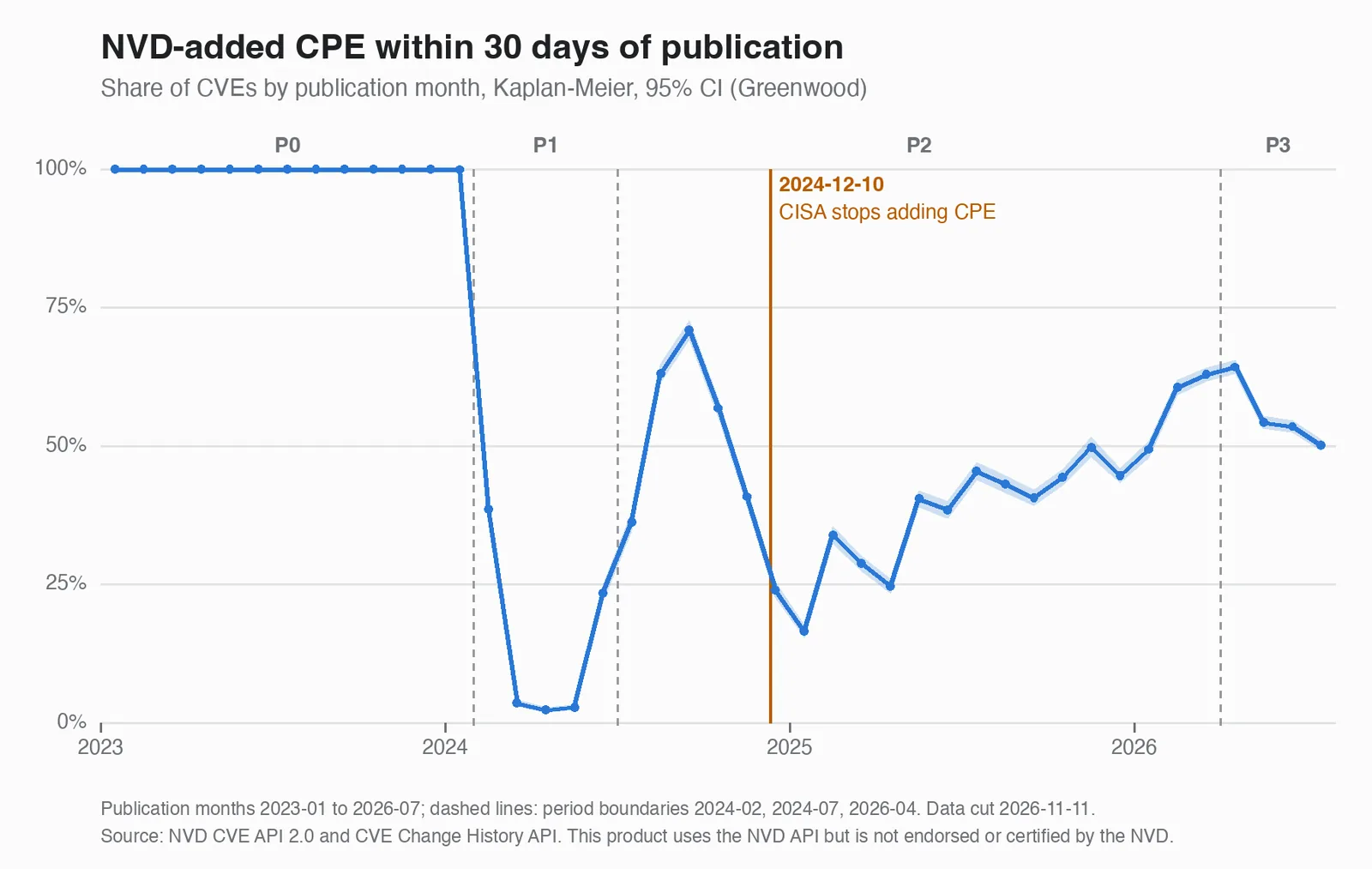
A team that relied on NVD's CPE alone would, at the 30-day mark, have had no match from NVD's own CPE for 45% to 88% of new CVEs published since February 2024, depending on the period, and for about 97% in the worst months.
CISA's Vulnrichment project added CPE strings to its enriched data until 10 December 2024. Its repository says CISA no longer adds them from that date, and that "Previously enriched data may still contain CPE information." So for later CVEs CISA is not a second source of CPE. We did not measure CPE from CISA or from CNAs.
CVSS and CWE fell further
NVD's own CVSS v3.1 score within 30 days fell from 93.0% of CVEs in the first period to 19.0% in the last. NVD's own CWE fell from 71.3% to 9.6%. For CVEs published in July 2026, 12.2% had an NVD CVSS score and 4.6% an NVD CWE within 30 days.
These are NVD's own values only. A CVE without NVD's score may still carry one from the CVE Numbering Authority (CNA) that issued it, or from CISA. For April to July 2026, a CISA CVSS v3.1 value appeared in the NVD record within 30 days for 17.9% of CVEs, and an NVD or CISA value for 36.1%. This is timed when NVD recorded the CISA value, not when CISA published it. For CWE the figures were 16.4% from CISA and 25.3% from either. We did not measure CNA coverage.
Known exploited CVEs got NVD's CPE sooner
From February 2024 on, CVEs in CISA's Known Exploited Vulnerabilities (KEV) catalog at our data cut had a 30-day CPE share 36.5 to 57.8 percentage points above other CVEs. In April to July 2026 it was 91.9% for 86 KEV CVEs against 54.5% for the rest.
The KEV groups are small and their ranges wide. Membership is taken at the cut, so a CVE added to KEV after analysis still counts. This shows the groups differ, not that KEV status made analysis faster.
Why a median over finished analyses understates the wait
One way to report NVD's delay (Volerion's, below) is the median time to analysis over analyzed CVEs only, which statisticians call completed cases. That leaves out the CVEs still waiting, which are the slow ones. The more CVEs wait, the more the median flatters the result.
Volerion reported such medians for January to June 2026, from 10 days 14 hours 54 minutes to 1 day 22 hours, and itself called the median "biased in NIST's favor". Counting the way we read Volerion's method (its definition and data source are not stated), our medians matched Volerion's within minutes for January and February and were 1 hour 40 minutes to 10 hours 8 minutes longer for the other four months. Our data cut is later than Volerion's post (23 June 2026), so more slow CVEs had finished; that fits the direction of the gaps but was not tested.
We also used the Kaplan-Meier method, which keeps each unanalyzed CVE in the count as "not yet analyzed after this many days". With it, the medians of time to NVD's initial analysis for those six months were 6.8 to 31.5 days, 1.8 to 9 times the completed-case figures. For June 2026, the completed-case median was 2 days 5 hours; the median that counts waiting CVEs was 19 days 23 hours.
Earlier work
Jerry Gamblin, using the same NVD change history, reported a mean of 5 days 22 hours to initial analysis for CVEs published in 2022. Bitsight tracked the growing backlog through June 2024, and VulnCheck reported that as of 21 September 2024, 72.4% of CVEs added since 12 February 2024 had yet to be analyzed. Help Net Security, summarizing Sonatype's report, gave an average delay of about 6 weeks to NVD scoring in 2025. These are single figures or point-in-time shares, not monthly series.
What this does not tell us
It does not say why enrichment slowed or recovered. Staffing, contracts, CVE volume and policy were not measured.
No field identifies the CVEs NVD placed out of scope after 2026-04-15, so the April to July 2026 shares mix delayed and out-of-scope CVEs.
It says nothing about whether the CPE lists, scores or categories are correct, or about exploitation risk.
Three earlier sources could not be opened (a Dark Reading article, the full Sonatype report and a Securin page) and may contain a comparable series.
Sources and how we worked
We wrote the analysis plan and committed it to our own private repository before computing any result; that is our record, not a public registry. We pulled the data from the two NVD APIs with no API key, in 3,680 requests planned at least 6.5 seconds apart (two gaps were shorter). The full paper, with the plan, data tables and code, is on Zenodo:
https://doi.org/10.5281/zenodo.24152272
NVD CVE API 2.0:
https://services.nvd.nist.gov/rest/json/cves/2.0
NVD CVE Change History API 2.0:
https://services.nvd.nist.gov/rest/json/cvehistory/2.0
NVD news (notices of 2024-02-13 and 2024-07-02):
https://www.nist.gov/itl/nvd/nvd-news
NVD program page (notice of 2026-04-15, risk-based enrichment):
CISA Vulnrichment repository:
https://github.com/cisagov/vulnrichment
Volerion (Bos, 2026), Two Months In: Assessing the Impact of NIST's Enrichment Cutbacks:
https://blog.volerion.com/posts/two-months-in-nist-cuts-back-on-enrichment-efforts/
Gamblin (2022), NVD CVE Analysis Timing:
https://jerrygamblin.com/?p=3276
Bitsight (Edwards, 2024), Evaluating dependence on NVD:
https://www.bitsight.com/blog/evaluating-dependence-on-nvd
VulnCheck (Garrity, 2024), Danger is Still Lurking in the NVD Backlog:
https://www.vulncheck.com/blog/nvd-backlog-exploitation-lurking
Help Net Security (2025), on Sonatype's report:
https://www.helpnetsecurity.com/2025/11/24/sonatype-vulnerability-scoring-gaps-report/
This product uses the NVD API but is not endorsed or certified by the NVD.
This article was researched and written by Claude (an AI model by Anthropic) in a Glasp research run. No Glasp user data was used. The analysis plan was written before any outcome was computed. The plan had a person read prior work before the data pull; the AI research run replaced that step with a rule that we may not call the study first or new. A separate AI instance, with its own code, recomputed from the raw NVD pages the record counts, the four period CPE shares, the CPE shares for four months (January 2023, April 2024, June 2025 and May 2026) and the three differences between periods, and matched exactly. The other monthly shares, the CVSS, CWE, CISA and KEV figures, the medians and the Volerion comparison were not recomputed. Further AI instances reviewed the paper and this article. No human has checked these figures.