Generative AI in CRM: Auto-Drafted Emails, Summaries, and Proposals

Aug 25, 2026
7 min read
4 views
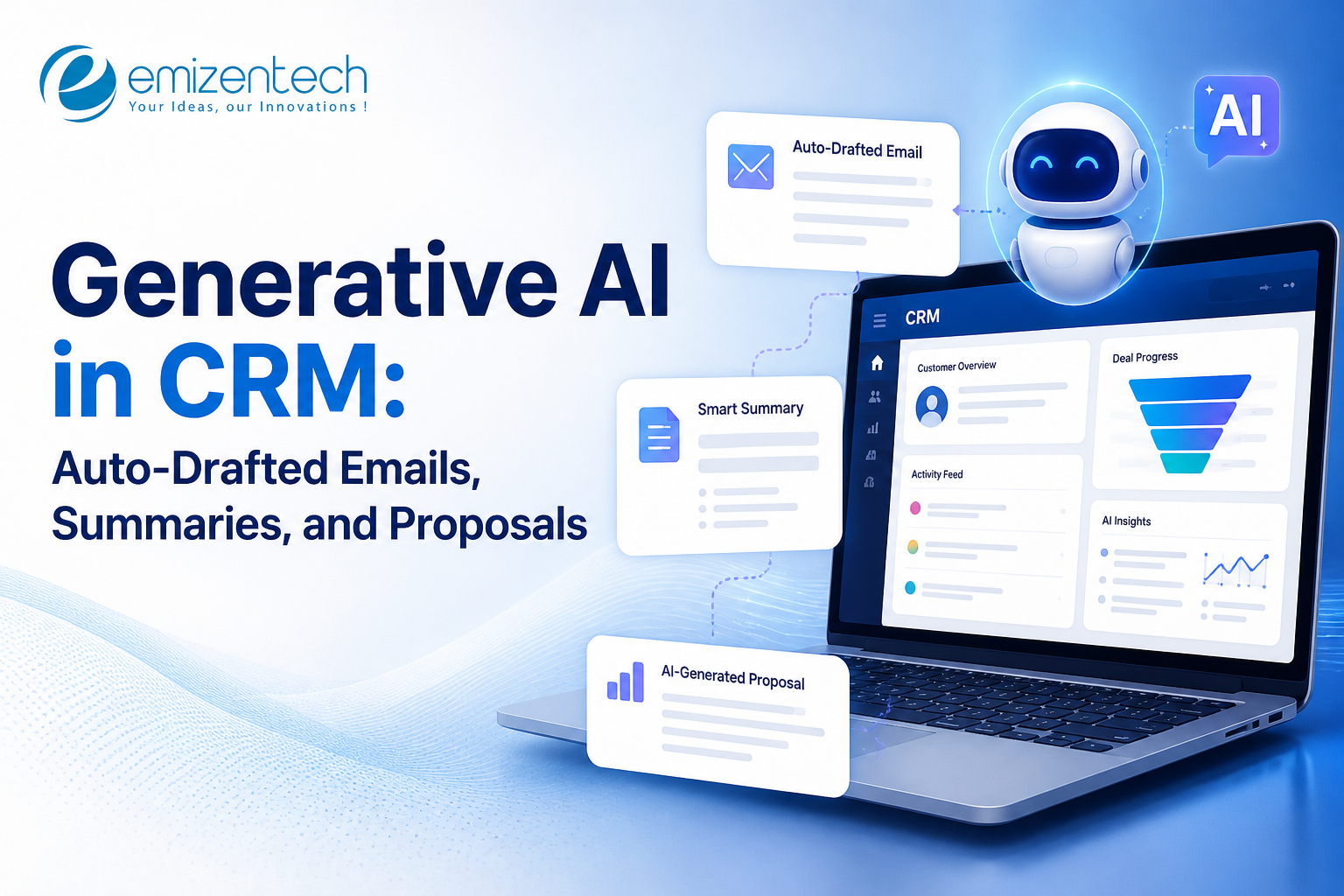
Customer relationship management has always been about helping teams stay organized, communicate better, and build stronger customer relationships. But as customer interactions increase, so does the amount of work required to manage them. Emails need responses, meetings need documentation, and proposals need to be created quickly.
This is where Generative AI is starting to make a noticeable difference. Instead of spending hours on repetitive tasks, CRM users can now generate drafts, summaries, and documents within seconds. The goal isn't to replace human input. It's to reduce routine work so teams can focus on conversations, decisions, and customer relationships.
As CRM platforms continue evolving, AI-powered features are becoming part of everyday workflows rather than optional add-ons.
What Is Generative AI in CRM?
Generative AI within a CRM system refers to technology that can create content based on existing data, prompts, and customer interactions.
Unlike traditional automation, which follows predefined rules, Generative AI can produce new content dynamically. It can draft emails, summarize conversations, create proposals, recommend responses, and generate reports using information already stored inside the CRM.
For example, after a sales call, AI can analyze meeting notes and generate a concise summary. When a salesperson needs to send a follow-up email, the system can create a draft based on previous interactions and customer history.
This makes CRM systems more than data repositories. They become active tools that help users complete work faster and with less manual effort.
Many organizations choosing to hire CRM developer professionals are now prioritizing AI-ready CRM solutions because these capabilities continue expanding across modern platforms.
Why CRM Teams Are Turning to Generative AI
The biggest reason is simple: time.
A large portion of CRM work involves administrative tasks. Writing emails, updating records, preparing documents, and summarizing meetings can consume a surprising amount of the workday.
Most professionals would rather spend that time speaking with customers, building relationships, or closing opportunities.
Generative AI helps reduce repetitive tasks without requiring major workflow changes.
Some common reasons teams are adopting AI-assisted CRM tools include:
Faster communication
Reduced manual documentation
Improved consistency
Better productivity
Quicker access to information
Less time spent on routine tasks
Another advantage is that AI can help maintain quality across communications. While every email still benefits from human review, starting with a strong draft is often much easier than beginning with a blank page.
For growing teams managing large customer databases, those time savings can add up quickly.
Auto-Drafted Emails: Saving Hours Every Week
Email remains one of the most common activities inside CRM systems.
Sales representatives send follow-ups. Support teams respond to customer requests. Account managers share updates and recommendations. Individually, each email may only take a few minutes. Collectively, they consume a significant amount of time.
Generative AI helps by creating email drafts automatically.
Instead of manually writing every message, users can generate content based on:
Previous conversations
Customer history
Meeting outcomes
Support requests
CRM records
Imagine finishing a customer call and instantly receiving a suggested follow-up email. The core message is already prepared. You simply review it, make adjustments if necessary, and send it.
The result is not just faster communication. It also helps ensure important details are not overlooked.
Organizations that hire CRM developer specialists to implement AI-driven CRM workflows often focus on email automation first because the productivity gains are immediate and easy to measure.
That said, human review still matters.
Customers appreciate personalized communication. AI can create the foundation, but thoughtful edits often make the message feel more genuine and relevant.
AI-Generated Meeting and Call Summaries
Ask almost any sales or customer success professional what happens after a meeting, and the answer is usually the same: notes.
Lots of notes.
The problem is that documenting conversations takes time. Sometimes details get missed. Sometimes notes are incomplete. Occasionally they never make it into the CRM at all.
Generative AI addresses this challenge by automatically creating summaries from meetings and calls.
These summaries can include:
Key discussion points
Customer concerns
Action items
Follow-up tasks
Next meeting details
Instead of spending fifteen or twenty minutes documenting every conversation, users can review and approve a summary that has already been generated.
This helps maintain more accurate CRM records while reducing administrative workload.
It also improves collaboration. Team members who weren't present during the discussion can quickly understand what happened without reading pages of notes.
As AI capabilities continue improving, meeting summaries are becoming one of the most practical applications within CRM platforms.
Proposal and Quote Generation with Generative AI
Creating proposals can be one of the most time-consuming stages of the sales process.
Every customer has different requirements, pricing structures, timelines, and objectives. Building customized proposals manually often requires pulling information from multiple sources.
Generative AI helps streamline this process.
Using CRM data, product information, customer requirements, and pricing details, AI can generate proposal drafts significantly faster than traditional methods.
This can include:
Project overviews
Service descriptions
Pricing summaries
Scope details
Implementation timelines
The same applies to quotations.
Instead of manually assembling every document, users can generate an initial version and focus their effort on refinement and customization.
Teams that hire CRM developer professionals to build proposal automation workflows often find that response times improve considerably. Faster proposal delivery can make a difference, especially when multiple vendors are competing for the same opportunity.
Of course, accuracy remains essential. Generated content should always be reviewed before being shared externally.
How CRM Developers Enable AI-Powered Workflows
Generative AI features do not simply appear inside a CRM system without planning and implementation.
Behind every AI-powered workflow is technical work involving integrations, customization, automation, and configuration.
This is where CRM developers play an important role.
A developer helps connect AI services with CRM platforms while ensuring data flows correctly between systems.
Typical responsibilities may include:
AI integration setup
Workflow automation
CRM customization
API development
Data management
Security configuration
The goal is to create workflows that feel natural rather than forcing users to switch constantly between different tools.
For example, a developer may configure the CRM to automatically generate email drafts after meetings or create proposal templates using customer data already stored in the system.
As CRM platforms introduce more AI-driven features, the need to hire CRM developer professionals with AI integration experience continues to grow.
Without proper implementation, even powerful AI tools can become difficult to use effectively.
Key Benefits of Generative AI in CRM
While individual use cases vary, the overall benefits tend to be fairly consistent.
The most obvious advantage is time savings.
Tasks that previously required several minutes can often be completed in seconds. Across hundreds of interactions each month, those savings become significant.
Other benefits include:
Improved Productivity
Users spend less time on administrative work and more time on customer-facing activities.
Faster Response Times
Drafted emails, proposals, and summaries allow teams to react more quickly.
Better Documentation
Automated summaries reduce the risk of incomplete or missing records.
Consistent Communication
AI-generated drafts help maintain a consistent tone and structure across customer interactions.
Enhanced User Experience
CRM systems become easier to use when repetitive tasks require less manual effort.
Many teams that hire CRM developer resources to modernize their CRM environment view these benefits as long-term operational improvements rather than short-term technology upgrades.
The value often comes from making everyday work a little easier and a lot more efficient.
Conclusion
Generative AI is changing how CRM users handle everyday tasks. Auto-drafted emails reduce time spent writing follow-ups. AI-generated summaries make meeting documentation easier. Proposal generation helps speed up sales processes without sacrificing quality.
The technology itself is impressive, but the real benefit comes from practical application. When implemented thoughtfully, AI helps reduce repetitive work and allows teams to focus more attention on customer relationships and strategic activities.
As CRM platforms continue adding AI capabilities, the role of developers becomes increasingly important. Organizations looking to build effective AI-powered workflows often hire CRM developer specialists who can connect CRM systems, automation processes, and AI tools into a seamless experience. Experienced CRM development teams such as EmizenTech can help ensure AI-powered features are integrated smoothly, allowing users to benefit from automation without disrupting existing workflows.
FAQ
1. What is Generative AI in CRM?
Generative AI in CRM refers to AI technology that can create content such as emails, summaries, proposals, and recommendations using customer and CRM data.
2. How does AI help with CRM emails?
AI can automatically draft follow-up emails, customer responses, and outreach messages based on previous interactions and CRM records.
3. Can Generative AI create meeting summaries?
Yes. AI can analyze conversations, notes, or transcripts and generate summaries that include key discussion points, action items, and next steps.
4. Why do CRM systems need developers for AI integration?
Developers handle integrations, workflow automation, data management, and customization to ensure AI features work effectively within the CRM environment.
5. Is Generative AI replacing CRM professionals?
No. Generative AI is designed to assist with repetitive tasks and content creation, while people continue making decisions, building relationships, and managing customer interactions.
Comments
I am Steve Jonas, a technical blogger at EmizenTech, a reputable software development company specializing in Magento 2 solutions and Salesforce development.