NVIDIA Consumer GPU Price Report, August 2026

Aug 15, 2026
9 min read
0 views
This market price report and analysis is provided by BuySellRam.com, NVIDIA GPU Price Report.
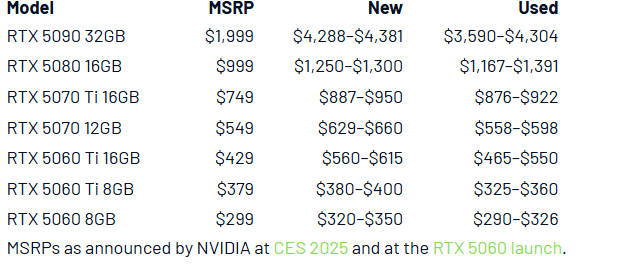
Across the RTX 50 stack, how far a card trades above its launch MSRP lines up almost perfectly with how much memory it carries — and barely at all with where it sits in the performance stack.
An RTX 5060 Ti 8GB can be found at its $379 launch price. The same GPU with 16GB, launched at $429, starts around $560. NVIDIA priced the memory difference at $50. The market is charging closer to $180 for it.
That gap is the through-line for everything below.
RTX 50 Series
The bottom of the stack is behaving normally
The RTX 5060 and RTX 5060 Ti 8GB are the only two cards in this report available at something close to their launch price, and the only two where used inventory shows a conventional discount without complications. Ranges are tight. Supply is there.
That is what a healthy GPU market looks like, and in August 2026 it exists only at 8GB.
Everything above 12GB carries a memory tax
The RTX 5070 at 12GB sits about 15% over MSRP. The three 16GB cards run 18% to 31% over. Board design, cooler quality, and brand account for some of the spread inside each tier, but not for the pattern across tiers.
The RTX 5060 Ti is the cleanest test available, because both versions are the same GPU on the same board with the same power delivery. Only the memory differs. The 8GB version is at launch price. The 16GB version is 31% above it.
Why: the cost is in the memory, not the silicon
DRAM contract prices rose roughly 80% quarter over quarter in Q1 2026, with a further 13% to 18% projected for Q3. GDDR6 and GDDR7 have moved with the broader market, because the three suppliers that make them — Samsung, SK Hynix, Micron — have been steering wafer capacity toward HBM and server DRAM for AI accelerators, where margins are far better than on the memory that ships on a gaming card. One forecast has AI data centers absorbing as much as 70% of global memory output in 2026, against roughly 20% to 30% in 2022.
The result reaches retail through wholesale increases rather than MSRP changes. Reporting through 2026 describes a 10% to 15% increase in January, a narrower mid-year increase aimed at the RTX 5090, and a further round of 20% to 30% after that. Official MSRPs have not moved. Shelf prices have.
More background on the mechanism: how memory economics are reshaping GPU pricing.
The high end: why the RTX 5090 and RTX 4090 are priced the way they are
These two cards sit far outside the structure of their own generations, and they get there by different routes. Both matter for anyone valuing retired hardware.
RTX 5090: 32GB of GDDR7 with nothing to price against
At $4,288–$4,381 new against a $1,999 MSRP, the RTX 5090 is the most distorted line in the report. Independent tracking on August 7 put the lowest listed retail card at $4,399, with most board variants between $4,400 and $4,829 — so the range here sits at or slightly below what a buyer would find at a major retailer.
Four things stack on top of each other:
The memory bill is the largest in the consumer stack. 32GB of GDDR7 in a market where graphics DRAM has repriced sharply. Whatever the per-gigabyte increase is, the RTX 5090 pays it four times over relative to an 8GB card. BuySellRam covered the specific mechanics in an earlier piece on RTX 5090 wholesale pricing and GDDR7 supply.
Wholesale increases compound. Each round lands on a cost base that already absorbed the previous one, and board partners apply margin on top. A card with high memory content amplifies every round.
The buyer pool extends past gaming. A 32GB card at $4,300 is still cheaper than professional and data-center parts with comparable memory. That puts a floor under the price that has nothing to do with what gamers will pay, and it does not lift when gaming demand softens.
No competitor occupies the tier. Nothing in the consumer market pairs that memory capacity with that level of compute, so there is no external pressure on the price.
The used RTX 5090 does not discount the way a used GPU should
Used RTX 5090 listings run $3,590–$4,304 against $4,288–$4,381 new. Measured against the bottom of the new range, that is a discount of roughly 2% at the top of the used market and about 16% at the very bottom of it. Most of the inventory sits in the upper half.
A consumer GPU normally sheds 15% to 25% the moment it becomes used. So even the cheapest used 5090 on the market only just reaches the shallow end of ordinary depreciation, and most of them do not get close.
There is a second thing hiding in that comparison. The usual 15% to 25% is measured against a new price that is itself drifting down over a product’s life. Here it is measured against a new price that has climbed all year. A used card holding within 16% of a rising number is behaving very differently from one holding within 16% of a falling one.
The mechanism is replacement cost. Used pricing tracks what it would take to buy the equivalent card today, not how old the card is. When replacement cost is climbing and availability is uncertain, a card that physically exists is worth close to what a new one costs — partly because the new one may cost more next quarter.
Depreciation has not stopped. It has slowed well past what an age-based schedule would predict, which is the part that matters when the card comes out of a decommissioned workstation.
RTX 4090: discontinued, and priced against its successor
NVIDIA ended RTX 4090 production in late 2024 to clear the way for the RTX 50 launch. No new supply has entered the channel since, and new-condition stock now varies widely by seller — $2,755 to $3,449 across the sources sampled, against a $1,599 launch MSRP.
The used figure is the more meaningful one: $2,350–$2,500, or roughly 47% to 56% above the card’s own launch price, used, close to four years after release.
The reason is what a buyer does when the RTX 4090 is unavailable. The nearest substitute with more memory is an RTX 5090 at $4,300 or more. Against that, $2,400 for 24GB is defensible. The RTX 4090’s price is set by the RTX 5090, not by its own launch price or its age.
Note the contrast inside its own generation. The RTX 4080 Super sits about 5% below MSRP and the RTX 4080 about 29% below. Both are also discontinued. Both have 16GB. The RTX 4090 is not expensive because RTX 40 cards are expensive — it is expensive because 24GB is expensive.
RTX 40 Series
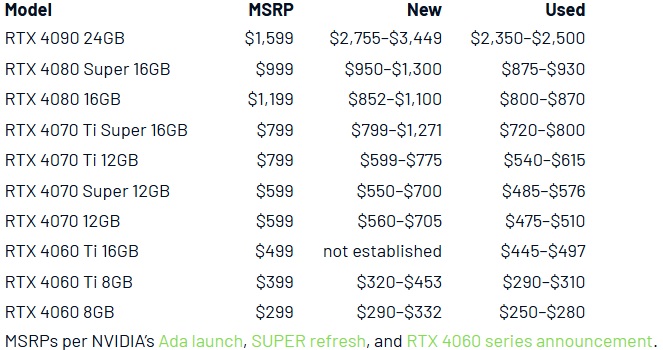
On the RTX 4060 Ti 16GB new price: cards are still listed at Newegg and Amazon, but this sampling did not produce enough verifiable in-stock pricing to publish a range. Rather than print a figure that cannot be checked, the cell is left empty. The used figure stands.
Read the new column carefully
The RTX 40 line is out of production. Nothing in the “New” column is current retail in the way the RTX 50 figures are — it is a mix of clearance stock and scarcity pricing, and the two pull in opposite directions.
Clearance shows up in the RTX 4080 at 29% below MSRP and the RTX 4060 Ti 8GB at 20% below. Scarcity shows up in the RTX 4090, where the spread between the cheapest and dearest new listing is close to $700 for the same product. That is what a channel with no resupply looks like.
The used column is the more reliable half of this table.
The 4070 tier is where the value sits
Used RTX 4070 inventory runs $475–$510 and RTX 4070 Super $485–$576, both below the $599 they launched at. For 12GB at 1440p, this is the most conventional value in the report — a card that depreciated the way hardware is supposed to.
The 16GB tier did not. Used RTX 4060 Ti 16GB runs $445–$497 here, roughly where the card launched. A specialist marketplace tracker shows a wider 12-month band of $375–$479 with an average sale near $410 across 27 sales, so treat the upper end cautiously. Either reading leaves it far above the 8GB version at $290–$310.
NVIDIA separated those two by $100 at launch. The used market separates them by $135 to $190.
Same pattern as the RTX 5060 Ti, one generation earlier.
RTX 30 Series
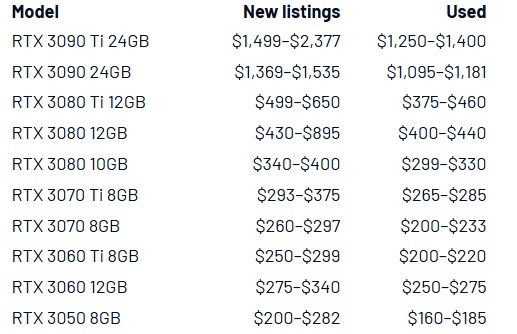
MSRP is omitted for RTX 30 and RTX 20. These products are four to six years old, long out of production, and their launch prices were set in a completely different memory-cost environment. Comparing them to today’s listings would produce a number without meaning.
The “New listings” column reflects new-condition and sealed inventory offered by individual and third-party sellers rather than a functioning retail channel. Sellers set those asks independently, so the column is wide, occasionally inverted, and should be read as an upper reference rather than a market price.
The stack has reordered itself around memory
A used RTX 3060 12GB runs $250–$275. A used RTX 3060 Ti 8GB — the faster card — runs $200–$220.
At launch the order was the other way round: $399 for the 3060 Ti, $329 for the 3060. The slower card is now worth more than the faster one.
This particular inversion is not new. It has been visible in used pricing for years, driven by the 3060’s 12GB being the cheapest entry point into workloads that will not fit in 8GB. What is new is the company it keeps. The same relationship now appears in the RTX 4060 Ti pair and the RTX 5060 Ti pair, which makes it look less like a quirk of one SKU and more like how the market prices memory generally.
NVIDIA appears to have noticed. The RTX 3060 12GB returned to retail in 2026 at $339, five years after launch and above its original price — consistent with the new-listing range above.
24GB Ampere is holding value it has no business holding
Used RTX 3090 cards remain above $1,000 and RTX 3090 Ti sits at $1,250–$1,400. These are 2020 and 2022 products, several generations behind, on an older memory standard, and considerably slower than a current mid-range card.
They hold those prices because 24GB is 24GB. For a workload gated on memory capacity rather than throughput, an RTX 3090 does something an RTX 5070 cannot do at any speed. As long as the cheapest new alternative with that much memory costs several thousand dollars, the floor under these cards stays where it is.
RTX 20 Series
ModelNew listingsUsedRTX 2080 Ti 11GB$250–$599$235–$255RTX 2070 Super 8GB$200–$550$150–$190RTX 2060 6GB$150–$200$125–$140
Used pricing here is tight and credible. The new-listing column is not — those bands are wide because remaining sealed stock is scarce and priced at whatever individual sellers decide to ask.
At this level, condition, thermal behavior, prior workload, and return terms matter far more than a $20 difference in the listing price. A cheap RTX 2080 Ti that ran three years of mining is not a bargain.