Why AI Is Raising RAM, SSD, and Server CPU Prices

Aug 08, 2026
9 min read
0 views
For most of the generative-AI boom, GPUs were the visible hardware bottleneck and high-bandwidth memory (HBM) became strategic. By 2026, that description is no longer enough.
In the first quarter of this year, TrendForce reported that conventional DRAM contract prices rose roughly 93% to 98% quarter over quarter. It separately reported that enterprise SSD contract prices increased by about 80%. In China, Reuters reported in July that prices for some server CPUs had increased more than 40% since the start of 2026.
Those figures describe different products, pricing channels, and geographies, so they should not be combined into a single inflation index. But they point to the same larger change: the AI build-out has expanded from a shortage of accelerators into a demand and capacity shock across the systems built around them.
AI infrastructure is not just a GPU market. It is a system market.
A GPU does not arrive at the data center alone
A modern AI server may be organized around accelerators, but those accelerators still need host CPUs, system memory, storage, networking, packaging, power, and cooling. CPUs handle orchestration, I/O, control-plane work, and many non-tensor operations. DRAM holds host-side working sets and application state; SSDs hold models, checkpoints, training data, embeddings, and logs.
Business AI adoption is also expanding into agentic workflows. In McKinsey's 2025 global AI survey, 23% of respondents said their organizations were scaling an agentic AI system somewhere in the enterprise and another 39% were experimenting. Most scaled deployments remained limited to one or two functions, but that expansion matters for the hardware mix.
Agents can call tools, query databases, retrieve documents, manage state, execute code, and coordinate repeated model calls. Model inference may still run on GPUs, while much of that surrounding work can land on CPUs, system DRAM, and storage. That helps explain why CPUs drew more attention after memory and storage tightened. BuySellRam's mid-2026 server CPU update traces that shift.
Vendor results point in the same direction. Intel's second-quarter 2026 results showed Data Center and AI revenue up 59% year over year to $6.3 billion, while AMD said in its first-quarter results that inference and agentic AI were increasing demand for high-performance CPUs and accelerators.
CPUs are not replacing GPUs. Enterprise AI is increasing demand for the system around the accelerator.
DRAM shows the clearest AI spillover
DRAM is where the supply-chain connection is easiest to see.
HBM is made from DRAM, while cloud providers also buy large quantities of server DRAM. Suppliers therefore have strong incentives to prioritize HBM and high-capacity server products over lower-margin PC, mobile, or legacy memory.
TrendForce was already describing that crowding-out effect in September 2025, when it said major DRAM suppliers were allocating advanced-process capacity primarily to high-end server DRAM and HBM. The pressure accelerated: conventional DRAM contract prices rose 45% to 50% in 4Q25, followed by the much larger increase in 1Q26.
This is why someone who never buys HBM can still be exposed to the HBM boom.
The connection is not one-for-one because DRAM products differ in process, packaging, and qualification. But wafer allocation, capital spending, and product mix are connected enough that prioritizing AI and server memory can restrict supply growth elsewhere.
Legacy products have an additional problem: vendors are also retiring older production. That helps explain why DDR4 can tighten even while the industry spends heavily on new memory technology. BuySellRam's July DRAM and NAND market update showed that split at the component spot-market level, with DDR4 still rising at the end of July while the tracked TLC NAND benchmark had spent most of the month falling.
SSDs got expensive through a different path
NAND flash should not be treated as a copy of the DRAM story.
In early 2025, NAND suppliers were still using conservative production strategies and inventory reduction to restore supply-demand balance. Enterprise demand then strengthened while most suppliers remained focused on process migrations rather than large near-term capacity additions.
By May 2025, TrendForce was warning that enterprise SSDs could move into undersupply as North American cloud providers expanded AI infrastructure. By September, shortages of high-capacity nearline hard drives were also pushing some cloud storage demand toward QLC enterprise SSDs.
By 1Q26, enterprise SSD orders were rising faster than output. TrendForce also reported that Micron had reallocated capacity away from smartphone and channel markets toward enterprise SSDs, illustrating how the product mix was shifting toward data-center demand.
NAND's surge therefore came from a different combination: AI and cloud storage demand, earlier production discipline, an HDD shortage, and a shift toward enterprise SSDs.
That difference is crucial because NAND may also exit the current cycle before DRAM does.
Server CPUs are tight, but that is not the same as a consumer CPU shortage
CPU pricing requires even more restraint. Reuters reported on July 23 that Intel and AMD were negotiating longer-term server CPU supply agreements with Chinese customers as demand rose and lead times stretched. Some server CPU prices in China had increased more than 40% since the beginning of 2026.
Agentic inference adds orchestration, retrieval, databases, tool execution, networking, and other CPU work outside model kernels. BuySellRam's analysis of AMD and Nvidia's different CPU strategies for agentic AI examines that split at the platform level.
But the strongest shortage evidence today is for server processors, specific customers, and specific regions. Desktop Ryzen and Core chips live in a different market with different inventories, launches, competition, and promotions. A server CPU shortage is not evidence that every consumer CPU will rise by 40%.
The narrower conclusion is that AI has become a meaningful source of incremental data-center CPU demand, enough in 2026 to constrain parts of the server market.
How the shortage spread: 2023 to 2026
The sequence matters.
2023–2024: accelerators and HBM dominate the bottleneck. AI infrastructure economics are discussed mainly in terms of scarce GPU capacity and the memory attached directly to accelerators. BuySellRam's later analysis of H100 rental economics shows how much that market has changed since the shortage period.
2025: pressure spreads into conventional memory and storage. DRAM suppliers allocate more capacity toward HBM and servers. Enterprise SSD demand strengthens while NAND suppliers remain cautious on output. HDD shortages add another storage constraint.
2026: the rest of the stack reprices. Conventional DRAM and enterprise SSD contract prices jump, consumer-facing memory and storage channels compete for allocation, and server CPU demand becomes strong enough to create longer lead times and price increases in some markets.
The AI boom has moved from competing for chips to competing for the industrial capacity behind complete systems.
When does it end? Probably not all at once
The most important forecast is that these component cycles may now separate again.
TrendForce's August 4, 2026 update says DRAM supply is expected to remain tight through 2027. It projects HBM bit shipments to grow 50–60% year over year in 2027 and still fall short of demand growth. SK hynix CEO Kwak Noh-jung went further in a Reuters interview, forecasting that 2027 could be the industry's worst year for memory supply. That is a supplier forecast, not an independent certainty.
Long construction cycles help explain why relief can be slow. SK hynix said on August 7 that first cleanrooms at its new M17 NAND and Yongin Y2 DRAM fabs are expected in December 2028 and June 2029, respectively; both projects are scheduled to begin construction in 2027.
NAND looks different. TrendForce currently expects NAND bit-supply growth to outpace demand in 2027 as process migrations and new capacity increase output while consumer demand remains weak. Its forecast is for the current supply shortage to begin easing in the second half of 2027.
That same TrendForce outlook expects server CPU constraints to ease significantly in 2027 as component availability improves. That is still a forecast, and individual platforms or regions can remain tight even if aggregate supply improves.
There may therefore be no single date when "AI hardware inflation" ends. DRAM can remain tight while NAND loosens, server CPU availability can improve, and GPU pricing can follow its own product and cloud-capacity cycle. The shortage may fragment back into several different markets.
What this means for different buyers
For AI infrastructure operators, GPU price alone is a weak measure of system economics. Cheaper accelerator rental does not guarantee cheaper AI infrastructure if memory, storage, CPU, networking, and power costs move the other way. TCO needs to be modeled at the rack or service level.
For enterprise IT and procurement teams, RAM, SSDs, and CPUs should not be purchased under one generic inflation assumption. Long-term supply agreements may make sense where availability matters most, but the risk of locking in near a peak differs between NAND and DRAM.
For hardware owners, constrained replacement markets are a reason to re-check residual values before equipment is retired. That does not mean every used DIMM, SSD, or processor has appreciated; generation, capacity, interface, endurance, form factor, and actual secondary-market demand still determine value. If a refresh leaves a meaningful surplus lot, BuySellRam maintains separate valuation paths for organizations looking to sell RAM, sell SSDs or hard drives, or sell CPUs and server processors.
For PC builders and individual consumers, the practical rule is simpler: do not treat RAM, SSDs, and CPUs as one trade. If current forecasts hold, NAND supply tightness has a plausible path toward easing in 2H27, which could reduce pressure on SSD pricing but does not guarantee an immediate retail-price decline. DRAM may remain tighter for longer; consumer CPUs should still be evaluated model by model rather than bought defensively because server processors are constrained.
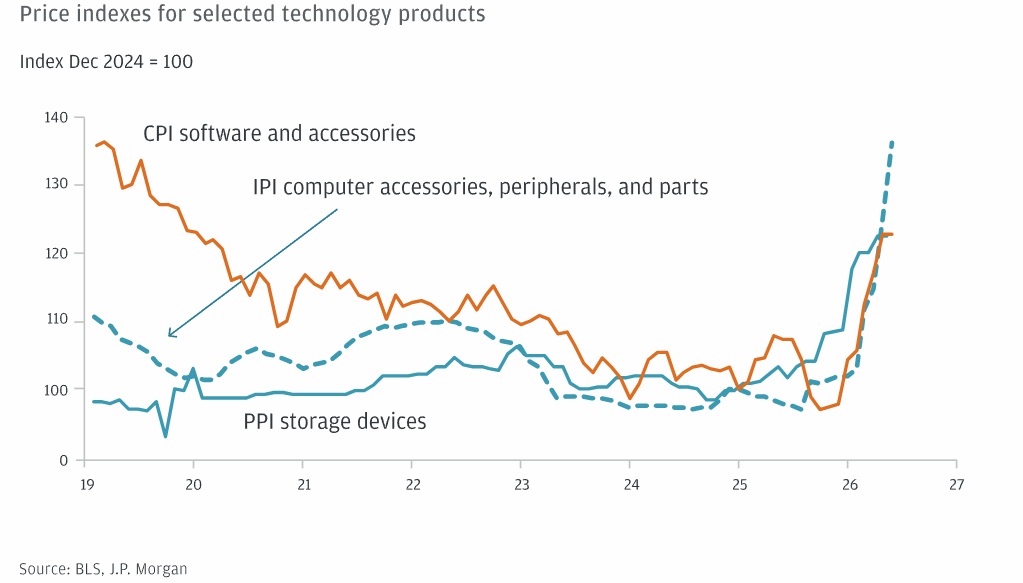
The impact is already visible beyond component contract markets. In its August 2026 The AI-Driven Memory Shortage, J.P. Morgan Global Research said the Consumer Price Index for software and accessories and the Producer Price Index for storage devices had each risen 23% since the end of 2024, while the import price index for computers, peripherals, and parts was up 37%. J.P. Morgan calls the resulting pressure "chipflation": higher memory and component costs passing into the prices of finished technology products.
The Federal Reserve's July 2026 Monetary Policy Report independently points in the same direction. It noted rapid early-2026 price gains for software and accessories, computers, and other electronics, and said those increases likely reflected surging demand for semiconductors and other components used in the AI data-center buildout.
A coalition of U.S. automotive, retail, electronics, and telecom groups also warned in June that the memory-chip imbalance could drive sustained consumer price increases and disrupt supply chains. Vendors may respond with higher prices, lower configurations, lower margins, or product delays.
Waiting for one broad "AI hardware crash" is therefore a weak buying strategy. Watch the component that limits the system you need.
The AI hardware question has changed
The first AI hardware question was how many GPUs the industry could supply.
The more useful question in 2026 is how many complete systems the supply chain can build without starving another market of memory, storage, CPUs, packaging, or power.
That is how a GPU-centered AI boom reached people who never planned to buy an accelerator: it changed what semiconductor companies prioritize and who competes for capacity.
The evidence today suggests the balance will return at different times for DRAM, NAND, and server CPUs.