Ango Sakaguchi Books in English: The Detective Novels, Discourse on Decadence and What Is Still Untranslated

Nov 17, 2026
7 min read
0 views
As an Amazon Associate I earn from qualifying purchases.
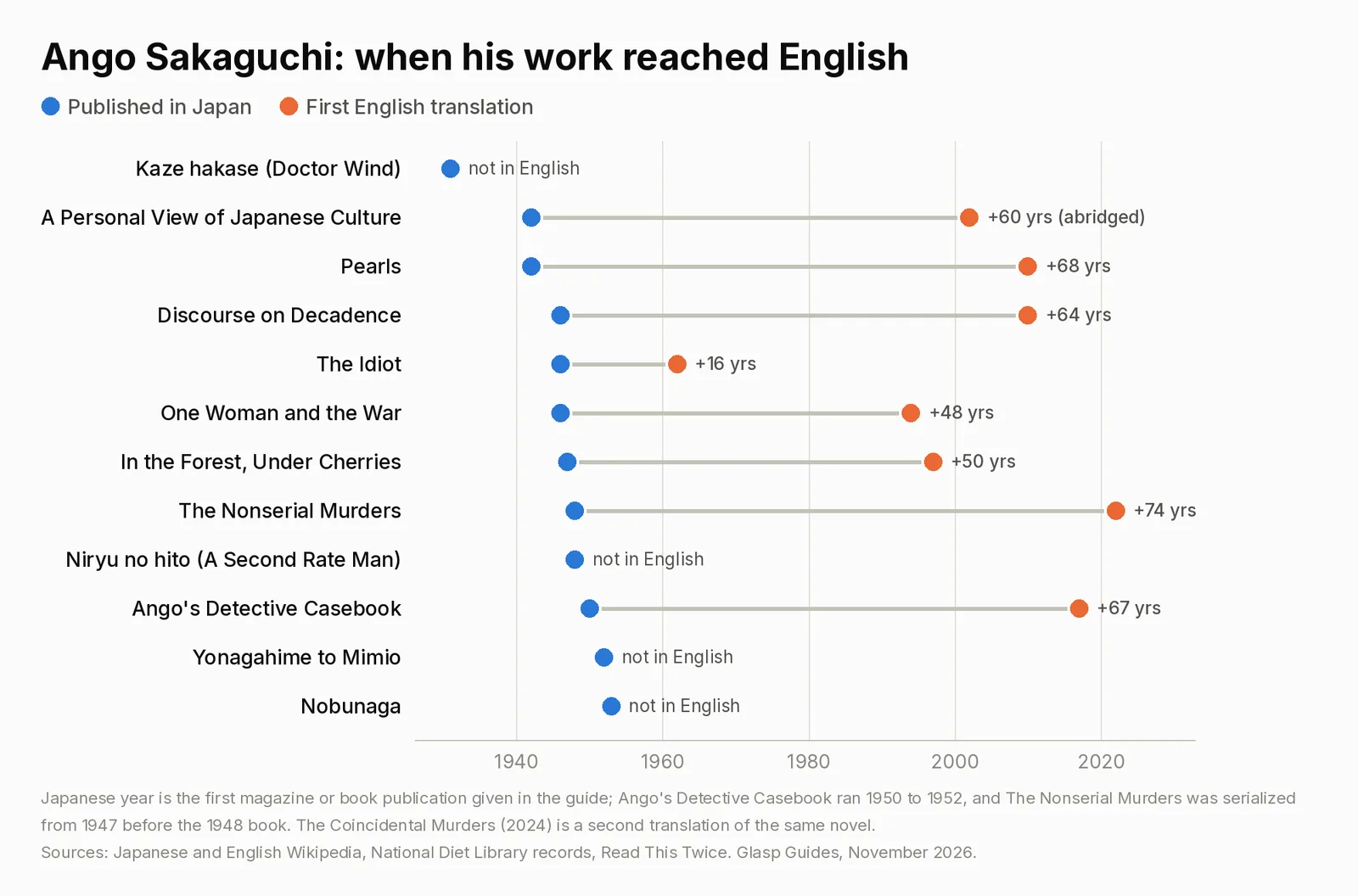
As of November 2026, Ango Sakaguchi's work in English is spread across a handful of small books and several anthologies. His detective novel 不連続殺人事件 (Furenzoku satsujin jiken) has two English translations, The Nonserial Murders (2022) and The Coincidental Murders (2024). His Meiji era detective stories, 明治開化 安吾捕物帖, are in English as Ango's Detective Casebook, and his famous essay 堕落論 (Darakuron) is in English as Discourse on Decadence. His best known stories, 白痴 (The Idiot) and 桜の森の満開の下 (In the Forest, Under Cherries in Full Bloom), have been in English anthologies for decades. Below, each English title is matched to its Japanese original, followed by the major works with no English translation found.
Who Ango Sakaguchi was
Sakaguchi Ango (坂口安吾) was born on October 20, 1906, and died on February 17, 1955, at 48, according to Japanese Wikipedia. English Wikipedia calls Darakuron, written in 1946, "his most famous essay", a look at the role of bushido during the war, and notes the common reading that he saw postwar Japan as decadent but more truthful than a wartime Japan built on illusions (English Wikipedia). Many younger readers now know his name from the anime UN-GO, which is based on his detective stories, and from Bungo Stray Dogs, which has a character named after him. On covers his name appears both as Ango Sakaguchi and as Sakaguchi Ango.
The detective fiction in English
Glasp earns a commission on purchases made through the Amazon links below.
不連続殺人事件 (Furenzoku satsujin jiken), serialized from 1947, book 1948. A murder mystery that won the Mystery Writers of Japan Award in 1948, according to English Wikipedia. It has two English versions, both listed there as translations of Furenzoku satsujin jiken: The Nonserial Murders, translated by Shelley Marshall (J Pop Books, 2022), and The Coincidental Murders (Kindle), translated by Alexis J. Brown (Zakuro Books, 2024). The National Diet Library holds a French translation, Meurtres sans série (Les Belles Lettres, 2016), and a Chinese one, whose record identifies it as the Chinese edition of 不連続殺人事件 (National Diet Library record).
明治開化 安吾捕物帖 (Meiji kaika Ango torimonochō), serialized 1950 to 1952. Twenty detective stories that ran in the magazine Shosetsu Shincho from the October 1950 issue to the August 1952 issue, with the gentleman detective Yuki Shinjuro as the hero and the statesman Katsu Kaishu as an armchair detective who is often wrong (Japanese Wikipedia). In English they appear as Ango's Detective Casebook No. 1 (July 2017) and No. 2, subtitled The Meiji Enlightenment Series, which describe themselves as an unabridged translation of the stories of the "Great Detective Yuki Shinjuro" in Meiji Japan (Read This Twice). Amazon credits the volumes to Ango Sakaguchi and Shelley Marshall. The 2011 anime UN-GO used these stories as its source but moved them to the near future.
Essays in English
Glasp earns a commission on purchases made through the Amazon links below.
堕落論 (Darakuron), 1946 → Discourse on Decadence. First published in a magazine in April 1946 (Japanese Wikipedia). A translation of both parts, the essay and its sequel 続堕落論, is in Literary Mischief: Sakaguchi Ango, Culture, and the War (Kindle), edited by James Dorsey and Doug Slaymaker with translations by James Dorsey (Lexington Books, 2010) (National Diet Library record). A separate translation by Clayton Maris is sold as a Kindle book.
日本文化私観 (Nihon bunka shikan), 1942 → A Personal View of Japanese Culture. Also in Literary Mischief, and in abridged form in The Columbia Anthology of Modern Japanese Literature, Volume 1 (2002), according to English Wikipedia. The essay collection of that name was published in December 1943.
真珠 (Shinju), 1942 → Pearls, a short story, also in Literary Mischief.
Literary Mischief is the most useful single English book on Ango, because it gathers the essay, its sequel, A Personal View of Japanese Culture and Pearls in one volume, all translated by James Dorsey.
Stories in English anthologies
These appear only inside collections, so look for the anthology title, not Ango's name. The details come from English Wikipedia's list of translations.
白痴 (Hakuchi), Shincho magazine, June 1946 → The Idiot, translated by George Saito in Modern Japanese Stories, edited by Ivan Morris (Tuttle, 1962).
桜の森の満開の下 (Sakura no mori no mankai no shita), June 1947 → In the Forest, Under Cherries in Full Bloom, translated by Jay Rubin in The Oxford Book of Japanese Short Stories, edited by Theodore W. Goossen (Oxford University Press, 1997).
戦争と一人の女 (Sensō to hitori no onna), October 1946 → One Woman and the War, translated by Lane Dunlop in Autumn Wind and Other Stories (Tuttle, 1994). A second translation, The War and a Woman by Robert Zetzsche, is printed in the photo book Sakiko Nomura: Ango (2017), which the National Diet Library records with the original title Sensō to hitori no onna (National Diet Library record).
私は海をだきしめていたい → I Want to Be Holding the Sea, translated by Shogo Oketani and Leza Lowitz in the journal Manoa (1995).
風と光と二十の私と → Wind, Light, and the Twenty-Year-Old Me, an abridged translation by Reiko Seri and Doc Kane (Maplopo, 2020).
The magazine dates for The Idiot, the cherry blossom story and One Woman and the War come from Japanese Wikipedia's bibliography.
Where to buy on Kindle
US Kindle editions found for this guide:
Glasp earns a commission on purchases made through the Amazon links below.
The Nonserial Murders (Kindle), translated by Shelley Marshall.
Ango's Detective Casebook No. 1 (Kindle), The Meiji Enlightenment Series.
Discourse on Decadence (Kindle), translated by Clayton Maris.
Ango's Detective Casebook No. 2 is listed without a link.
Not yet in English
No English translation of these works turned up in the National Diet Library's catalogue (26 records under his romanized name, read in November 2026) or in Wikipedia's lists of translations:
風博士 (Kaze hakase, "Doctor Wind"), 1931, an early story that Japanese Wikipedia lists first among his major works.
二流の人 (Niryū no hito, "A Second Rate Man"), book 1948, also on Japanese Wikipedia's list of major works.
夜長姫と耳男 (Yonagahime to Mimio, "Princess Yonaga and Mimio"), Shincho magazine, June 1952, the last story on that list.
信長 (Nobunaga), serialized in the newspaper Shin Osaka from October 1952 and published as a book in May 1953.
Most of the essays. Only the pieces in Literary Mischief, the Columbia anthology and the separate Discourse on Decadence translations are in English.
Readers of other languages have more: the library's 26 records include French, Spanish, Catalan, Italian and Polish translations, among them a Spanish 堕落論 (Sobre la decadencia, Satori, 2020) (National Diet Library record) and a Spanish 桜の森の満開の下 (National Diet Library record). The English glosses of the untranslated titles are Glasp's.
Where to start
For mystery readers, The Nonserial Murders or The Coincidental Murders is the obvious first book, and since both translate the same novel you only need one. If you came from UN-GO, Ango's Detective Casebook is the source material. For Ango as a thinker, read Discourse on Decadence, ideally in Literary Mischief with its notes. For his fiction at its strongest, find In the Forest, Under Cherries in Full Bloom in The Oxford Book of Japanese Short Stories.
FAQ
Are The Nonserial Murders and The Coincidental Murders the same book?
Yes. Both are English translations of 不連続殺人事件 (Furenzoku satsujin jiken), by different translators: Shelley Marshall (2022) and Alexis J. Brown (2024).
Is Discourse on Decadence available in English?
Yes. James Dorsey's translation of both parts is in Literary Mischief (Lexington Books, 2010), and a separate translation by Clayton Maris is on Kindle.
Which anime is based on Ango Sakaguchi?
UN-GO (2011, 11 episodes) uses 明治開化 安吾捕物帖 as its source, moved to the near future. Bungo Stray Dogs has a character named after him but does not adapt his books.
Is In the Forest, Under Cherries in Full Bloom in English?
Yes, translated by Jay Rubin in The Oxford Book of Japanese Short Stories (1997). That anthology is the version this guide could confirm; check the translator before buying any standalone ebook of the story.
Has 信長 (Nobunaga) been translated?
No English translation was found in the National Diet Library's catalogue or in Wikipedia's lists as of November 2026.