7 Ways First Time Investors Can Strengthen a Ground Up Construction Loan Application

Sep 17, 2026
14 min read
1 views
Getting your first ground up construction project off the ground can be exciting, but financing a property that does not exist yet is different from financing an existing home. A lender is not only looking at your credit and financial history. The lender also needs confidence that the property can be built on time, within budget, and for a value that supports the loan.
For first time investors, the biggest challenge is often construction experience. You may have a strong investment plan but no previous ground up development project to show a lender. That does not automatically mean you cannot qualify. It does mean you need to do more to demonstrate that your project is well planned and that the right people are involved.
A strong application can help answer the questions a Ground Up construction loan lender is likely to have before approving financing.
The good news is that many parts of your application are within your control.
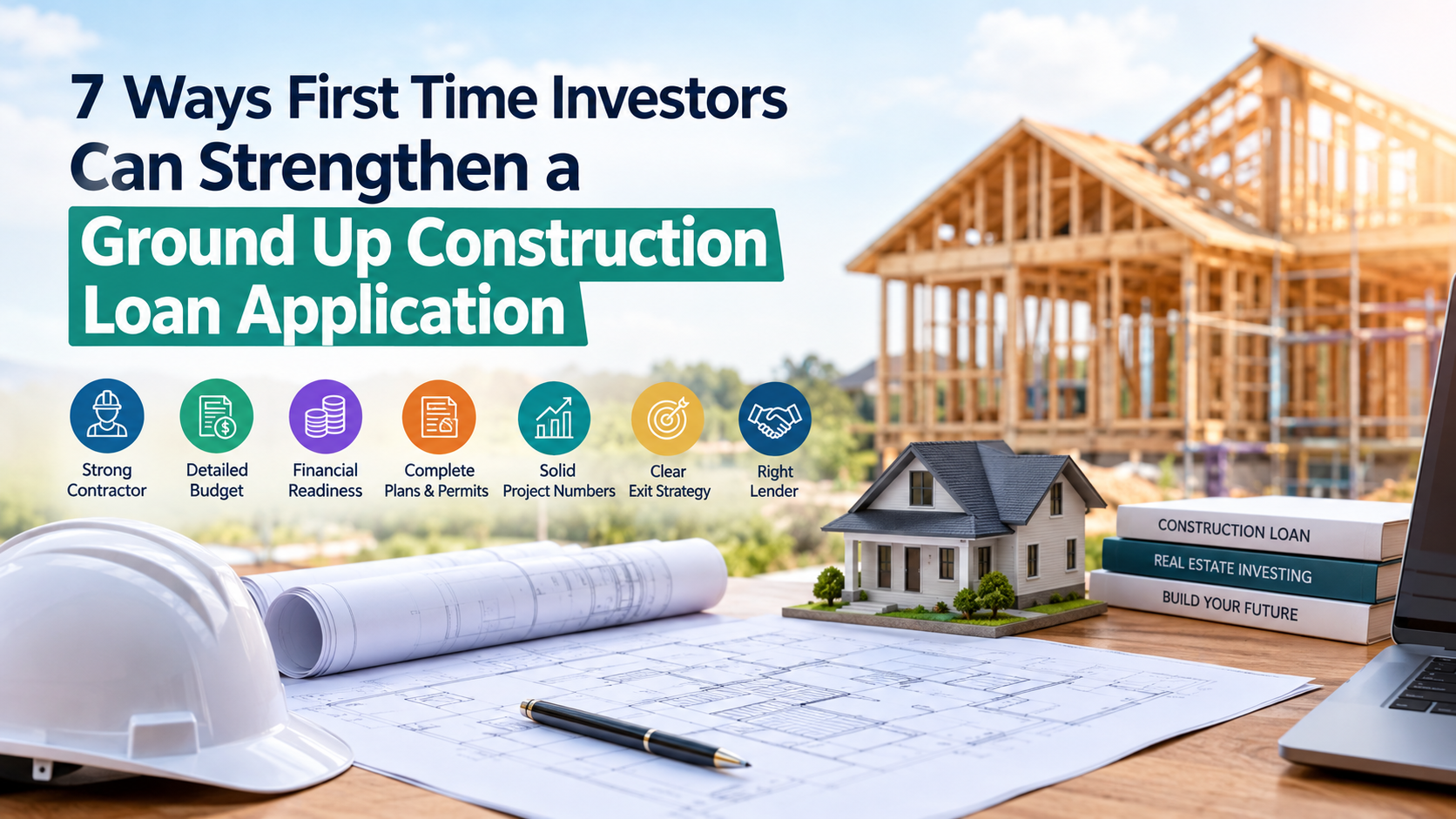
Here are seven practical ways first time investors can strengthen an application for ground up construction loans.
What Does a Lender Look for in a First Time Investor?
Before looking at the seven strategies, it helps to understand the basic underwriting approach.
A lender generally evaluates three major areas. These are the borrower, the project, and the execution plan.
The borrower review may include credit, liquidity, assets, liabilities, real estate experience, and the ability to contribute equity. The project review can include the location, land, property type, projected value, construction costs, and market demand. The execution review focuses on the plans, contractor, timeline, permits, budget, and exit strategy.
For a first time investor, the goal is to reduce uncertainty wherever possible.
Recent construction lending guidance shows that first time developers may still qualify when they have a qualified general contractor, detailed plans, a realistic budget, adequate liquidity, and a credible project structure. Some lenders may also adjust leverage or other terms based on the borrower’s experience and overall strength.
1. Work With an Experienced General Contractor
One of the most effective ways to strengthen a first time investor application is to work with an experienced general contractor.
If you have never managed a ground up construction project, a lender has limited evidence that you can manage construction schedules, subcontractors, inspections, change orders, material costs, and unexpected problems.
A qualified general contractor can help reduce that concern.
The contractor you choose should have experience with projects similar to yours. For example, if you plan to build a single family investment property, experience building similar homes can be more useful than a contractor whose background is primarily large commercial projects.
When reviewing your contractor, a lender may want to see information such as:
Construction experience
Completed projects
Relevant licenses
Insurance
References
Financial strength
Experience with similar property types
Ability to complete projects within budget and on schedule
Do not wait until after you apply to find a contractor.
A lender ready application is much stronger when the construction team is already established.
Ask your contractor for a resume or project history and keep documentation for recently completed projects. If possible, include examples of projects that are similar in size, location, design, and construction complexity.
For a first time investor, a strong contractor can provide an important layer of confidence.
Some current construction lenders specifically state that first time investors can qualify when they work with an experienced licensed general contractor.
2. Prepare a Detailed and Realistic Construction Budget
Your construction budget is one of the most important parts of a ground up construction loan application.
A lender needs to understand how much the entire project will cost and where the money will go.
A simple estimate such as “construction will cost $400,000” does not provide enough information.
Instead, prepare a detailed line item budget.
Depending on your project, the budget may include:
Land acquisition
Site preparation
Foundation
Framing
Roofing
Plumbing
Electrical work
Heating and cooling
Windows and doors
Interior finishes
Appliances
Landscaping
Permits
Architectural fees
Engineering fees
Survey costs
Insurance
Builder fees
Financing costs
Contingency reserves
Your budget should also be supported by actual contractor bids whenever possible.
This is important because construction costs can change during a project. A budget based on realistic estimates and documented bids gives the lender more confidence than numbers that appear to have been guessed.
Current lender guidance emphasizes detailed line item budgets, contractor bids, and contingency reserves when evaluating construction applications.
Do not make the mistake of trying to make the project look more profitable by making the budget unrealistically low.
A low construction estimate may look attractive at first, but it can create a funding problem later. If the project runs out of money, you may need to contribute additional capital or find another source of financing.
A realistic budget is not just good for loan approval. It is also good for protecting your investment.
3. Show That You Have Enough Liquidity
A first time investor does not need to have unlimited cash, but you should be prepared to show that you can support the project financially.
Construction projects rarely go exactly according to the original plan.
Material prices can change. Inspections can take longer than expected. A contractor may discover an unexpected site issue. A design change may increase costs. A project may also take longer to complete than originally planned.
This is why lenders pay attention to liquidity.
Liquidity refers to assets that can be accessed relatively quickly to cover your financial obligations.
Depending on the lender and project, this can include cash, bank account balances, certain investment accounts, or other acceptable liquid assets.
Before submitting your application, understand exactly how much capital you will need to bring to the transaction.
You may need funds for your equity contribution, closing costs, reserves, and unexpected expenses that are not covered by the construction loan.
Do not move all of your available cash into the project without considering your remaining reserves.
A strong application does not simply show that you can close the loan. It shows that you have thought about what happens after closing.
Some lenders specifically evaluate liquidity and additional available capital when considering first time construction investors.
4. Get Your Plans, Permits, and Project Documents Organized
A lender should not have to piece your project together from incomplete documents.
Before applying, organize the important information into a clear loan package.
Your package may include:
Property information
Land purchase agreement or proof of ownership
Architectural plans
Engineering documents
Construction specifications
Contractor agreement
Construction budget
Project timeline
Permits or permit status
Property appraisal information when available
Comparable property sales
Projected selling price or rental income
Insurance information
Borrower financial information
Entity documents
The exact requirements vary by lender and project.
The important point is to have the project well documented.
Permits are especially important because construction cannot move forward normally if the project is not legally ready to proceed.
If permits are still being processed, tell the lender rather than assuming the issue will not matter.
The same applies to zoning, architectural approvals, surveys, environmental issues, and other property specific requirements.
A first time investor can strengthen the application by showing that these details have already been considered.
Recent lender materials consistently identify plans, permits, budgets, contractor information, and property documentation as important parts of a construction financing package.
5. Make Sure the Project Numbers Actually Work
A lender is not only financing construction. The lender is evaluating the financial viability of the entire project.
That means you should understand your numbers before requesting financing.
Start with the total project cost.
Then estimate the completed property value using realistic comparable properties.
If you plan to sell the property, research recent sales of similar properties in the same market.
Look at factors such as:
Location
Property size
Lot size
Number of bedrooms
Number of bathrooms
Property condition
Recent sale prices
New construction demand
Expected time to sell
If you plan to keep the property as a rental, evaluate expected rent, operating expenses, vacancy, taxes, insurance, and the likely refinancing strategy.
Do not rely on the highest possible sale price or rent estimate just because it makes the project look more profitable.
A conservative analysis can make your application more credible.
For example, suppose your total project cost is expected to be $500,000 and you believe the completed property will be worth $700,000.
That creates a meaningful difference between your total investment and projected value.
But the lender will still want to understand how you arrived at the $700,000 figure.
That is why comparable sales and market research matter.
A current construction underwriting approach commonly evaluates the completed value, construction budget, builder, land, and exit strategy together rather than looking at only one number.
6. Have a Clear Exit Strategy Before You Apply
One of the most important questions a lender may ask is simple:
How will the loan be repaid?
Your answer should be clear before you submit your application.
For investors, common exit strategies include selling the completed property or refinancing into longer term financing.
For example, an investor may build a single family property, sell it after completion, and use the sale proceeds to repay the construction loan.
Another investor may build a rental property and refinance into a long term rental loan after construction is complete and the property meets the requirements for refinancing.
Your exit strategy should match the project.
If you plan to sell, research the local market and comparable sales.
If you plan to rent and refinance, research expected rental income and potential long term financing before construction begins.
Do not simply write “sell the property” or “refinance” in the application without explaining why the strategy is realistic.
A strong exit plan shows that you have considered what happens after construction is finished.
Current construction lenders consistently identify the exit strategy as an important part of underwriting because the lender needs to understand how the construction debt will ultimately be repaid.
7. Choose the Right Ground Up Construction Loan Lender
Not every lender approaches construction financing in the same way.
This is particularly important for a first time investor.
Some lenders may have strict experience requirements. Others may be willing to consider first time investors when the project has a strong contractor, adequate equity, realistic numbers, and a well documented plan.
Before applying, ask potential lenders questions such as:
Do you work with first time investors?
What experience does the general contractor need?
How much equity is typically required?
How are construction draws handled?
What documents are required?
How are inspections handled?
What happens if construction is delayed?
How are cost overruns handled?
What exit strategies do you accept?
What property types do you finance?
What geographic areas do you serve?
These questions can help you determine whether the lender fits your project.
Do not choose a lender based only on the advertised interest rate.
Construction financing involves ongoing communication throughout the project. Draw timing, inspections, documentation, and responses to construction issues can all affect your experience.
A lender that understands ground up construction loans for investors may be better positioned to evaluate your project based on the complete picture.
It is also worth confirming whether you are working directly with the lender or through an intermediary. Understanding who is making the underwriting decision can help you know what to expect during the process.
What If You Have No Construction Experience?
This is one of the biggest concerns for first time investors.
The answer is that having no previous ground up construction experience does not automatically mean you cannot obtain financing.
Lender requirements vary significantly.
Some programs specifically accept first time investors. Others place greater emphasis on the borrower’s previous construction history.
If you have no construction track record, focus on the areas you can strengthen.
Work with an experienced general contractor.
Prepare a detailed budget.
Provide complete plans and project documents.
Show adequate liquidity.
Demonstrate that you understand the local market.
Prepare a realistic exit strategy.
Consider whether starting with a smaller and simpler project makes sense for your experience level.
The objective is to give the lender evidence that the lack of personal construction history is being offset by a strong project and experienced professionals.
Current market offerings demonstrate that first time investors can be considered when the project has an experienced GC and strong supporting documentation, although specific requirements vary by lender.
A Simple Checklist Before Submitting Your Application
Before submitting a ground up construction loan application, go through this checklist.
Borrower
Do you have the required equity?
Can you demonstrate sufficient liquidity?
Is your credit profile in good shape?
Are your financial documents organized?
Property
Do you have a clear land position?
Is the property suitable for the planned construction?
Have you researched comparable properties?
Construction
Do you have an experienced general contractor?
Are the plans complete?
Is the construction budget detailed?
Are contractor bids available?
Is there a realistic contingency reserve?
Legal and approvals
Are zoning requirements understood?
Are permits approved or progressing appropriately?
Is the ownership structure clear?
Is insurance available?
Exit
Do you plan to sell or refinance?
Are your projected sale price or rental numbers realistic?
Have you researched the market supporting your exit strategy?
If you can answer these questions confidently, you are in a much better position to approach a lender.
Final Thoughts
Applying for your first ground up construction loan can feel overwhelming, especially when you do not have a long construction track record.
But experience is only one part of the picture.
A well structured project can demonstrate that you have thought carefully about the risks and responsibilities involved in construction.
The seven most important steps are to work with an experienced general contractor, prepare a realistic construction budget, demonstrate adequate liquidity, organize your plans and permits, validate your project numbers, develop a clear exit strategy, and choose a lender that understands your type of project.
The goal is not to make your application look perfect. The goal is to make it complete, realistic, and easy for the lender to understand.
For investors seeking ground up construction loans, preparation can make a meaningful difference. The more clearly you can demonstrate how the project will be built, funded, completed, and repaid, the easier it becomes for a Ground Up construction loan lender to evaluate the opportunity.
Simplending Financial works with real estate investors seeking financing for new construction projects. If you are planning your first ground up development, you can discuss your project, construction budget, property, and financing goals with the team to understand what type of financing may fit your situation.
Frequently Asked Questions
Can a first time investor get a ground up construction loan?
Yes. Some lenders offer ground up construction loans for first time investors. Approval depends on the lender, property, borrower qualifications, construction plan, contractor experience, available equity, liquidity, and overall project strength. An experienced general contractor can be particularly helpful when the investor does not have a previous construction track record.
What does a lender look for in a first time construction investor?
A lender may evaluate the borrower’s credit, liquidity, equity contribution, real estate experience, construction team, property, budget, plans, completed property value, market demand, and exit strategy. Requirements vary by lender, so investors should ask about the specific criteria before submitting a complete application.
How can I qualify for a ground up construction loan with no experience?
You can strengthen your application by working with an experienced general contractor, preparing detailed plans and a realistic budget, demonstrating adequate liquidity, contributing appropriate equity, researching comparable properties, and presenting a credible exit strategy. Some lenders specifically offer programs for first time investors, while others may have minimum experience requirements.
Does a first time investor need an experienced general contractor?
Many lenders prefer or require an experienced general contractor for a first construction project. The contractor’s experience can help reduce concerns about construction execution, scheduling, budgeting, and project management. Requirements vary, so confirm the lender’s contractor requirements before applying.
What documents are needed for a ground up construction loan?
Requirements vary, but lenders may request architectural plans, construction specifications, a detailed budget, contractor information, land documents, permits, property information, borrower financial documents, insurance information, and an exit strategy. Having these documents organized before applying can make the process more efficient.
How much money should I have before applying for a ground up construction loan?
There is no single amount that applies to every investor or lender. You may need funds for your equity contribution, closing costs, reserves, and unexpected project expenses. The amount depends on the total project cost, loan structure, property, lender requirements, and your financial profile. It is important to understand your full cash requirement before closing.
Can land equity help with a ground up construction loan?
In some cases, yes. If you already own the land and have meaningful equity in it, that equity may be considered as part of the overall project capital depending on the lender and loan structure. Investors should provide clear documentation showing their ownership and basis in the land.
What is the best way to strengthen a ground up construction loan application?
The best approach is to reduce uncertainty. Present a qualified construction team, realistic budget, complete plans, appropriate equity, adequate liquidity, credible property values, and a clear exit strategy. Choosing a lender that regularly handles ground up construction loans can also help because the lender is more familiar with the risks and documentation involved.
Should first time investors start with a smaller construction project?
A smaller and less complex project can be easier for a first time investor to manage, although the right project depends on the investor’s financial position, market, construction team, and goals. Investors should focus on selecting a project they can realistically manage rather than taking on a larger development simply to increase potential returns.
Why is the construction budget so important to a lender?
The construction budget helps the lender understand how much capital is needed to complete the project. If costs are underestimated, the project may run out of funds before completion. A detailed budget supported by contractor bids and an appropriate contingency reserve can give the lender greater confidence that the project has been planned realistically.
Comments
Written by Simplending Financial
Simplending Financial is a trusted private lending firm offering customized financing solutions for real estate investors.