7 Ways to Stress Test a Ground Up Construction Project Before Applying for Financing

Oct 14, 2026
12 min read
4 views
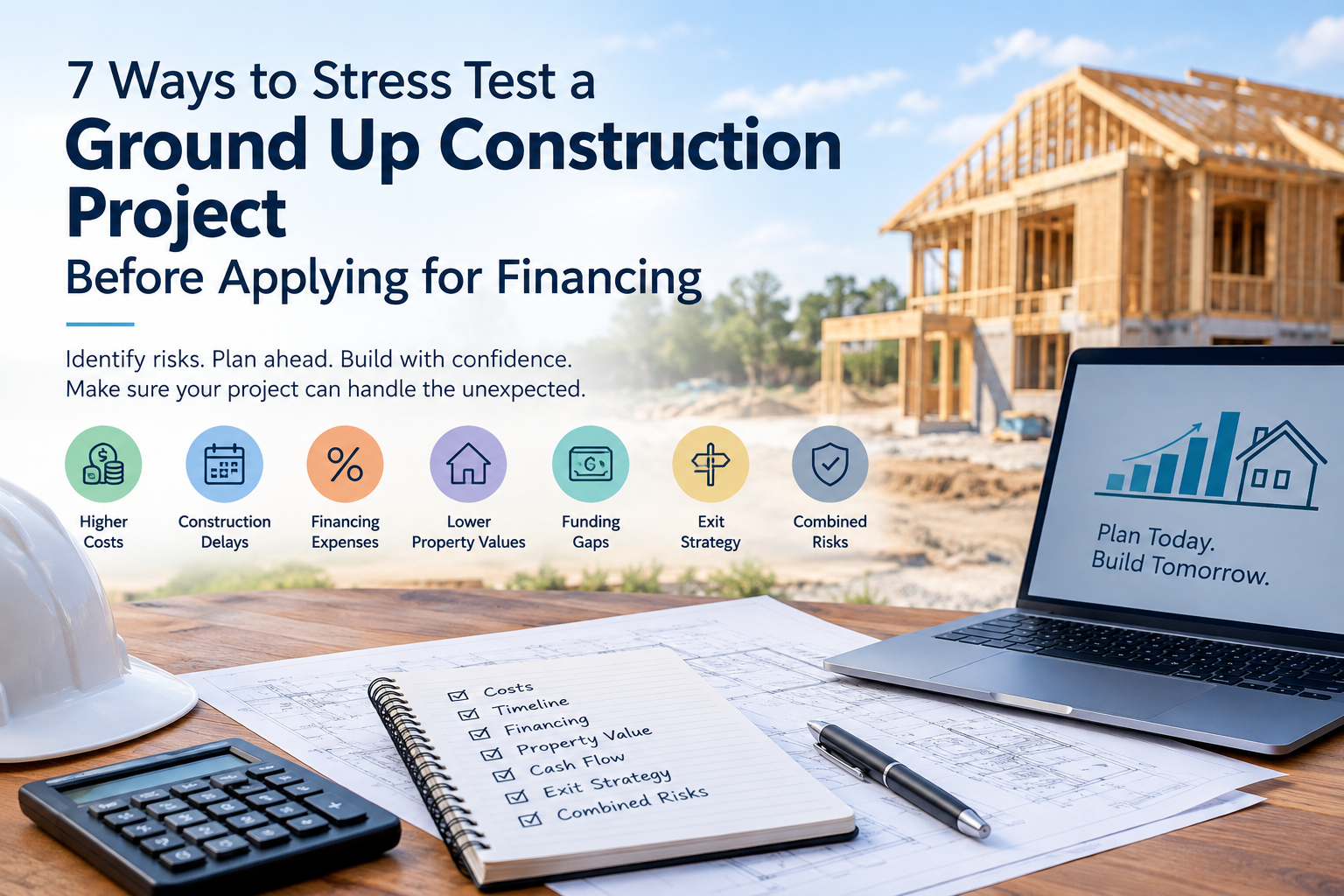
A ground up construction project can look profitable on paper, but unexpected costs, construction delays, changing property values, and financing expenses can quickly affect the final results. Before applying for a construction loan, real estate investors should evaluate whether their project can remain financially stable when things do not go according to plan.
Stress testing is the process of examining how a real estate project performs under less favorable conditions. Instead of assuming that construction will finish on time and within budget, investors consider what could happen if expenses increase, the property sells for less than expected, or refinancing becomes more difficult.
For investors seeking ground up construction loans, this process can reveal financial weaknesses before they become expensive problems. It can also help investors prepare a more realistic project budget and present a stronger financing application.
Here are seven practical ways to stress test a ground up construction project before approaching lenders.
1. Test What Happens If Construction Costs Increase
Construction costs are among the biggest risks in a new development project. Prices for lumber, concrete, roofing, electrical supplies, plumbing, and labor can change between the planning stage and the completion date.
An estimate that looks reasonable today may not cover the actual expenses several months later. Changes to the building design, unexpected site conditions, or contractor pricing adjustments can also increase the total cost.
Investors should calculate how their project would perform if construction expenses exceeded the original budget by 5 percent, 10 percent, or 15 percent. These are illustrative scenarios rather than predictions of actual cost increases.
For example, suppose a residential construction project has an estimated building cost of $400,000.
A 5 percent increase would add $20,000 to the budget. A 10 percent increase would add $40,000, while a 15 percent increase would add $60,000.
The investor should determine whether available cash reserves can cover these additional expenses without affecting other project obligations.
Before applying for ground up construction financing, review contractor bids, material allowances, labor costs, and the scope of work. Ask the contractor which items are fixed and which could change.
It is also important to maintain a contingency reserve for unexpected expenses. The appropriate reserve depends on the property's condition, design complexity, construction stage, and project risks.
Practical tip: Prepare a revised budget that includes at least one higher cost scenario. If the project becomes unprofitable after a relatively small increase, reconsider the purchase price, design, or construction plan before moving forward.
2. Evaluate the Impact of Construction Delays
Construction timelines rarely depend on the contractor alone. Building permits, inspections, weather, material availability, subcontractor schedules, and utility connections can all affect completion.
A delay can create several financial problems at once. The investor may need to pay interest for longer, cover additional insurance and property taxes, extend contractor arrangements, and postpone the expected sale or rental income.
To stress test the timeline, prepare three schedules: the expected completion date, a moderately delayed completion date, and a more difficult delay scenario.
For example, assume a project is expected to take 10 months to complete. Consider what would happen if it instead required 12 or 14 months.
Calculate the additional carrying costs for each scenario. These may include loan interest, insurance, taxes, security, utilities, and other ongoing expenses.
Investors should also check the proposed loan term. A project that requires 14 months to complete may be exposed to repayment pressure if its financing matures after 12 months.
Ask potential ground up construction lenders about extension options, extension fees, maturity requirements, and any conditions that must be met to qualify for additional time. Do not assume an extension will automatically be approved.
A realistic schedule should include time for inspections, corrections, final approvals, and preparing the property for sale or occupancy.
Practical tip: Leave enough time for delays between construction completion and the point when the property can generate income or be sold. Finishing the physical work does not always mean the project is immediately ready for its intended exit.
3. Calculate How Much the Project Can Handle in Additional Financing Costs
Financing costs can affect project profitability even when the construction budget remains unchanged.
Ground up construction loans may involve interest charges, origination fees, appraisal expenses, inspections, legal fees, and other closing costs. The exact expenses depend on the lender, loan structure, property, and project.
Investors should calculate the total cost of financing rather than comparing loan offers based only on the interest rate.
Consider a hypothetical project with a loan balance of $300,000. At a simple annual interest rate of 10 percent, the annual interest on the full balance would be $30,000. Over six months, that would equal $15,000.
If the project takes three additional months, interest on that same balance would add approximately $7,500, assuming the balance and rate remain unchanged.
Actual construction loan interest may be calculated on the amount drawn rather than the full committed loan amount. The example is intended to illustrate the effect of time, not predict a specific loan's cost.
Investors should also test what happens if the loan costs more than expected or the project requires an extension. If interest rates are variable, evaluate how a rate increase could affect the budget.
Review whether the financing structure includes an interest reserve. An interest reserve sets aside funds to cover scheduled interest payments during the project. However, the reserve may be insufficient if construction takes longer than planned.
When comparing ground up construction financing options, ask for a clear breakdown of interest, fees, draw related expenses, and repayment terms.
Practical tip: Calculate the expected financing cost and a higher cost scenario. Include both in your project analysis before deciding how much equity you can afford to invest.
4. Test Whether the Project Remains Profitable if Property Values Decline
A new building may be completed according to plan without achieving the expected market value. Property values can change because of local supply, buyer demand, mortgage costs, neighborhood conditions, or broader economic factors.
Investors should avoid relying on a single optimistic estimate of the completed property's value.
Start by reviewing comparable properties that have recently sold in the same area. Compare property size, age, layout, location, features, and overall quality. Asking prices can provide useful context, but completed sales usually offer stronger evidence of what buyers have actually paid.
Next, calculate the project's expected results using three possible completed values: the expected value, a value that is 5 percent lower, and a value that is 10 percent lower.
For example, if the expected completed value is $500,000, a 5 percent decline would reduce it to $475,000. A 10 percent decline would reduce it to $450,000.
The investor should then subtract the total project cost, selling expenses, financing costs, and other applicable expenses to estimate the remaining profit.
This exercise is especially important for investors building properties for resale. A lower valuation can also affect the amount a lender is willing to advance because loan proceeds may be limited by both project costs and the appraised value after completion.
Ground up construction lenders may require an appraisal based on the property being completed according to the approved plans and specifications. The actual underwriting approach varies by lender and loan program.
Practical tip: If the project only produces an acceptable return at the highest projected sale price, it may carry too much risk. Reconsider the land cost, building design, or expected profit before applying for financing.
5. Check Whether You Have Enough Cash to Cover a Funding Gap
One of the most important questions is whether you can finish the project if the original budget or financing plan changes.
A construction loan does not necessarily provide all the money an investor needs at the beginning. Many loans release funds in stages as construction progresses. Draws may require inspections, documentation, and confirmation that specific work has been completed.
This means investors must understand when money will become available and when contractors expect payment.
Suppose a contractor requires payment for materials and completed work before the next loan draw is released. If the investor does not have enough cash to cover that temporary gap, construction could slow down even when the overall loan commitment appears sufficient.
Prepare a cash flow schedule showing expected expenses, loan draws, equity contributions, and payment dates throughout construction.
Then test what happens if a draw is delayed, a contractor requests additional payment, or an unexpected expense arises before the next funding release.
Include funds for expenses that may not be eligible for loan financing. Depending on the loan terms, these could include certain preconstruction expenses, cost overruns, or other project obligations.
Investors should also avoid committing all their available cash to the initial land purchase or construction deposit. Maintaining liquidity can provide flexibility when problems arise.
Practical tip: Ask prospective lenders how their draw process works, whether inspections are required, what documents must be submitted, and how eligible costs are funded. Make sure your cash flow plan reflects the actual process rather than assuming money will be available immediately.
6. Stress Test Your Exit Strategy
Every construction project needs a clear plan for repaying its loan. Investors commonly plan to sell the completed property or refinance it into longer term financing, particularly when developing rental properties.
Both strategies carry risks that should be evaluated before construction begins.
For a project intended for resale, consider what happens if the property takes longer to sell or the final sale price is lower than expected. Additional holding costs may reduce the profit, and the loan may mature before the sale closes.
For a rental property, test whether the expected rent can support operating expenses and the proposed permanent financing. Consider vacancy, property management, maintenance, insurance, taxes, and other ownership expenses.
If the plan depends on refinancing, do not assume that another lender will approve the future loan. Qualification may depend on the completed property's value, rental income, debt service coverage, borrower finances, seasoning requirements, and the financing options available at that time.
For example, a property might be completed successfully but receive a lower appraisal than expected. If the investor planned to refinance and use the proceeds to repay the construction loan, the available refinance amount might be insufficient.
Prepare an alternative repayment plan. This might involve additional cash, a longer holding period if permitted, a revised sale strategy, or another financing option that is realistically available.
Practical tip: Identify the earliest date by which the loan must be repaid and compare it with the expected sale or refinance timeline. Understand the lender's maturity and extension provisions before accepting the loan.
7. Combine the Risks to See How the Entire Project Performs
Testing one problem at a time is helpful, but several problems can occur together. Construction costs may rise while the schedule slips and property values weaken.
A combined stress test helps investors understand whether their project can withstand multiple setbacks.
Prepare a simple financial model with three scenarios.
Expected scenario: Construction finishes close to schedule, expenses remain near budget, and the property achieves the expected value.
Moderate stress scenario: Construction costs increase by 5 percent, completion takes two additional months, and the completed value falls by 5 percent.
Severe stress scenario: Construction costs increase by 10 percent, completion takes four additional months, and the completed value falls by 10 percent.
These figures are examples for planning purposes. Investors should choose assumptions that reflect the actual property, local market, construction contract, and financing terms.
For each scenario, calculate total project costs, financing expenses, available cash, expected sale proceeds or rental income, and the amount remaining after repayment of the construction loan.
Look at more than the final profit. Determine whether the project can meet contractor payments, carry the loan until completion, and repay the debt within the available term.
If the severe scenario produces a loss, that does not automatically mean the project should be abandoned. It does mean the investor should understand the size of the potential loss and whether it can be absorbed.
Possible adjustments include negotiating a lower land price, simplifying the design, increasing reserves, revising the construction schedule, or choosing a financing structure that better matches the project.
Practical tip: Keep the model updated as bids, permits, loan terms, and market information become more reliable. A stress test is most useful when it reflects current project information rather than early estimates that are no longer accurate.
Final Thoughts
Stress testing a ground up construction project helps investors make decisions based on realistic financial expectations rather than the assumption that everything will go according to plan.
By reviewing construction cost increases, delays, financing expenses, completed property values, cash flow gaps, exit strategies, and combined risks, investors can identify weaknesses before committing substantial capital.
A strong financing application should be supported by a detailed budget, a realistic construction schedule, a qualified builder, documented funds, and a clear repayment strategy. These details also help potential lenders evaluate the project's feasibility.
Before applying for ground up construction loans, take the time to understand both the expected outcome and the potential downside. A project that can withstand reasonable setbacks may be better positioned for successful completion than one that depends on perfect conditions.
The goal is not to eliminate every risk. It is to understand the risks, prepare for them, and make sure you have a practical plan for handling them.
Frequently Asked Questions
1. What does it mean to stress test a ground up construction project?
Stress testing means evaluating how a construction project performs under less favorable conditions. Investors examine possible cost increases, construction delays, lower property values, higher financing expenses, and changes to their repayment plan before committing to the project.
2. How much contingency should I include in a construction budget?
The appropriate contingency depends on the project's size, complexity, stage of planning, and uncertainty in the cost estimates. Some projects use a reserve of around 5 percent to 10 percent of construction costs as an initial planning reference, but this is not a universal rule. Investors should base the reserve on project specific risks and lender requirements.
3. What do ground up construction lenders evaluate before approving a loan?
Lenders commonly review the project budget, land and property details, approved plans, permits, builder qualifications, borrower equity, estimated completed value, construction schedule, and repayment strategy. Requirements vary by lender and financing program.
4. How do construction delays affect ground up construction financing?
Delays can increase interest expenses, insurance, property taxes, and other holding costs. They may also postpone property sales or rental income. If a delay extends beyond the loan maturity date, the borrower may need an approved extension or another repayment solution.
5. Can I get a ground up construction loan if my project has a tight budget?
Possibly, but the project must still meet the lender's requirements and have a credible plan for covering construction costs. A very limited budget with no funds for unexpected expenses can create significant risk. Investors should review their available equity, contingency reserve, and cash flow before applying.
6. Why is the after completion value important for construction financing?
The after completion value is the estimated market value of the property once construction is finished according to the approved plans. Lenders may use this valuation, along with project costs and other underwriting factors, to determine the maximum loan amount. A lower valuation can reduce available financing or require additional borrower equity.
7. How can I tell whether my construction project is financially feasible?
Estimate the full cost of the project, including land, construction, professional fees, permits, insurance, financing, contingency, and other applicable expenses. Compare those costs with the expected sale proceeds or rental performance. Then test the results under less favorable scenarios and confirm that you have enough cash and a realistic plan to repay the loan.
8. Should I stress test my project before contacting a construction lender?
Yes. Preparing a stress test before applying can help you identify budget gaps, assess your required cash contribution, and explain how you plan to manage risks. It also gives you a clearer basis for comparing loan terms and discussing the project with potential lenders.
Comments
Written by Simplending Financial
Simplending Financial is a trusted private lending firm offering customized financing solutions for real estate investors.