BIM Clash Detection Service Providers in West Virginia for Conflict-Free MEP Coordination

Oct 22, 2026
5 min read
0 views
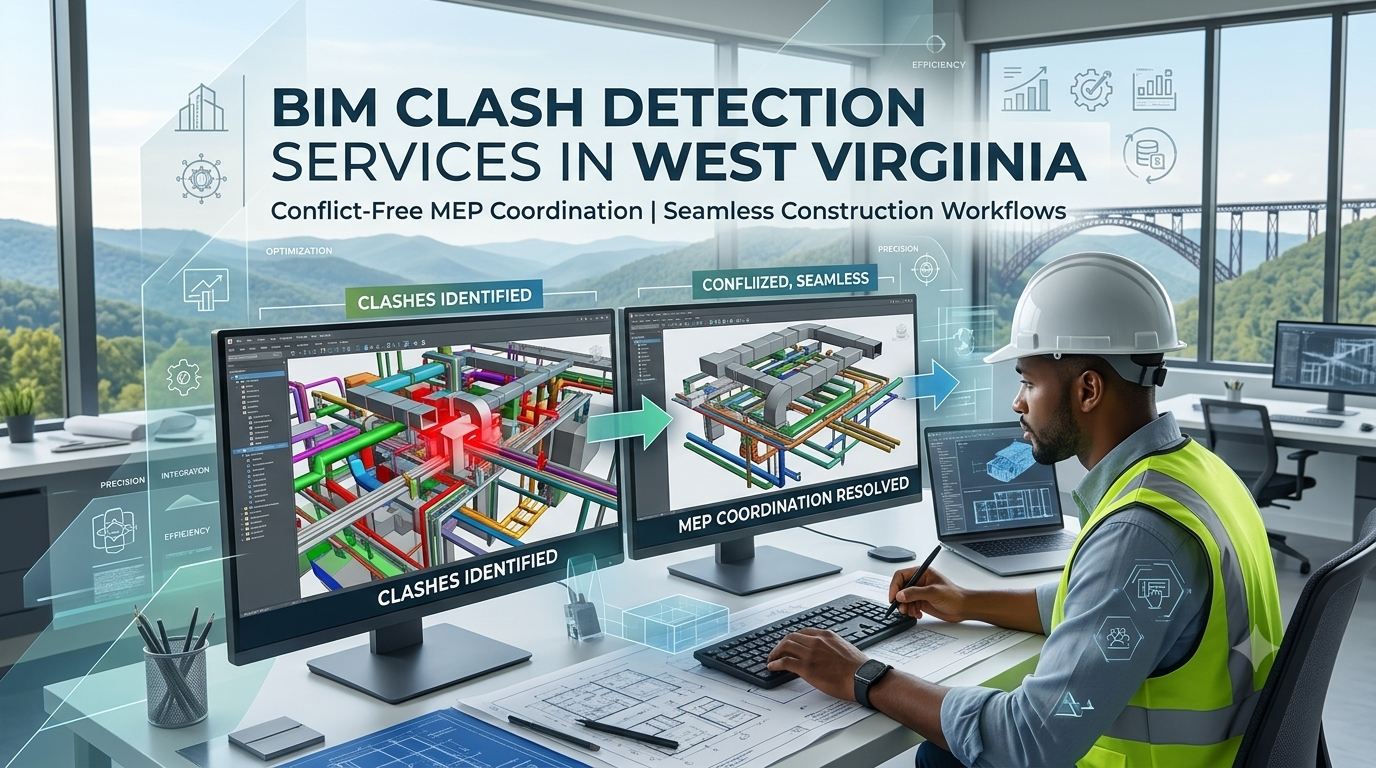
Every MEP installation depends on clean coordination between trades, and BIM clash detection service providers in West Virginia help contractors and engineers spot conflicts in the 3D model before crews start work on site. Ducts, pipes, cable trays, and sprinklers compete for the same ceiling space, and a single missed clash can stop installation on an entire floor.
Unresolved clashes reach site as rework, RFIs, change orders, and schedule delays. This article explains how clash detection works in an MEPF workflow. Where MEP BIM coordination breaks down on West Virginia projects, and how a structured clash process delivers conflict-free models.
What Clash Detection Means for MEP Coordination
BIM clash detection finds conflicts between MEP, architectural, and structural models before construction starts. Coordinators combine the discipline models in Navisworks or Revit, run clash tests, and review each conflict with the responsible trade. MEP systems create many of these clashes because ducts, pipes, and cable trays share limited ceiling and riser space.
Coordination teams track three clash types:
Hard clashes: Two objects take up the same space, such as a duct running through a beam or a pipe crossing a column.
Soft clashes: An object enters the clearance, access, or maintenance space that another item needs.
Workflow clashes: Work schedules, material deliveries, or trade sequences conflict with each other.
A complete clash detection service covers model checks, clash test setup, clash grouping, coordination reports, issue tracking, and coordinated model updates after each review cycle.
Clash testing only delivers value when the team resolves each issue and updates the models. A clash report alone removes no conflicts; the coordination process around it decides whether the site receives clean drawings.
Why MEP Coordination Breaks Down on West Virginia Projects
Most coordination failures come from workflow gaps, not from missing software. West Virginia projects face six recurring problems that push unresolved clashes onto the construction site.
Existing Building Constraints
Renovations of older hospitals, schools, and civic buildings bring low floor-to-floor heights, undocumented services, and as-built drawings that no longer match site conditions. Coordinators who model from outdated drawings miss clashes that only appear on site. Historic structures add thick masonry walls and irregular framing that restrict new service routes.
Mismatched Levels of Development
Architectural, structural, and MEP models progress at different speeds and detail levels. An MEP model at LOD 200 shows only approximate sizes and locations, which makes clash results against a LOD 300 structural model unreliable. Coordinators chase conflicts that disappear once the design matures.
Unfiltered Clash Reports
A raw clash test can produce a long list of results, many of them duplicates or insulation-level overlaps. Teams waste meeting time sorting noise instead of solving conflicts.
Weak Issue Tracking
Without clear ownership, nobody knows which trade must fix each clash or whether anyone closed it. Open issues carry forward into shop drawings and fabrication.
Limited In-House BIM Capacity
Many regional contractors and smaller design firms lack dedicated BIM coordinators for complex healthcare and industrial projects. Firms that hire BIM service providers in West Virginia or remote coordination teams fill this gap without permanent hiring.
Late Trade Involvement
Fabricators and installers frequently join after the design models freeze. Their hanger spacing, insulation thickness, and access requirements trigger a second round of clashes. Early fabricator input during coordination prevents this repeat cycle.
Each gap leads to the same result: crews reroute and reinstall services on site, and owners absorb rework costs, change orders, and schedule delays.
How Specialist Providers Deliver Conflict-Free MEP Coordination
Experienced clash detection service providers act as structured coordination partners, not just software operators. They follow a repeatable process that moves conflict resolution from the site into the model.
Model Audit and Setup
Coordinators check shared coordinates, model units, LOD, and element categories before running any test. A clean combined model prevents false results from misaligned or incomplete files. Teams also agree on a regular model exchange schedule to keep every discipline current.
Rule-Based Clash Tests
Providers build a clash matrix by discipline pair, such as ductwork against structure or sprinklers against cable trays. Defined tolerances filter out minor overlaps and keep the team focused on real conflicts.
Clash Grouping and Ranking
Coordinators group clashes by level, zone, and system, then rank them by installation impact. One grouped issue can replace dozens of duplicate results and speed up every review.
Coordination Meeting Support
Before each meeting, the provider prepares saved viewpoints, clash reports, and proposed routing solutions. Trades spend meeting time agreeing on fixes rather than locating problems. Meeting minutes record each decision and its owner.
Issue Tracking and Ownership
Each clash receives an owner, a status, and a target resolution date in BCF-based tools or a shared issue log. Clear ownership stops open issues from reaching fabrication.
Laser Scan Integration for Renovations
Providers import point cloud data from laser scans of existing buildings and coordinate new services against real site conditions. This step removes guesswork from renovation projects with missing or outdated as-built records.
Coordinated Deliverables
The process ends with clash-free models, combined services drawings, and shop drawings that fabricators and installers can use directly. Each drawing shows the final agreed routing, levels, sleeve positions, and hanger locations that match the structure.
Teams that work with clash detection service providers in West Virginia or remote coordination partners resolve conflicts on screen, where a fix costs far less than site rework. This structured approach protects budgets, schedules, and installation quality.
Conclusion
Conflict-free MEP coordination depends on a structured clash process. Model audits, rule-based tests, grouped issues, tracked ownership, and laser scan verification together keep clashes off the construction site. This process gives every trade one reliable coordinated model to build from.
BIM and AEC professionals can start by auditing their current clash workflow, from model setup to issue closure, before the next project kicks off. Archdraw Outsourcing supports West Virginia project teams with MEP modeling, clash coordination, and shop drawing support that delivers conflict-free models ready for fabrication and installation.