The Role of Chatbots and AI Assistants in Modern CRM Solutions

Aug 03, 2026
6 min read
5 views
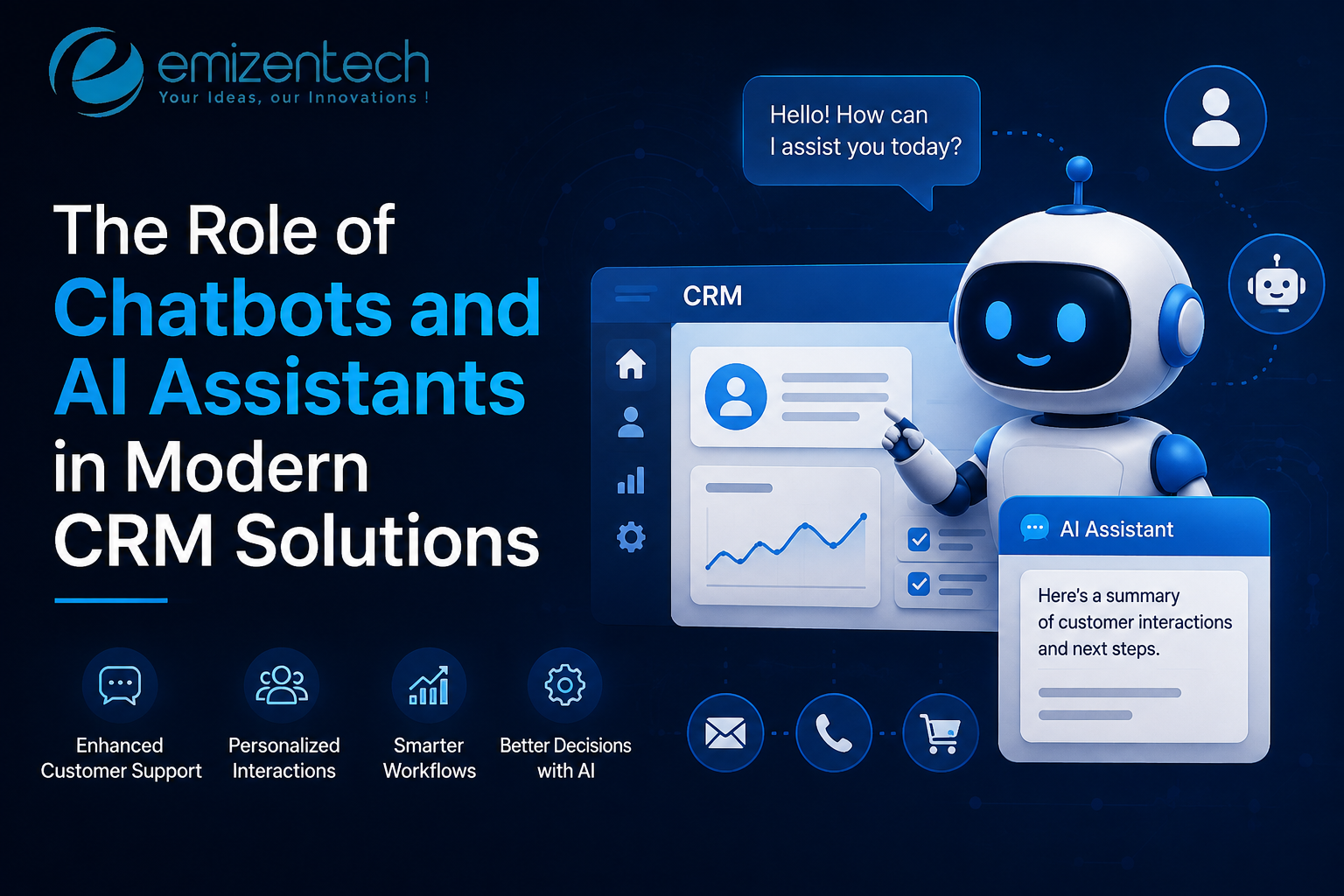
Customer expectations have changed significantly in recent years. People now expect quick responses, personalized interactions, and consistent support across multiple communication channels. Businesses are increasingly relying on Customer Relationship Management (CRM) systems to organize customer information and deliver better experiences. However, as customer interactions continue to grow, managing them manually becomes more challenging.
This is where chatbots and AI assistants play an important role. By combining automation with intelligent decision-making, these technologies help businesses handle customer conversations more efficiently while allowing human teams to focus on complex tasks. From answering routine questions to assisting sales representatives with customer insights, AI-powered tools are becoming an essential part of modern CRM solutions.
Understanding Chatbots and AI Assistants in CRM
Chatbots and AI assistants are often mentioned together, but they serve different purposes within a CRM system. Chatbots are designed to automate conversations by answering frequently asked questions, guiding users through simple processes, or collecting information. AI assistants go a step further by understanding customer intent, learning from previous interactions, and providing contextual recommendations based on customer data.
Modern CRM platforms integrate these technologies to create smarter customer experiences. AI-powered systems analyze customer history, purchase behavior, communication preferences, and support records to provide relevant responses. This allows organizations to maintain meaningful customer relationships while improving operational efficiency. Modern CRM platforms often include these capabilities to support business workflows and customer engagement, with a CRM Development Company integrating them according to project requirements.
How Chatbots and AI Assistants Enhance CRM?
Chatbots and AI assistants improve CRM by automating routine interactions, organizing customer information, and delivering timely responses. They reduce manual work, strengthen customer engagement, and provide employees with valuable insights that support faster and more informed decision-making.
24/7 Customer Support
Customers expect assistance regardless of business hours. AI-powered chatbots provide instant answers to common questions, resolve basic issues, and collect information before transferring complex requests to support agents, ensuring uninterrupted customer service throughout the day.
Lead Generation and Qualification
Chatbots interact with website visitors by asking relevant questions, collecting contact details, and identifying customer requirements. Based on predefined criteria and AI analysis, qualified leads can be automatically assigned to the appropriate sales representatives for timely follow-up.
Personalized Customer Interactions
AI assistants analyze customer purchase history, browsing behavior, and previous conversations to deliver personalized recommendations and responses. This context-aware communication creates more meaningful customer interactions while helping businesses build stronger and longer-lasting relationships with their audiences.
Sales Process Automation
Sales teams often spend valuable time on repetitive administrative tasks. AI assistants automate meeting scheduling, reminder notifications, CRM record updates, and follow-up communications, allowing sales professionals to focus more on building customer relationships and closing opportunities.
Customer Self-Service
Many customers prefer solving simple issues independently before contacting support. Chatbots enable self-service by providing answers to frequently asked questions, appointment scheduling, order tracking, account updates, and basic troubleshooting without requiring human intervention.
Key Benefits of AI-Powered CRM Solutions
AI-powered CRM solutions combine automation, analytics, and intelligent decision-making to improve customer engagement and internal efficiency. They help organizations manage customer relationships more effectively while supporting data-driven business decisions and long-term customer satisfaction.
Improved Customer Experience
Customers appreciate quick responses and personalized communication. AI assistants reduce waiting times, provide consistent support across multiple channels, and ensure customers receive relevant information based on their previous interactions and individual preferences whenever assistance is required.
Increased Employee Productivity
By automating repetitive customer service and administrative tasks, AI allows employees to dedicate more time to strategic activities. Customer support representatives, marketers, and sales teams can work more efficiently while maintaining higher service quality and faster response times.
Better Decision-Making Through Data
Modern AI systems continuously analyze customer interactions, purchasing patterns, and engagement metrics. These insights help organizations identify trends, predict customer needs, improve retention strategies, and make informed business decisions supported by reliable customer intelligence.
Cost Efficiency and Scalability
As customer interactions increase, businesses need scalable support solutions. AI-powered CRM systems handle large volumes of inquiries without requiring proportional increases in staffing, helping organizations optimize operational costs while maintaining consistent service quality.
Smarter Workflow Automation
AI automates repetitive CRM workflows such as ticket routing, customer segmentation, follow-up scheduling, and task prioritization. Organizations implementing a reliable CRM Development Service can streamline these processes while reducing manual errors and improving overall operational consistency.
The Future of Chatbots and AI Assistants in CRM
Artificial intelligence continues to evolve rapidly, making CRM systems more intelligent and proactive. Future developments will focus on predictive customer engagement, conversational intelligence, deeper personalization, and seamless collaboration between AI systems and human customer service professionals.
Generative AI for Intelligent Conversations
Generative AI enables chatbots to produce more natural, context-aware responses instead of relying solely on predefined scripts. This allows businesses to manage more complex customer conversations while maintaining accuracy, consistency, and conversational quality across multiple channels.
Hyper-Personalized Customer Experiences
Future AI assistants will combine customer history, behavioral patterns, preferences, and real-time activities to deliver highly personalized recommendations, communications, and support experiences that adapt continuously as customer needs and expectations evolve over time.
Predictive Customer Engagement
Rather than waiting for customers to reach out, AI will identify potential issues, predict customer behavior, and recommend proactive actions. Businesses can address concerns early, improve retention, and strengthen customer relationships through timely interventions.
Voice AI and Multimodal Communication
Voice-enabled AI assistants are becoming increasingly important as customers use smart devices and voice search more frequently. Future CRM systems will support seamless interactions across voice, text, email, messaging platforms, and other digital communication channels.
Human-AI Collaboration
The future of CRM is not about replacing people but supporting them with intelligent technology. AI assistants will manage repetitive activities while human professionals focus on empathy, negotiation, strategic problem-solving, and handling situations requiring personal judgment and expertise.
Conclusion
Chatbots and AI assistants have become valuable components of modern CRM solutions by helping organizations manage customer interactions more efficiently and intelligently. From automating routine conversations to delivering personalized experiences and supporting data-driven decisions, these technologies contribute to stronger customer relationships while improving operational performance. As artificial intelligence continues to advance, CRM systems will become even more adaptive, predictive, and capable of meeting changing customer expectations. Businesses that thoughtfully integrate AI into their CRM strategies will be better prepared to deliver consistent customer experiences while maintaining efficiency and scalability. Ongoing advancements in CRM technology continue to transform customer relationship management, with EmizenTech contributing through innovative and practical CRM solutions.
FAQs
1. What is the role of chatbots in customer relationship management?
Chatbots automate customer interactions by answering common questions, collecting information, and providing instant support.
2. How are AI assistants different from chatbots?
AI assistants use advanced technologies to understand context, learn from interactions, and offer personalized recommendations beyond predefined responses.
3. Can AI improve customer experience?
Yes, AI helps deliver faster responses, personalized interactions, and consistent support across multiple communication channels.
4. Which industries benefit from AI-powered CRM solutions?
Industries such as retail, healthcare, banking, education, and technology commonly use AI to improve customer engagement and service efficiency.
Comments
I am Steve Jonas, a technical blogger at EmizenTech, a reputable software development company specializing in Magento 2 solutions and Salesforce development.