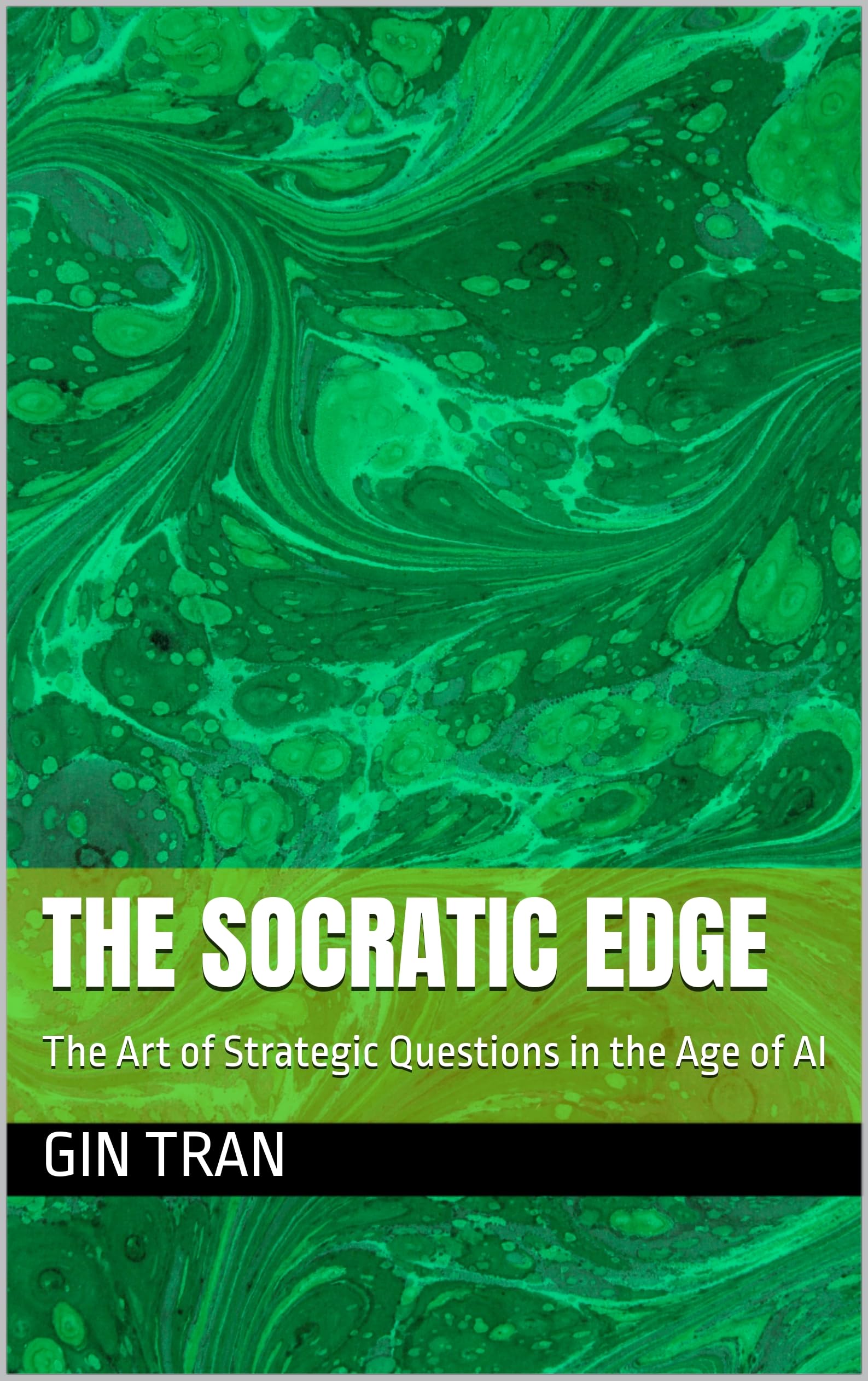
THE SOCRATIC EDGE: The Art of Strategic Questions in the Age of AI

Top Highlights
THE SOCRATIC EDGE The Art of Strategic Questions in the Age of AI GIN TRAN CONTENTS Preface: Before the First Question ACT I — THE DIAGNOSIS One — The Bottleneck Two — What You See Is All There Is Three — The Six Questions ACT II — THE EVIDENCE Four — The Interrogator and the Delegator Five — The Socratic Loop Six — Three Domains Seven — How Questions Become Automatic ACT III — THE PRACTICE Eight — The Leader's Question Nine — Teaching to Question Ten — The Examined Life Conclusion: What You Now Hold
This book is organized in three acts. Act I — Chapters One through Three — makes the case: why the AI age is a question-quality problem, what WYSIATI and invisible failures tell us about the gap, and what the six types of Socratic questions are as a map of where thinking breaks down. Act II — Chapters Four through Seven — builds the practice: how expert questioners actually use the six types, how to run them live inside an AI conversation, how they apply across three high-stakes domains, and how deliberate practice compresses them into intuitive fluency. Act III — Chapters Eight through Ten — extends the practice to scale: to leadership, where one question shapes the room; to education, where the suppression of questioning in childhood creates the cognitive profile most vulnerable to confident wrong answers; and to personal mastery, where the discipline becomes, ultimately, a way of living.
Put more plainly: most people, most of the time, were using one of the most powerful reasoning tools in human history primarily to help them write emails and summarize documents.
The gap between the AI experiences of early power users and average users was not narrowing. It was widening.
On average, human-AI collaborations underperform both the AI alone and the best human decision-makers working without AI assistance. The technology is not the limiting factor. The quality of the human's question is the limiting factor — and it always was.
What Power Users Actually Do Differently The Anthropic research and the OpenAI usage study together suggest a consistent pattern among users who extract transformative value from AI. They are not using better prompt techniques. They are not memorizing template strings or studying prompt engineering guides. What they are doing, with remarkable consistency, is spending time before the prompt — thinking about what question they actually need answered, rather
elaborative interrogation requires the learner to generate the question. And question generation, it turns out, is a skill that the educational system has spent generations systematically suppressing.
In the prompting paradigm, the human is a command-giver and the AI is an executor. In the context engineering paradigm, the human is an architect — someone who designs the space in which work happens — and the AI is a highly capable worker operating within that space.
He gave this tendency an acronym: WYSIATI. What you see is all there is.
It is efficiency. System 1 — the fast, automatic cognitive mode that handles the vast majority of human thinking — is designed to reach conclusions quickly, using whatever information is immediately available.
Recommended Books

Revisit Your Highlights, Deepen Your Understanding
Import your Kindle highlights to review, organize, and share the ideas that matter most to you.
Get the free browser extension