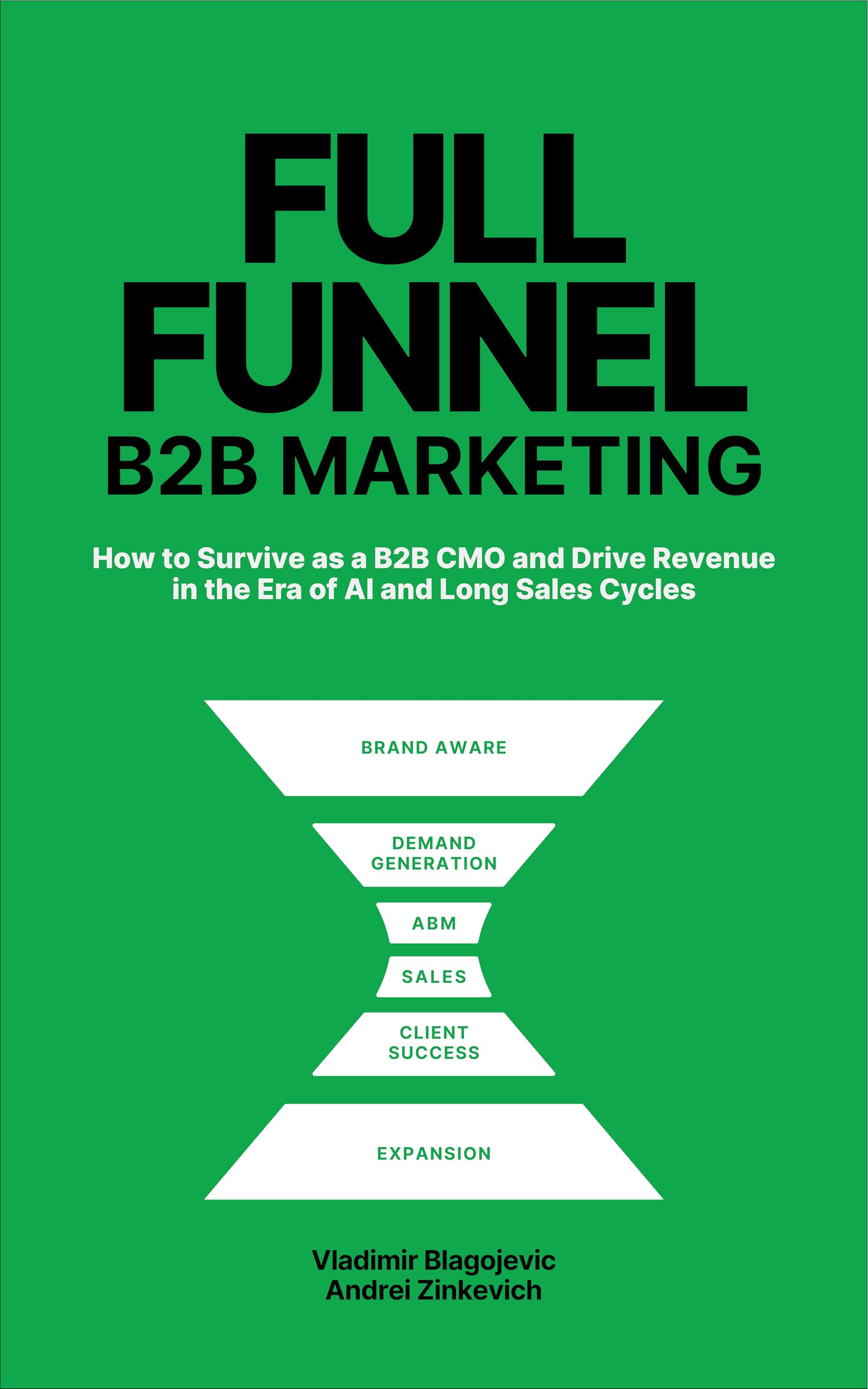
Full-Funnel B2B Marketing: How to survive as B2B CMO and drive revenue in the era of AI and long sales cycles (English Edition)

Top Highlights
Foreword The wake up call Ken Roden stared at his marketing dashboard, experiencing what he would later describe as the most confusing moment of his career. 3,500 marketing qualified leads (MQLs) in a single month: CrossKnowledge's best performance ever. But instead of feeling proud, Ken felt a growing pit in his stomach. "We had our most successful MQL month in the history of the company," Ken recalled, "and it barely converted into sales opportunities and revenue." Ken wasn't a junior marketing manager. He was a seasoned Marketing Director with 15+ years in enterprise B2B SaaS working for Wiley’s brand CrossKnowledge (CK). He represented exactly the kind of seasoned CMO now facing the collapse of the broken B2B marketing playbook: lead volume without value. Despite hitting an all-time MQL record, every revenue metric was falling down. Deal sizes were shrinking. Sales cycles were lengthening. The sales team and BDRs (Business Development Representatives) were more frustrated than ever, feeling that the marketing team doesn’t understand them at all. "Sales felt as if we were just doing things for the sake of doing them," Ken admitted. "I called this, ‘Random acts of marketing’." What's really going on behind the scenes While marketing conferences and social media celebrate new AI breakthroughs and AI tactics that generate pipeline, B2B marketing leaders like Ken are dealing with the harsh reality that threatens their career. Ken identified 3 fundamental challenges that were leading CrossKnowledge down. Challenge #1: The performance of the old B2B marketing playbook is plummeting What used to work has stopped working. Organic reach on LinkedIn is declining. Cold outreach generates fewer replies. Getting buyers to sign up for webinars or download gated content has become extremely hard. As Ken reflects: "What generated 200 webinar registrants in 2020 now barely pulls 80." Not only does the old playbook underperform. The costs per click and acquisition are constantly rising (by 12.5% since 2020 according to Pavilion), making it impossible to sustain. "Buyer habits are changing," Ken explained. "They no longer wait for vendors to educate them; they educate themselves. Often, vendor awareness comes from chats with AI, peer conversations, communities, and thought leadership content." In the "B2B Buying Disconnect Report" by TrustRadius and Pavilion, Sam Jacobs and Vinaj Bhagat shared that 86% of enterprise buyers shortlisted a product they had heard of before starting the research process. Two main takeaways: 1. The way buyers become aware of different vendors and make buying decisions has changed. 2. Everybody competes for attention. If you don't align marketing and sales with the modern buyer journey, it's only a matter of time before the crisis hits. Challenge #2: Going too broad to hit the revenue targets During an interview for the “State of Full-Funnel Marketing” research, one CMO shared with us: “Our GTM blocker is sticking to our ICP. When...
"We were getting further and further away from our ICP (Ideal Customer Profile)," Ken observed. "Our deals were getting smaller and smaller. Our sales team was just going after anyone they could get their hands on, anyone who would engage." Which leads to the last challenge. Challenge #3: The misalignment with sales Marketing and sales were speaking different languages, chasing different goals. The MQL targets as the North Star metric were pulling marketing away from what really matters: sales opportunities with strategic accounts and revenue. The main reason? When the targets were missed, marketing shifted towards volume and activity (aka “we generated 3,500 MQLs, it’s a sales problem”) as a survival tactic. While sales desperately tried to generate opportunities reaching out to hundreds of accounts. "We needed to shift from “how to generate and convert more MQLs” conversation to “how can we generate sales opportunities with our ICP accounts and increase marketing-sourced pipeline?”," Ken said. Fixing the fundamental challenges without a revolution Ken knew that the change was inevitable, otherwise it might cost his career. The signals were already there: growing frustration from sales, and the growing gap between the revenue targets and the actual results. At the same time, he knew what wouldn’t work: an organization-wide revolution. He knew it would likely fail before it had a chance to prove itself. So Ken reframed the problem: "If my end goal was to get a new approach implemented, how was I going to sell that internally?" Ken asked himself. "Getting stakeholder buy-in, and then actually making it come to life after we implemented it." That question led to a strategic decision: treat change like an internal buyer journey. Instead of working on an immediate solution, Ken focused on understanding his internal “buying committee”: the CRO (Chief Revenue Officer), the VP of Business Development, the demand generation leader. What were they accountable for? What were their KPIs and targets? What were their GTM challenges? He began with one-on-one conversations with each of them. “I swallowed a bit of pride,” Ken said. “I acknowledged that what marketing was doing wasn’t as effective as we had hoped. That’s a good way to build trust. Then I asked for their advice.” These conversations revealed exactly what Ken wanted to hear. When sales said: “We aren’t connecting with the types of buyers we’re looking for”, Ken used it as an alignment point. “That’s exactly what I’m seeing too”, he responded, “so how can we work together to fix it?” With this approach, Ken created the necessary conditions for change: 1. Aligning marketing, sales and leadership on the same strategic problems 2. Agreeing that continuing to run and optimize the current playbooks won’t help. Everybody clearly saw the cost of inaction: what will happen if the organization doesn’t fix the fundamental challenges. What was left was the hardest part: fixing the strategic problems and...
He then broke down marketing and sales silos by forming a true cross-functional pilot team (one team member from marketing, content, sales development and account executive teams). “We had to change the mentality from ‘it’s not my job’ to ‘we’re solving problems together,’” Ken explained. But to make it work, incentives also needed to be aligned. The team agreed that the credits for the expansion and new sales opportunities would go to the AE (Account Executive) and SDR (sales development rep) who were part of the cross-functional team. While in the attribution report, they will also be presented as “marketing-sourced”. 2. A minimal viable pilot program The team asked themselves: What is the minimal program we can run part-time that can fix our go-to-market (GTM) challenges and demonstrate results? The pilot program was scoped down to a single quarter and focused on a small list of strategic accounts with a shared use case. The pilot team sat together and mapped out the full buyer journey and activities to influence it: how do they create awareness among strategic accounts? What will help to engage and nurture the buying committees? What activities will help to generate sales opportunities without a desperate cold outreach? 3. Weekly planning and review meetings to prevent resistance "Even my most resilient team member was questioning everything by the third week. Someone who's a fantastic marketer and human being was frustrated, asking why aren't we seeing results? Why isn't this working like we planned? We've been working our butts off," Ken said. What helped prevent disengagement and kept the pilot alive were weekly planning meetings and daily standups. The team reviewed together: - What has been accomplished so far? - Are there any bottlenecks that prevented them from finishing the tasks? - What interactions with the target accounts did they have? - What signals accounts demonstrated to plan the next account development tasks? Every meeting started by sharing small wins: "a decision-maker from a target account agreed to be a guest on the podcast" or "an account that never replied before responded to my message on LinkedIn". These wins showed that the new approach works and helped keep the motivation of the pilot team. 4. Operationalization and scaling As results started to appear, Ken asked the pilot team to document their playbooks: timeline, scripts...
We’ll walk you through everything from why great B2B CMOs are laid off to how to gradually change the role of marketing and prove marketing impact on revenue. PART I. THREAT Why so many great CMOs get fired We’ll show you why fewer than 30% of CEOs trust their CMOs, and how marketing became an “MQL factory” instead of being a strategic function. You’ll see 4 factors that created a system where marketing is doomed despite the best intentions. PART II. SOLUTION How to align marketing with the way B2B buyers actually buy The key to successful marketing is aligning it with how modern B2B buyers buy: from creating awareness to continuous nurturing of multiple stakeholders across a long sale cycle. You’ll learn how to align existing marketing and sales mix with the buyer journey and fix fundamental GTM challenges. PART III. BUY-IN How to get organizational buy-in for a pilot full-funnel marketing program You’ll learn how to align marketing, sales and leadership on the top priority GTM challenges and their buy-in for a pilot full-funnel marketing program. Then, how to fix misaligned incentives and broken last-click attribution that don’t allow you to prove results. PART IV. PROOF How to prove your pilot program works without getting fired You’ll learn how to create and run a successful full-funnel marketing pilot program in 90 days. Without extra budget, new hires, or pausing existing programs. You’ll see how to capture the small wins and report on them to leadership to make everybody talking about your program. PART V. SCALE How to scale the successful pilot into an organization-wide program You’ll see how to turn your pilot into a documented, repeatable revenue engine supported by AI and technology. You also get the framework to deploy it successfully across different regional teams and business units. WHO THIS BOOK IS FOR We wrote this book for B2B marketing leaders at companies with long and complex sales cycles: VPs Marketing, CMOs, and Demand Generation and ABM leaders. If you're facing any of these challenges, this book is for you: 1. You're aligned with sales in theory but work in silos in practice. You exchange wish lists and plans but miss revenue targets while leadership pressures both teams. 2. You can't prove marketing's impact on pipeline and revenue. Leadership questions every program. Attribution is a constant battle. 3. Your outbound, paid ads,...
PART I. THREAT Why so many great CMOs get fired I. THE CRIME SCENE: The state of B2B marketing It's Monday at 9AM, the end of the quarter, and you're staring at a new impossible equation. Your CEO sent an email asking why the marketing-sourced pipeline dropped this month. He also mentions that the VP of sales complained about low quality leads from recent marketing programs, and asks to justify them. At 10 AM you have a budget meeting with the CFO, who already explicitly said that all programs without clear pipeline/leads attribution won't be approved. At 2PM you have a meeting with your demand gen agency to challenge them to generate "more leads" with "less budget". At 4PM you're in a team meeting about doing "more with AI." And at 6 PM you receive new, aggressive revenue targets with a reduced budget and a clear message between the lines: “You better deliver this if you want to stay employed.” Sounds familiar? This is not a marketing fiction drama. This is what 180+ B2B tech CMOs shared with us when we interviewed and surveyed them for the "State of Full-Funnel Marketing" research. Here is what we learned. The widening leadership expectation gap. CMOs are under constant pressure to hit short-term pipeline and revenue targets, regardless of market reality. Elena Tatarenkova, CMO at KYND, shared with us: "Leadership wants faster results, bigger numbers, and cheaper acquisition—all of that at once. But buying cycles have lengthened, budgets are tighter, and market noise is deafening." Executives demand pipeline and revenue, but won't fund what actually creates it: brand programs, customer research, thought leadership, and a frictionless buyer experience. The reason is simple: these programs don't drive immediate revenue, and are difficult to attribute. Under pressure to hit targets, marketing and sales teams squeeze the maximum from the existing pipeline and double down on short-term demand capture and lead-generation campaigns. Because it’s the only type of program the leadership will fund and accept. But this approach fails spectacularly for companies with long sales cycles. When targets get missed, someone gets blamed. Less than a third of CEOs currently trust their CMOs, with over half believing marketing teams put their own interests over the company’s (Boathouse). The average tenure of a SaaS marketing leader is between 16 and 18 months (SaaStock)....
Invest a budget → generate leads → pass leads to sales → attribute marketing-sourced pipeline → optimize for the lowest CAC. Simple. Predictable. Measurable. This playbook matched exactly what VCs, leadership, and CFOs wanted to see. We transitioned from buyer-centric marketing to company-centric lead generation. MarTech and SalesTech vendors saw the opportunity and built an industry around this fiction. Marketing automation platforms promised we could nurture hundreds of contacts simultaneously. Automation tools promised we could scale the pipeline generation by reaching out to more people with a few clicks. For two decades, we assumed that our GTM problem was not having enough volume, budget, and technology, completely ignoring the reality: The buyer journey was never linear, and we never had control over it No B2B buyer ever said: "Hey, I’m interested in being your MQL. Please send me your automated email nurturing cadence and pass my email and phone number to your sales rep. I’d love to spend a few hours on a qualification call and then hang out with your account executive to discuss how much budget I have." The B2B buyer journey is long and complex. According to a HockeyStack report, it takes 222 value-added touchpoints and 2,627 impressions to generate a deal (usually spread over 12+ months). Yet we built an entire marketing strategy around the utopian MQL funnel and changed the definition of "lead". An enterprise SaaS CMO lived this dysfunction firsthand when he joined a new company: "We have weird situations where the regional marketers wanted to have higher conversion rates of MQLs. They asked the salespeople: are you okay to take that lead and then transform it into an opportunity, so that I can maximize my conversion rate? At the end of the day, I get completely skewed conversion rates that give me a false picture of reality, which in turn when I'm preparing my budget for next year... is completely messed up." This story clearly demonstrates the ugly reality of the old playbook: creating fake reports to hit the leadership lead targets and protect...
Leads are the result of brand awareness, demand generation, joint marketing and sales nurturing and activation, customer advocacy, and great products—not a single personalized ad or email cadence. III. Where we are now: The five inherited problems that keep us stuck So here we are: at the bottom of the B2B marketing death spiral. But we can't just say: "The king is dead, long live the king!" Running the obsolete playbook for two decades led to five fundamental problems we inherited and must address today to survive: 1. Broken attribution 2. The quarterly hamster wheel 3. Misalignment despite the best intent 4. The AI fantasy 5. The psychological trap 1. Broken attribution In the State of Full-Funnel study, 64.74% of marketing leaders said they struggle proving direct revenue and pipeline influence. As Hanna Kvame, Head of B2B Marketing at Aritma, shared with us: Deals take months, sometimes years. There are multiple internal discussions and back-and-forths before decisions. Buyer journeys aren’t linear. Buyers might read our content, attend an event, see us on LinkedIn, talk to a partner, and only then reach out to sales. But in the CRM, all that early influence disappears, and the "credit" goes to whatever the last touch was before the deal. That creates a gap in understanding and undervalues marketing’s role in creating the conditions for a sale. And because early- and mid-funnel influence is invisible, leadership decisions about what to invest in and support are made on incomplete and biased information. 2. The quarterly hamster wheel Without clear attribution to early and middle-funnel activities, leadership doubles down on short-term ROI. As Emma Clayton, a fractional CMO, said: “We became pipeline obsessed hamsters on a quarterly wheel” What do CMOs do under pressure? We start looking for playbooks and tactics designed for short-term metrics that are easy to implement and attribute. Quarter targets, quarter campaigns. When forced to choose under pressure, CMOs are 5X likely to pick demand over brand — even though 73% say brand makes demand more efficient, and 63% say brand directly feeds demand. …Only 28% say they can link brand investments to pipeline. What gets measured gets funded. What doesn't get cut. – Study carried out by Jon Miller, Ray Rike (...
Different marketing and sales functions receive their own key performance indicators (KPIs) that are not aligned with the revenue target. They develop their own programs and pursue their own KPIs instead of a joint GTM strategy. Here is an example: - Content: traffic - Demand gen: MQLs - Field marketing: sign-ups - Customer success: NPS - SDRs: number of lead-gen touches and meetings booked - AEs: pipeline won In most cases, different units are not aware of the programs executed by others. Instead of joint planning, the system runs on handoffs. Marketing passes leads to SDRs. SDRs pass meetings to AEs. AEs are the only ones responsible for revenue targets. No one is responsible for influencing the full buyer journey and creating sales opportunities end to end. As long as the company is hitting its revenue targets, nobody questions the broken model. But when the targets are missed, all the fingers are pointing to marketing. The truth we ignore: it’s impossible to create a robust and scalable GTM strategy without cross-functional collaboration between sales, marketing, content, demand generation, client success, and product. 4. The AI fantasy The rise of AI startups only widens the leadership expectation gap. As a Fintech CMO shared with us: "The C-suite often hears ‘AI’ and assumes instant results and lower costs, but in reality, it still requires strong GTM fundamentals, quality data, strategic direction, and human judgment." Shopify’s CEO set a new standard in the tech space for the marketing teams: Prove first that you can’t do it with AI before requesting a budget or resources. All while pipeline and revenue targets remain unchanged. Mindy Johnson, Sr. Demand Generation Manager, gives a perfect summary: "Without a clear strategy of...
If you're feeling overwhelmed reading this, you're not alone. This dysfunction isn't your fault. You inherited a broken system and were told it was best practice. The guilt, the imposter syndrome, “I’m not sure I know what I’m doing anymore,” and the quarterly panic—every B2B CMO feels this. But recognizing the system is broken is the first step to fixing it. The second step is to initiate the change. The goal of this book is to show you how to do it. IV. The escape It might feel like the only path forward requires ripping out the entire infrastructure and starting from scratch. New systems, new metrics, new team structures. But no leadership will support it. Revolutions get marketing leaders fired. The solution is an evolution, not a revolution, of your marketing mix and how your team works. What works are small, necessary changes executed in the right order. In the next chapters, we’ll walk you through exactly how to do that: 1. How to build the internal case for change while protecting your career 2. How to design a focused pilot that proves results within a single quarter 3. How to turn that pilot into a repeatable, company-wide motion without a massive budget or an organizational overhaul We built this framework from 50+ enterprise programs and the success stories of companies like CrossKnowledge, Customs4Trade, BenchPrep, and Cardata, and many more that we’ll share in this book. The good news? You and other teams are already running activities that influence some parts of the buyer journey, just in a disconnected way. Most importantly, you don’t need massive resources or a massive budget to start. This framework leverages your existing team and budget, avoiding endless debates about whether the new initiative will pay off. While the entire transformation takes months, you’ll see early...
PART II. SOLUTION How to align marketing with the way B2B buyers actually buy You've just seen how the current system is designed to fail you from the first day you join the company. The question now isn't whether the current system is broken. You already know it is. The question is: what does a working system actually look like? Part II shows you the solution: the Full-Funnel Marketing framework that replaces the broken system and aligns your organization with how buyers actually buy. The framework isn't built on more tactics or better technology. It's built on a fundamental shift: orchestrating cross-functional activities that influence the entire buyer journey: from creating awareness among strategic buyers to growing revenue with existing strategic clients through expansion. Most importantly, you don't need massive resources to implement this. You're already running different activities, but they are usually disconnected and rarely aligned with the buyer journey. Part II shows you how to replace the broken system with full-funnel marketing without starting an internal revolution: 1. How enterprise B2B buyers actually buy. You'll understand demand generation from the B2B buyer perspective and how to create it. 2. The Full-Funnel Marketing Framework. You'll see the complete framework: how to influence the entire buyer journey from awareness to expansion, with coordinated activities across marketing, sales, and customer success. 3. How to implement full-funnel marketing: You'll understand how to leverage the existing marketing and sales mix to gradually develop a full-funnel marketing function and fix GTM fundamentals. Parts III and IV will take you through steps to implement this framework without getting fired. 1. How enterprise B2B buyers actually buy Our...
Recommended Books






Revisit Your Highlights, Deepen Your Understanding
Import your Kindle highlights to review, organize, and share the ideas that matter most to you.
Get the free browser extension