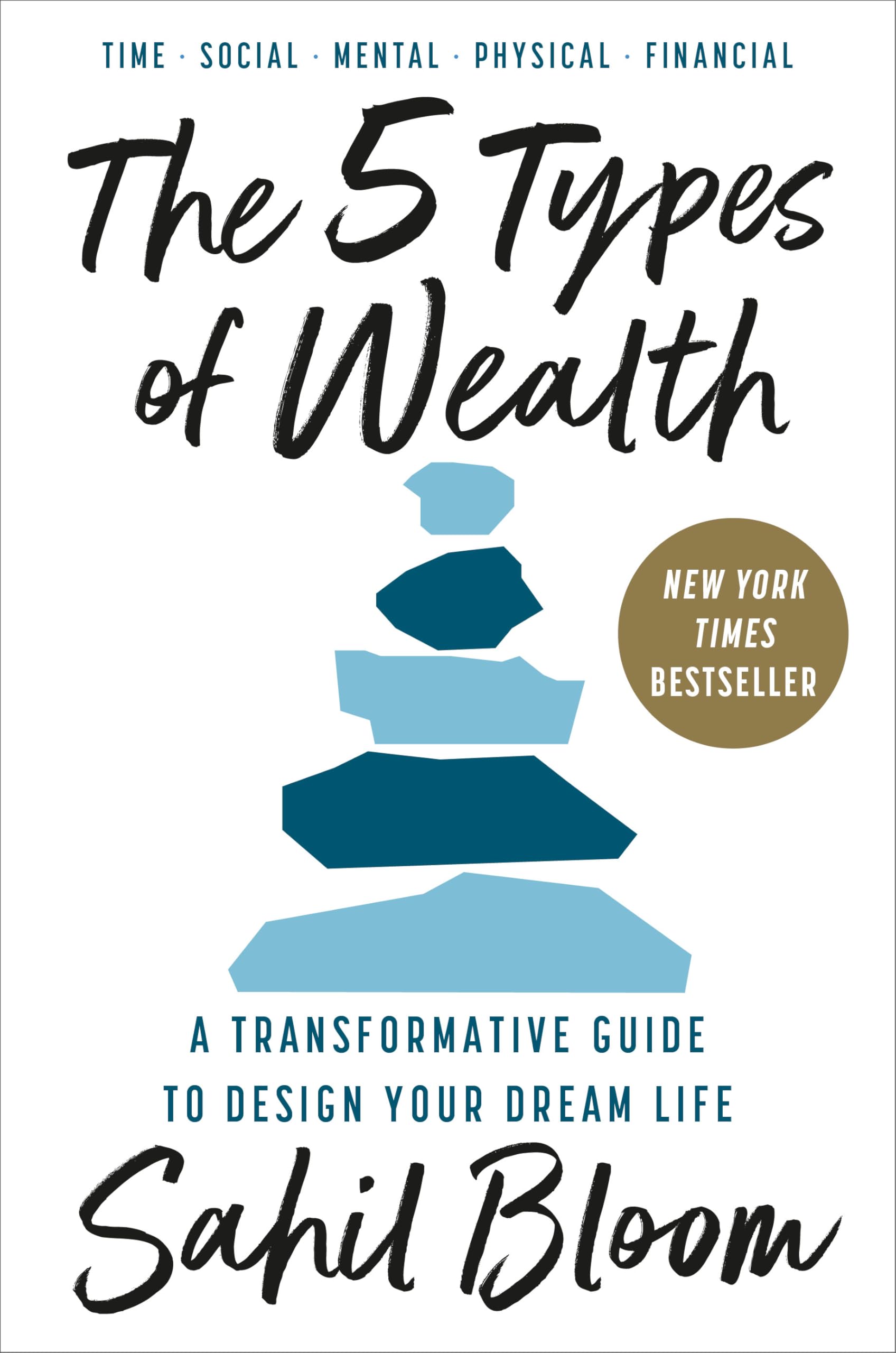
The 5 Types of Wealth: A Transformative Guide to Design Your Dream Life
About This Book
The 5 Types of Wealth by Sahil Bloom argues that most of us are keeping score with a broken scoreboard. We measure life almost entirely in money, and as a result our actions revolve around money alone — we "hit another quarterly profit target but miss another anniversary dinner." Bloom's central reframe is that a truly wealthy life is measured across five dimensions:
- Time Wealth — the freedom to choose how, where, and with whom you spend your time
- Social Wealth — depth, breadth, and earned (not bought) status in your relationships
- Mental Wealth — purpose, growth, and space for stillness
- Physical Wealth — movement, nutrition, and recovery
- Financial Wealth — income, expense management, and long-term investing, with "enough" as a conscious target
The book opens with a gut-punch realization — "From the outside looking in, I was winning, but if this was what winning felt like, I began to wonder if I was playing the wrong game" — and the discovery that everyone's ideal future day converges on the same things: time, people, purpose, and health, with money as an enabler, not an end.
From there it becomes intensely practical. Bloom introduces tools like the Life Razor (a single identity-defining rule), anti-goals, the Two-List Exercise, the Energy Calendar, the 1-1-1 journaling method, and Gottman's relationship research. He warns against the arrival fallacy and Pyrrhic victories, and reminds readers that relationship satisfaction at fifty is the single greatest predictor of health at eighty. The recurring theme: awareness of time's finiteness should reshape today's actions. "Your entire life can change in one year" — one year of measuring the right things and acting on them.
Key Takeaways
- 1.A broken scoreboard leads to broken actions — if you measure only money, all your actions revolve around it; fix the scoreboard to measure five types of wealth and your actions follow.
- 2.Money is an enabler, not an end; once baseline needs are met, more money is unlikely to meaningfully increase happiness.
- 3.Relationships are the strongest predictor of life satisfaction — relationship satisfaction at fifty predicts physical health at eighty better than cholesterol levels.
- 4.Awareness of time's finiteness is transformative: "No matter how many times you do something, there will come a day when you do it for the last time."
- 5.A Life Razor — one identity-defining rule — cuts through noise and keeps decisions aligned with who you are.
- 6.Pursue earned status, not bought status; respect won through hard-won achievement lasts, while purchased status symbols are fleeting.
- 7.High-leverage systems and anti-goals let you work smart, conserve energy for key moments, and avoid Pyrrhic victories where you win the battle but lose the war.
Top Highlights
Your wealthy life may be enabled by money, but in the end, it will be defined by everything else.
Highlighted by 6 people · 1 left a note
The arrival fallacy is the false assumption that reaching some achievement or goal will create durable feelings of satisfaction and contentment in our lives.
Highlighted by 4 people · 1 left a note
Time, people, purpose, health.
Highlighted by 4 people
Never let the quest for more distract you from the beauty of enough.
Highlighted by 4 people · 1 left a note
How many folks, in country and in town, Neglect their principal affair; And let, for want of due repair, A real house fall down, To build a castle in the air?[1]
Highlighted by 3 people
The victory damages the victor beyond repair. He wins the battle but loses the war.
Highlighted by 3 people
Your new scoreboard is the five types of wealth: Time Wealth Social Wealth Mental Wealth Physical Wealth Financial Wealth
Highlighted by 3 people · 1 left a note
“Despite not being at the end of your life, you may very well be nearing the end of your time with some of the most important people in your life.”
Highlighted by 3 people
had prioritized one thing at the expense of everything.
Highlighted by 2 people
From the outside looking in, I was winning, but if this was what winning felt like, I began to wonder if I was playing the wrong game.
Highlighted by 2 people
AI Review
Based on Glasp's analysis of highlights from 10 readers, this is a resonant, highly quotable book whose core reframe — measuring wealth across five dimensions — clearly landed with its audience. Reader engagement clusters strongly around its emotional, life-finiteness passages.
Pros
- +Memorable central framework of five types of wealth that gives readers a new scoreboard
- +Exceptionally quotable, with emotionally resonant lines on time, family, and finiteness
- +Rich set of practical tools — Life Razor, anti-goals, Energy Calendar, 1-1-1 method, Two-List Exercise
- +Grounded in credible research (the Harvard relationship study, Gottman, Dunbar, Morgan Housel)
- +Balances inspiration with concrete, level-by-level action plans across each wealth domain
Cons
- −Borrows heavily from familiar self-help and research sources, so some ideas feel derivative
- −The sheer volume of frameworks and lists can feel overwhelming or checklist-heavy
- −Light on rigorous new theory for readers seeking academic depth rather than application
Glasp AI analysis based on highlights from 10 readers.
Who Should Read This
Ambitious professionals, entrepreneurs, and high achievers who feel they're "winning" on paper yet sense something is missing. It speaks powerfully to anyone navigating work-life tension — parents weighing career against family time, people far from loved ones, or those who have hit financial milestones without lasting fulfillment. Readers who enjoy actionable self-improvement built on frameworks (think Atomic Habits or The Psychology of Money) will find a toolkit here. Less ideal for those seeking deep academic theory rather than practical exercises.
Frequently Asked Questions
What is The 5 Types of Wealth about?
Who is the book for?
What are the key lessons?
Is it worth reading?
What is a Life Razor?
What is the arrival fallacy?
What practical tools does the book offer?
How to Apply What You Read
- 1.Visualize your ideal day at eighty years old, then reverse-engineer the actions in your present life to move toward it.
- 2.Define your own Life Razor — a single controllable, ripple-creating, identity-defining rule — and use it to guide decisions.
- 3.Run the Energy Calendar exercise: color-code a week of activities as energy-creating, neutral, or draining, then amplify the green and cut the red.
- 4.Calculate how many times you'll likely see a loved one again, and let that number reshape how you prioritize time with them.
- 5.Write a letter to your future self describing the life you hope to be living, and use it as your true north.
Discussion Questions
- Q1.If you imagined your ideal day at eighty, what would you be doing, and who would be with you — and how does that compare to how you spend time now?
- Q2.Which of the five types of wealth are you neglecting most, and what would it cost you to keep ignoring it?
- Q3.What does "enough" mean to you financially, and how would naming it change your decisions?
- Q4.What would your own Life Razor be — the single rule that defines who you are and cuts through life's noise?
- Q5.Do you measure status by what you've earned or what you've bought, and how does that affect your relationships?
- Q6.Think of a recent "victory" that cost you something important — was it a Pyrrhic victory?
- Q7.Where in your life are you living on the deferred-happiness plan, postponing what matters for some imagined future?
Recommended Books

Revisit Your Highlights, Deepen Your Understanding
Import your Kindle highlights to review, organize, and share the ideas that matter most to you.
Get the free browser extension