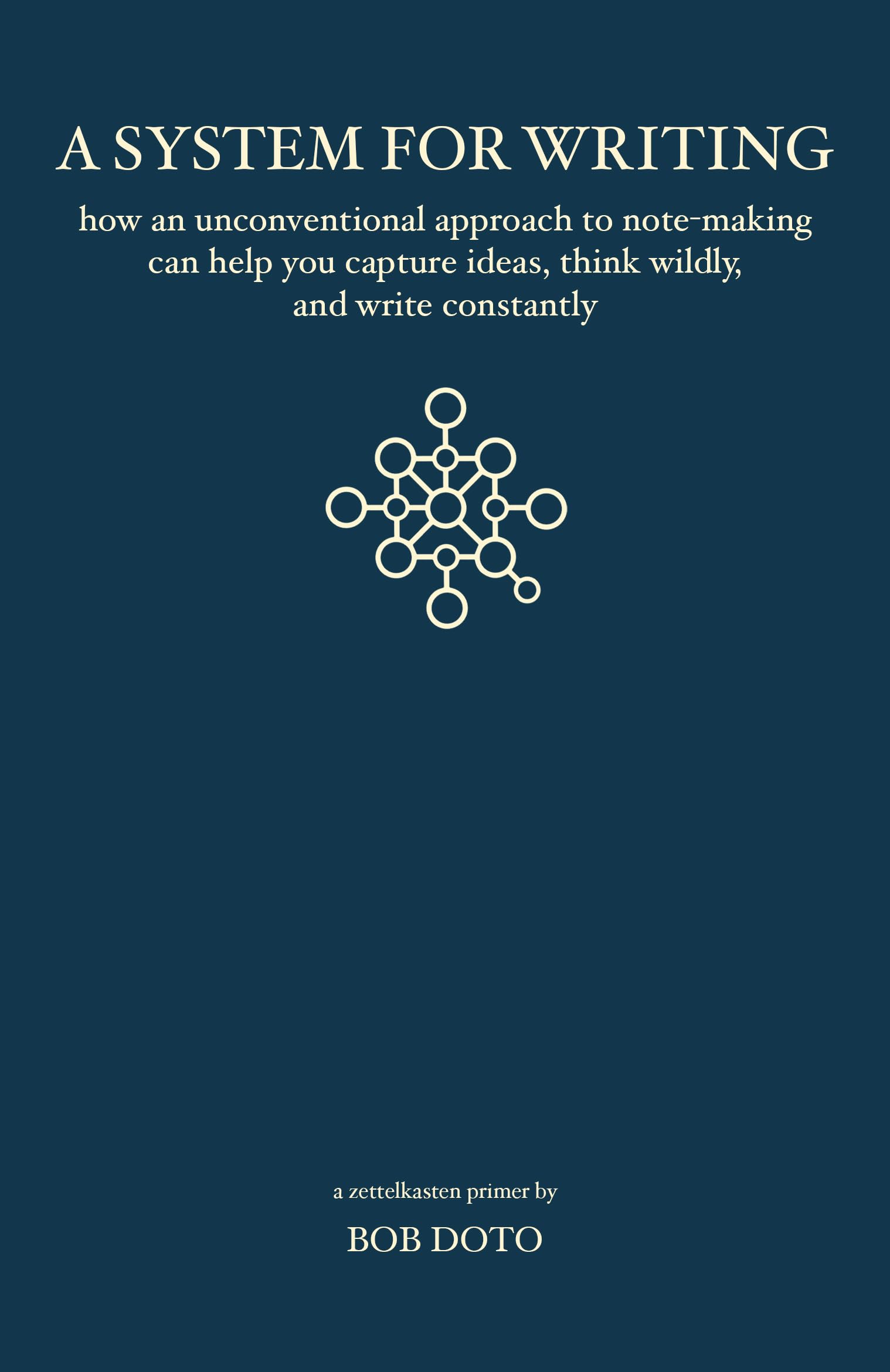
A System for Writing: How an Unconventional Approach to Note-Making Can Help You Capture Ideas, Think Wildly, and Write Constantly - A Zettelkasten Primer
About This Book
A System for Writing is a practical primer on the zettelkasten method, the note-making system popularized by sociologist Niklas Luhmann. The author frames the zettelkasten as both an object (a container of differentiated note-types) and a practice—"a thing and a way to do things"—built on David Allen's premise that "the mind is for having ideas, not holding them."
The book's core argument is a workflow that moves ideas from capture to publication:
- Capture passing thoughts as fleeting notes and source material as reference notes.
- Transform worthy captures into main notes—single, atomic ideas paired with at least one contextualized link to another note.
- Establish relationships between main notes, always stating why a connection exists.
- Track emerging threads with hub notes, structure notes, and a keyword index.
- Turn these "trains of thought" into finished writing.
Central principles recur throughout: atomicity (reducing ideas to essentials makes them broadly reusable), the value of connection over storage, and developing ideas either "in light of" or "in spite of" what's already in the slip box. The author stresses that notes need not be perfect or original—"let the connections reveal what's original"—and that the zettelkasten induces serendipity rather than mere retrieval.
Crucially, the book warns against letting the system write for you: "Your zettelkasten is a terrible writer." The final sections turn practical, covering inboxes, "sleeping" folders, interstitial journaling, mutable outlines, and project management. Writing, the author insists, must take priority—"become a writer first and a note maker second." The result is a hands-on guide that situates note-making inside a larger "triangle of creativity": reading, thinking, writing, and publishing in a continuous loop.
Key Takeaways
- 1.A zettelkasten is both an object and a practice—it can take months or years to appreciate, so treat it as ongoing devotion, not a quick setup.
- 2.Atomicity is the engine: reducing each note to a single essential idea makes it sensitive to context and broadly reusable across different trains of thought.
- 3.Connections only have value when you state the reason for them; an unexplained "see" link will be forgotten and lose its meaning.
- 4.Ideas develop either in light of or in spite of what's already stored—both paths are valid, and you link afterward in the second case.
- 5.Titles should be declarative statements (a condensed thesis), not topic descriptors, which makes ideas clearer and easier to dedupe.
- 6.The zettelkasten induces serendipity—finding what you weren't looking for—rather than serving as a database for retrieving individual facts.
- 7.Writing must take priority: become a writer first and a note maker second, and reframe captured ideas for each specific piece.
Top Highlights
Other elements that can be included in your main notes are: a title a quote or reference to where the idea comes from a record pointing to where and how the idea has been used in your writing a unique
Highlighted by 3 people
To process your inbox, take out or open one of the notes contained inside.
Highlighted by 3 people · 1 left a note
If the idea is unrelated to anything else, edit the idea so it’s readable, and import it without linking the idea to others.
Highlighted by 3 people
Atomicity Creates Possibility The reason we’re able to relate ideas within different trains of thought is due, in part, to atomization, the practice of reducing ideas to their essential points.
Highlighted by 3 people
leverage chaos.
Highlighted by 3 people
Every piece of writing I work on is supported by two documents: a daily journal and a creative log. The daily journal is broad in scope, including a record of the writing I completed, as well as tasks and thoughts unrelated to my creative work. Creative logs are used to track progress only on my writing. These two record-keeping systems work in tandem.
Highlighted by 3 people
“The mind is for having ideas, not holding them.”7 Taken
Highlighted by 2 people
1.4 Stage Your Fleeting Notes in an Inbox
Highlighted by 2 people
What Is a Reference Note? A reference note is a single long-note containing brief citations or “references” to what caught your attention while reading a book, listening to a podcast, watching a video, or having a conversation.15 These long-notes are stored in your zettelkasten sometimes in a separate section or folder.
Highlighted by 2 people
reference notes act as a bridge between source material and the main compartment in your zettelkasten
Highlighted by 2 people
AI Review
Based on Glasp's analysis of highlights from 4 readers, this is a clear, well-structured zettelkasten primer whose most-shared passages cluster tightly around the practical mechanics of main notes, linking, and atomicity.
Pros
- +Concrete, step-by-step workflow from fleeting notes to finished writing
- +Strong emphasis on atomicity and contextualized links as the source of value
- +Honest reminder that the zettelkasten is a terrible writer—the human must do the work
- +Practical extras like interstitial journaling, sleeping folders, and mutable outlines
- +Grounded in Luhmann's actual practice while remaining accessible to beginners
Cons
- −Some readers questioned whether note-types are over-engineered versus simply searching or tagging
- −Heavy on system mechanics, which may feel procedural for those wanting more on the writing craft itself
Glasp AI analysis based on highlights from 4 readers.
Who Should Read This
This book suits writers, researchers, students, and knowledge workers who want a repeatable system for capturing ideas and producing finished work. It is ideal for those curious about or already experimenting with a zettelkasten but frustrated by abstract theory—the author favors concrete workflows over philosophy. Readers familiar with personal knowledge management tools (Obsidian, analog slip boxes) will get the most value, though newcomers will find the step-by-step structure approachable. Less useful for those seeking quick productivity hacks rather than a long-term practice.
Frequently Asked Questions
What is the book about?
Who is the book for?
What are the key lessons?
What is the difference between fleeting, reference, and main notes?
Does the zettelkasten do the writing for you?
Do main notes need to be original ideas?
Is it worth reading?
How to Apply What You Read
- 1.Set up an inbox plus a "sleeping" folder, and process your fleeting notes into main notes at least once a week.
- 2.Write declarative titles for every main note and add at least one contextualized link explaining why the connection exists.
- 3.Watch for the words "but" and "however" while note-making—when they appear, pause and ask whether the next thought deserves its own atomic note.
- 4.Adopt interstitial journaling to record what you completed and what you're about to do, clearing your mind between tasks and projects.
- 5.Treat your own past writing—blogs, comments, emails—as source material, parsing it into reusable main notes.
Discussion Questions
- Q1.Are fleeting notes simply the equivalent of highlights, and what is lost when you can't reverse a note back to its original context?
- Q2.When does the sheer quantity of notes start to degrade your idea space, like clutter in a basement or garage?
- Q3.Is the value in creating a keyword index or in using it—and why not just rely on full-text search?
- Q4.How do you decide whether an idea is "atomic enough" without making notes too simplistic or too complex?
- Q5.Does requiring context for every connection improve thinking, or does it add friction that discourages capture?
- Q6.The author warns the zettelkasten is a "terrible writer"—where is the line between using your notes and letting them dictate your writing?
- Q7.How might the principle of developing ideas "in spite of" what you already believe help you confront, rather than reinforce, your own assumptions?
Recommended Books



Revisit Your Highlights, Deepen Your Understanding
Import your Kindle highlights to review, organize, and share the ideas that matter most to you.
Get the free browser extension