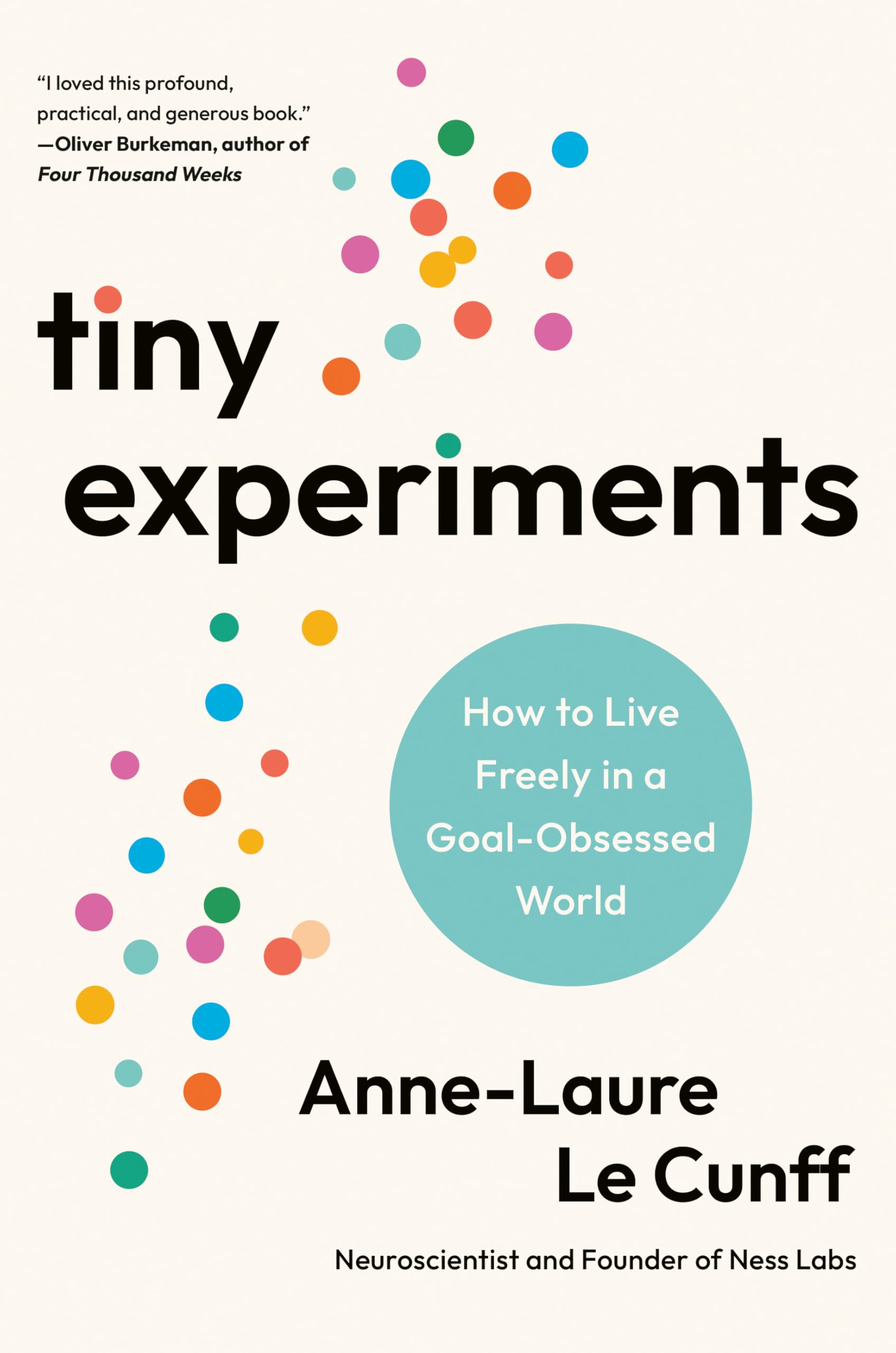
Tiny Experiments: How to Live Freely in a Goal-Obsessed World
About This Book
Tiny Experiments by Anne-Laure Le Cru challenges the dominant culture of rigid, linear goal-setting and offers an alternative built on curiosity and experimentation. The central argument is that fixed, ladder-style goals often aren't even our own—they stem from mimetic desire, copying what peers and society value—and they breed fear, competition, and toxic productivity while promising a false certainty.
In its place, the book proposes living an experimental life organized around a few core tools.
- The pact: a simple format ("I will [action] for [duration]") that focuses on outputs rather than outcomes, making success about showing up rather than hitting a number.
- Mindful productivity: managing your physical, cognitive, and emotional resources to cultivate Kairos moments—quality of time over quantity—using sequential focus instead of multitasking.
- The Triple Check (head, heart, hand) for diagnosing procrastination as a "listening failure" rather than a moral one.
- Plus Minus Next: a three-column reflection tool for turning action into learning.
The book reframes failure, quitting, and imperfection as data and adaptability rather than defeat—drawing on metacognition, the sunk-cost fallacy, kintsugi, and Stoic acceptance. It argues that confidence is built through action, that disruptions can be danced with rather than resisted, and that growth comes from completing trial-and-error loops with genuine reflection.
Finally, it widens the lens to community and generativity: surrounding yourself with fellow curious minds and creating value for others. Rather than chasing one singular purpose, Le Cru invites readers to treat life as a laboratory—running small, low-stakes experiments aligned with authentic curiosity, where there is no wrong choice, only learning.
Key Takeaways
- 1.Shift from outcome-based to process-based success—progress comes from incremental experimentation, not ticking off big goals.
- 2.Many of our goals are borrowed through mimetic desire; reclaiming curiosity means questioning whether they're truly ours.
- 3.A pact ("I will [action] for [duration]") relies on momentum, not motivation—success is simply showing up.
- 4.Mindful productivity is about being more present and managing energy, attention, and emotions to create Kairos moments rather than maximizing every minute.
- 5.Procrastination is a listening failure, not a character flaw—diagnose it through head, heart, and hand.
- 6.Growth requires completing the trial-and-error loop: action without reflection just keeps you busy.
- 7.Intentional imperfection and adaptability—pausing, pivoting, or persisting—matter more than chasing flawless, fixed plans.
Top Highlights
To live in Kairos time, we need to shift the focus from what we do with our time to how we experience each moment—what
Highlighted by 7 people · 1 left a note
Our goals are often not even our own;
Highlighted by 6 people · 1 left a note
Head: “Is the task appropriate?” Heart: “Is the task exciting?”
Highlighted by 5 people
Plus Minus Next, and it does what it says on the tin with just three columns; positive observations go in the first column (Plus), negative observations in the second column (Minus), and plans for what’s next in the last column (Next).[*]
Highlighted by 5 people
Linear goals stimulate fear.
Highlighted by 4 people
Linear goals encourage toxic productivity.
Highlighted by 4 people
Linear goals breed competition and isolation.
Highlighted by 4 people
When confronted with a stressful experience, our first instinct is to remove the stressor. And when we cannot eliminate the source of stress, we urgently seek activities that restore our sense of control—anything
Highlighted by 4 people
Your life doesn’t need to follow predictable acts and arcs. The best stories are full of surprises, with colorful characters and unexpected plot twists. To avoid recycling old stories, we need to break free from the scripts we write for ourselves.
Highlighted by 4 people · 1 left a note
What makes a pact so effective is that it focuses on your outputs (e.g., “publish 25 newsletters over the next 25 weeks”) rather than your outcomes (e.g.,
Highlighted by 4 people
AI Review
Based on highlights from 11 readers, Tiny Experiments shows strong consensus around its central reframe—process over outcome—with widely shared, quotable passages and overwhelmingly positive, applied notes.
Pros
- +Strong consensus on its central idea of mindful productivity over doing more
- +Highly practical, repeatable tools like the pact, Triple Check, and Plus Minus Next
- +Compassionate, reframing approach to procrastination, failure, and imperfection
- +Grounded in research and philosophy (mimetic desire, Kairos, metacognition, Stoicism)
- +Reader notes show ideas readily applied to real projects and lives
Cons
- −Open-ended, process-first philosophy offers little for those wanting fixed outcomes
- −Readers themselves question how to balance persistence versus pivoting ("quitters never win")
- −Some concepts overlap with other popular productivity and habit books
Glasp AI analysis based on highlights from 11 readers.
Who Should Read This
This book suits knowledge workers, creators, and entrepreneurs who feel burned out by hustle culture, OKRs, and ever-climbing goal ladders. It speaks to anyone in a liminal or transitional phase—career pivots, post-graduation drift, or creative blocks—who wants a gentler, curiosity-led framework. Readers drawn to productivity, psychology, and personal-development titles (think Atomic Habits or Four Thousand Weeks) will find practical, low-stakes tools. Those who want guaranteed outcomes or rigid step-by-step plans may find its open-ended, process-first philosophy less satisfying.
Frequently Asked Questions
What is Tiny Experiments about?
Who is this book for?
What are the key lessons?
What is a pact and how is it different from a habit or resolution?
How does the book suggest dealing with procrastination?
Is Tiny Experiments worth reading?
What does the book say about quitting and failure?
How to Apply What You Read
- 1.Write one pact in the form "I will [action] for [duration]"—start with a tiny, ten-day version aligned with your genuine curiosity.
- 2.Run the Triple Check next time you procrastinate: ask whether the task is appropriate (head), exciting (heart), and doable (hand).
- 3.Track your energy levels for a week and color-code your calendar to protect your magic windows and use sequential focus.
- 4.Reflect weekly with the Plus Minus Next tool—note what worked, what didn't, and what you'll do next.
- 5.Build a curiosity circle by investing in deeper relationships and sharing your experiments openly with like-minded people.
Discussion Questions
- Q1.Which of your current goals are truly your own, and which did you borrow from peers, social media, or society?
- Q2.Where in your life are you climbing a linear ladder when an experimental loop might serve you better?
- Q3.Think of a recent bout of procrastination—was it coming from your head, heart, or hand, and what was it trying to tell you?
- Q4.How do you personally balance persistence with pivoting—when does "showing up consistently" become clinging to a sunk cost?
- Q5.What would change if you measured success by showing up rather than by outcomes and numbers?
- Q6.Where could you practice intentional imperfection to enable sustainable excellence elsewhere?
- Q7.Who is in your curiosity circle, and how might sharing your experiments more openly change your trajectory?
Recommended Books



Revisit Your Highlights, Deepen Your Understanding
Import your Kindle highlights to review, organize, and share the ideas that matter most to you.
Get the free browser extension