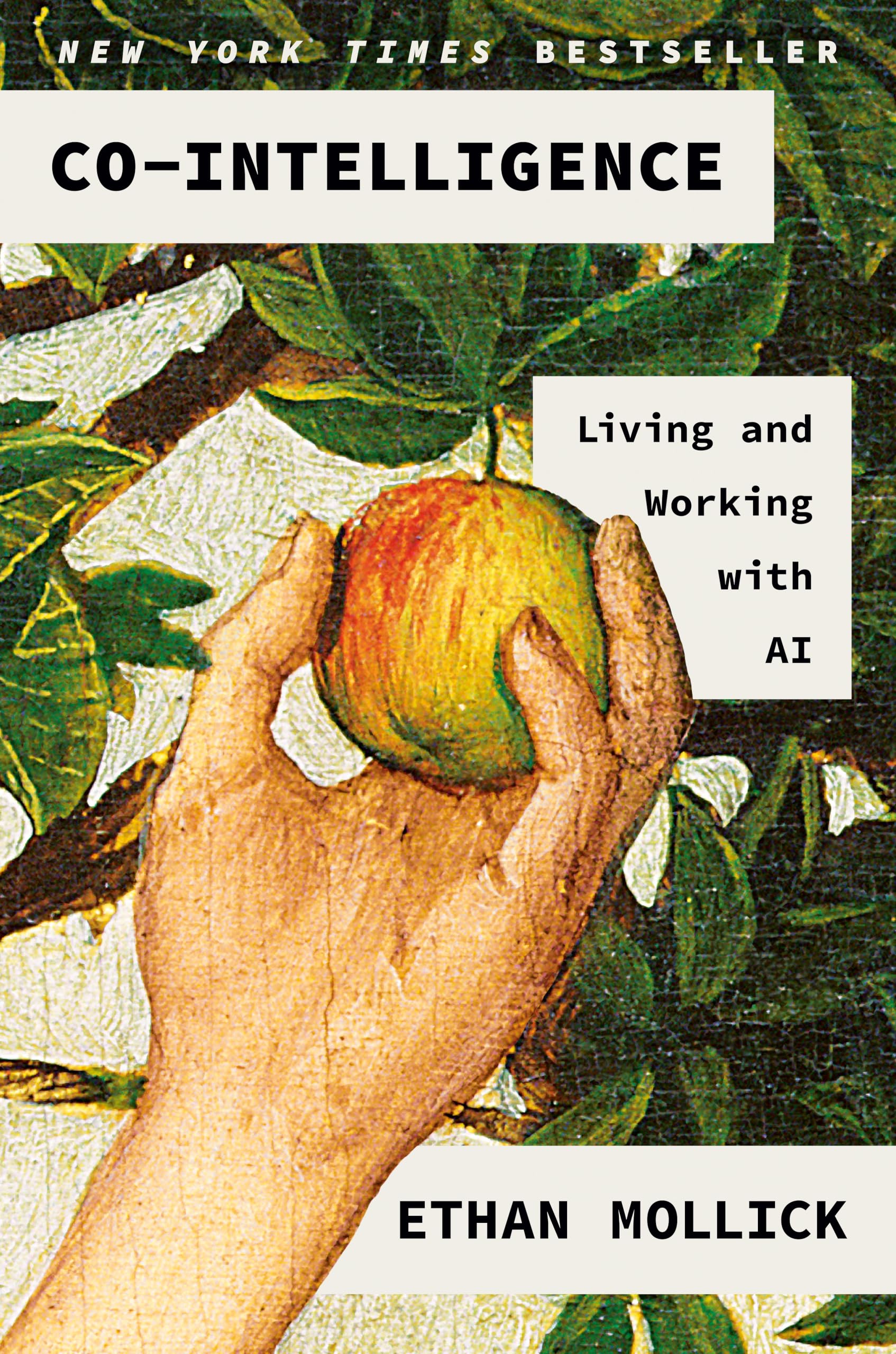
Co-Intelligence: Living and Working with AI


About This Book
Co-Intelligence by Ethan Mollick is a practical guide to living and working alongside generative AI, written not by a computer scientist but by a Wharton professor who studies how technologies are actually used. Mollick frames AI as a General Purpose Technology—on par with steam power or the internet, and possibly bigger—that already delivers 20 to 80 percent productivity gains across jobs from coding to marketing.
The book is organized around four guiding principles:
- Always invite AI to the table.
- Be the human in the loop.
- Treat AI like a person (but tell it what kind of person it is).
- Assume this is the worst AI you will ever use.
Mollick explains the technical foundations accessibly—Transformers, the attention mechanism, prediction of the next token, weights, and Reinforcement Learning from Human Feedback (RLHF)—while stressing that AI does not truly "know" anything and will hallucinate confidently because "make you happy" often beats "be accurate."
He introduces the Jagged Frontier: AI is unexpectedly brilliant at some tasks and surprisingly poor at others, and the only way to learn its shape is through hands-on experimentation. He distinguishes Centaur work (a clear division of labor between human and machine) from Cyborg work (deep integration), and warns of "falling asleep at the wheel" when we over-trust capable AI.
The later chapters explore AI as coworker, teacher, expert, and companion—covering creativity, the "Homework Apocalypse," the future of expertise, work redesign, and alignment risks. Mollick urges readers to build human expertise rather than outsource thinking, and closes with four scenarios for how the AI age might unfold, from stagnation to exponential, machine-driven change.
Key Takeaways
- 1.AI is a General Purpose Technology like steam or the internet, already delivering 20–80% productivity gains across many jobs.
- 2.Use the four principles: invite AI to everything, stay the human in the loop, treat it like a person, and assume it's the worst you'll ever use.
- 3.AI maps an uneven Jagged Frontier—you must experiment to learn what it does well and where it fails.
- 4.LLMs don't "know" anything; they predict the next token and will hallucinate confidently because pleasing you beats being accurate.
- 5.Over-trusting capable AI causes "falling asleep at the wheel"—skill and judgment erode when humans stop paying attention.
- 6.Working with AI as a Centaur or Cyborg combines human strengths with machine speed, but humans must keep providing oversight and ethics.
- 7.Building deep human expertise matters more, not less, because only experts can effectively check and direct AI output.
Top Highlights
Principle 1: Always invite AI to the table. You should try inviting AI to help you in everything you do, barring legal or ethical barriers. As you experiment, you may find that AI help can be satisfying, or frustrating, or useless, or unnerving. But you aren’t just doing this for help alone; familiarizing yourself with AI’s capabilities allows you to better understand how it can assist you—or threaten you and your job. Given that AI is a General Purpose Technology, there is no single manual or instruction book that you can refer to in order to understand its value and its limits.
Highlighted by 7 people · 1 left notes
Principle 3: Treat AI like a person (but tell it what kind of person it is).
Highlighted by 7 people
AI is what those of us who study technology call a General Purpose Technology (ironically, also abbreviated GPT). These advances are once-in-a-generation technologies, like steam power or the internet, that touch every industry and every aspect of life. And, in some ways, generative AI might even be bigger.
Highlighted by 5 people
The Transformer solved these issues by utilizing an “attention mechanism.” This technique allows the AI to concentrate on the most relevant parts of a text, making it easier for the AI to understand and work with language in a way that seemed more human.
Highlighted by 5 people
answers. That feedback is then used to do additional training, fine-tuning the AI’s performance to fit the preferences of the human, providing additional learning that reinforces good answers and reduces bad answers, which is why the process is called Reinforcement Learning from Human Feedback (RLHF).
Highlighted by 5 people
Principle 2: Be the human in the loop. For now, AI works best with human help, and you want to be that helpful human. As AI gets more capable and requires less human help—you still want to be that human. So the second principle is to learn to be the human in the loop.
Highlighted by 5 people
Early studies of the effects of AI have found it can often lead to a 20 to 80 percent improvement in productivity across a wide variety of job types, from coding to marketing. By contrast, when steam power, that most fundamental of General Purpose Technologies, the one that created the Industrial Revolution, was put into a factory, it improved productivity by 18 to 22 percent. And despite decades of looking, economists have had difficulty showing a real long-term productivity impact of computers and the internet over the past twenty years.
Highlighted by 4 people
After that, we can dive into how AI can change our lives by acting as a coworker, a teacher, an expert, and even a companion.
Highlighted by 4 people
Where AI works best, and where it fails, can be hard to know in advance. Demonstrations of the abilities of LLMs can seem more impressive than they actually are because they are so good at producing answers that sound correct, at providing the illusion of understanding. High test scores can come from the AI’s ability to solve problems, or it could have been exposed to that data in its initial training, essentially making the test an open book. Some researchers argue that almost all the emergent features of AI are due to these sorts of measurement errors and illusions, while others argue that we are on the edge of building a sentient artificial entity. While these arguments rage, it is worth focusing on the practical—what can AIs do, and how will they change the ways we live, learn, and work?
Highlighted by 4 people
The latest AI boom started in the 2010s with the promise of using machine learning techniques for data analysis and prediction. Many of these applications used a technique called supervised learning, which means these forms of AI needed labeled data to learn from. Labeled data is data that has been annotated with the correct answers or outputs for a given task.
Highlighted by 3 people
AI Review
Based on Glasp's analysis of highlights from 9 readers, Co-Intelligence generates strong consensus as a clear, practical, and timely framework for working with AI, with reader notes overwhelmingly marking passages as "extremely important."
Pros
- +Memorable, actionable four principles for everyday AI use
- +Accessible explanation of how LLMs, Transformers, and RLHF actually work
- +The Jagged Frontier and Centaur/Cyborg concepts give a useful mental model
- +Grounded in real studies showing 20–80% productivity gains
- +Honest about risks: hallucination, over-reliance, bias, and alignment
- +Rich, concrete examples for writing, idea generation, and education
Cons
- −Fast-moving field means some specifics may date quickly, as one reader noted
- −Speculative final scenarios are necessarily uncertain
- −Light on deep technical detail for readers wanting machine-learning theory
Glasp AI analysis based on highlights from 9 readers.
Who Should Read This
This book suits knowledge workers, managers, educators, students, and entrepreneurs who want to use AI productively without a technical background. It is ideal for professionals deciding how AI affects their careers, teachers rethinking assignments after ChatGPT, leaders planning AI adoption, and anyone curious but uncertain about generative AI. No coding knowledge is required—Mollick deliberately writes for the practical user. Readers seeking deep technical machine-learning theory or definitive predictions about superintelligence may find it more accessible than exhaustive.
Frequently Asked Questions
What is Co-Intelligence about?
Who is the book for?
What are the key lessons?
Is Co-Intelligence worth reading?
What is the Jagged Frontier?
What's the difference between a Centaur and a Cyborg?
Does the book address AI's dangers?
How to Apply What You Read
- 1.Experiment with AI on every task that isn't barred by law or ethics to discover the shape of your own Jagged Frontier.
- 2.Assign AI a clear persona with context and constraints—tell it who it is and use step-by-step or chain-of-thought prompts for better results.
- 3.Verify AI output for hallucinations, fake citations, and subtle errors instead of pasting answers straight into your work.
- 4.Delegate tedious, low-stakes, easily checkable tasks to AI first, then move toward deeper Centaur and Cyborg collaboration.
- 5.Invest in your own expertise in a focused area so you remain the indispensable human who can guide and evaluate the AI.
Discussion Questions
- Q1.Which of Mollick's four principles do you find most useful, and which is hardest to follow in practice?
- Q2.Where does the Jagged Frontier lie in your own work—what does AI do surprisingly well, and where does it fail?
- Q3.Are you more of a Centaur or a Cyborg in how you work with AI, and why?
- Q4.How should schools and workplaces respond to the "Homework Apocalypse" and the temptation of "The Button"?
- Q5.If AI can mimic empathy and creativity, what tasks would you reserve as "Just Me" tasks, and why?
- Q6.How do we avoid "falling asleep at the wheel" while still capturing AI's productivity gains?
- Q7.Which of Mollick's future scenarios—stagnation, linear growth, or exponential change—do you find most plausible, and how should we prepare?
Recommended Books






Revisit Your Highlights, Deepen Your Understanding
Import your Kindle highlights to review, organize, and share the ideas that matter most to you.
Get the free browser extension