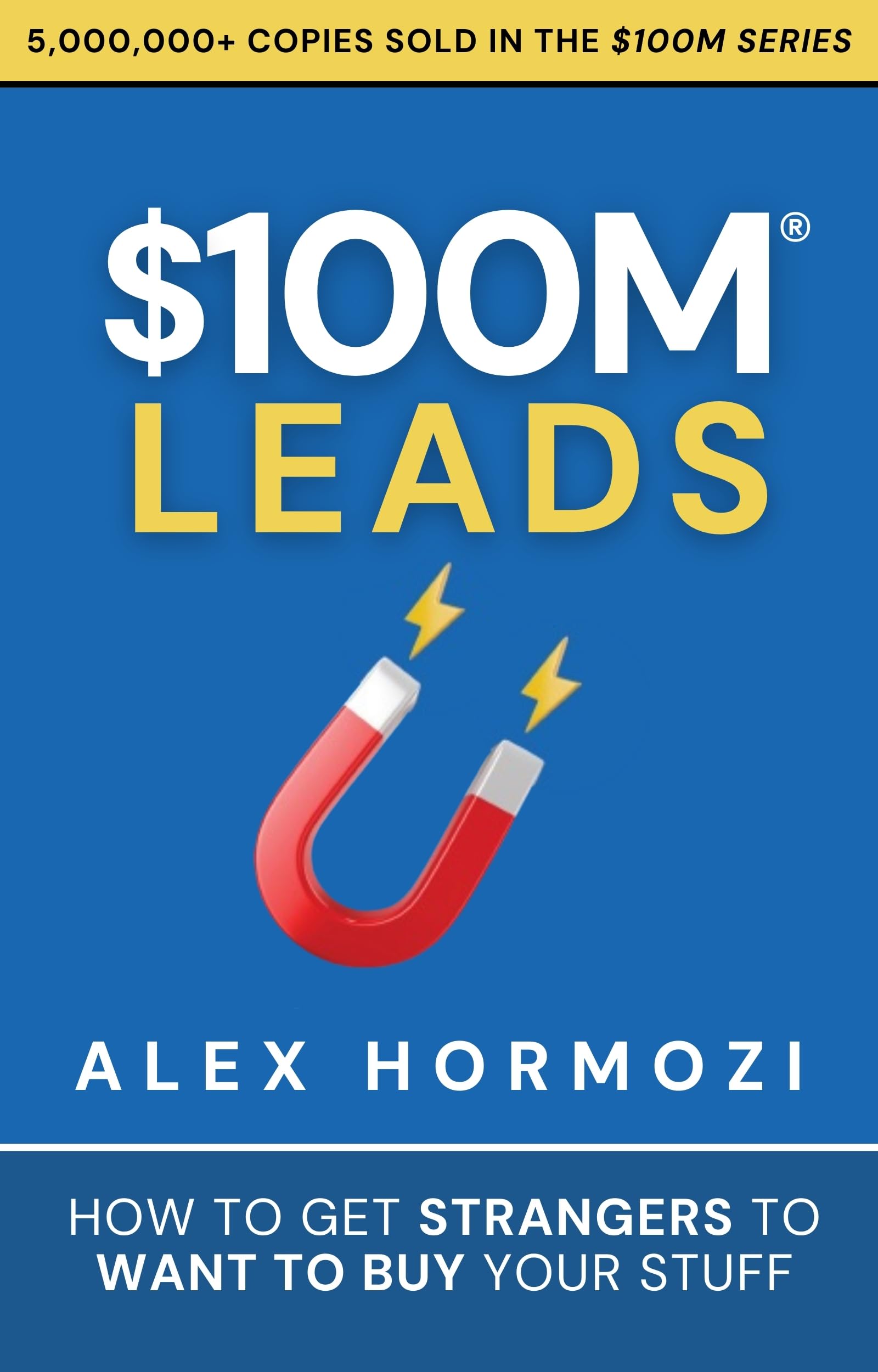
$100M Leads: How to Get Strangers To Want To Buy Your Stuff (Acquisition.com $100M Series)
About This Book
In $100M Leads, Alex Hormozi frames lead generation as a practical system for turning strangers into interested prospects. The core distinction readers highlighted most is between leads and engaged leads: a lead is simply someone you can contact, but an engaged lead is someone who has shown interest. That makes engaged leads—not raw contact volume—the real output of advertising.
The book’s main play is simple: when selling a higher-ticket or trust-dependent offer, don’t lead with the sale if a lead magnet can lower resistance. Hormozi defines a lead magnet as a complete solution to a narrow problem that also reveals the next problem your paid offer solves. The most resonant framework in the highlights is his step-by-step method:
- Pick a narrow, meaningful problem.
- Solve it in a way that naturally leads to your core offer.
- Deliver it via software, information, services, or physical products.
- Test the packaging, especially the headline.
- Make it easy to consume in multiple formats.
- Make it genuinely valuable.
- Add a clear CTA plus reasons to act now.
He organizes lead magnets into three types: reveal problems, samples/trials, and one step of a multi-step process. Across the highlights, readers repeatedly latched onto his insistence that free value should be strong enough to be paid for. The market judges your free material too, so weak freebies damage trust while excellent freebies create it.
From there, the book expands into the "core four" ways to get attention: warm outreach, content, cold outreach, and paid ads. The sequencing matters: start with people who know you, create content to warm future buyers, then scale into colder channels. Throughout, Hormozi emphasizes clear CTAs, ethical scarcity, urgency, repeated messaging, and high-volume testing. The throughline is that lead generation improves when you make value obvious, action easy, and the next step unmistakably clear.
Key Takeaways
- 1.Engaged leads matter more than leads because interest, not mere contactability, is what makes advertising useful.
- 2.A strong lead magnet solves a narrow, meaningful problem and naturally points people toward the next paid solution.
- 3.You should package lead magnets in multiple formats because ease of consumption can multiply engagement without changing the core idea.
- 4.Testing matters most at the packaging layer, especially headlines, images, and subheadlines.
- 5.Free value is part of your reputation; weak freebies reduce trust, while exceptional freebies increase willingness to buy.
- 6.Clear CTAs outperform clever ones when they pair a direct next step with reasons to act now.
- 7.The four acquisition channels—warm outreach, content, cold outreach, and paid ads—work best when used in a deliberate sequence.
Top Highlights
Seven Steps To Creating an Effective Lead Magnet
Highlighted by 12 people · 1 left a note
problem you want to solve. Then, make sure your core offer can solve the next problem that comes up.
Highlighted by 11 people
lead is a person you can contact. That’s all. If you bought a list of emails, those are leads. If you get contact information from a website or database, those are leads. The numbers in your phone are leads. People on the street are leads. If you can contact them, they are leads.
Highlighted by 8 people
So your lead magnet should be valuable enough on its own that you could charge for it.
Highlighted by 8 people
One Step Of A Multi-Step Process.
Highlighted by 8 people
Physical Products:
Highlighted by 8 people
Action Step: Package your lead magnet in every way you can.
Highlighted by 8 people
Reasons to do it right now
Highlighted by 8 people
We start by picking a problem that’s narrow and meaningful. Then, solve it. And, like we just learned, when we solve one problem, a new problem reveals itself. Here comes the important part- if we can solve that new problem with our core offer, we’ve got a winner. This is because we solve this new problem in exchange for money. That’s it. Don’t overthink it.
Highlighted by 7 people · 1 left a note
people really can do it all themselves. But, they also reveal the time, effort, and sacrifice of doing it all. So you offer financial services to solve all that.
Highlighted by 7 people
AI Review
Glasp's AI analysis of 24 reader highlights suggests this is a highly resonant, execution-focused marketing book. The strongest consensus centers on its clear frameworks for lead magnets, CTAs, and outreach, with notes showing readers immediately applying the ideas to real businesses.
Pros
- +Clear definition of leads vs. engaged leads
- +Actionable framework for building lead magnets
- +Strong emphasis on solving narrow, meaningful problems
- +Practical advice on packaging offers in multiple formats
- +Memorable CTA guidance: be clear, not clever
- +Useful breakdown of warm outreach, content, cold outreach, and paid ads
- +Encourages testing headlines, names, and offer presentation
Cons
- −Tone can be blunt and repetitive
- −Some tactics prioritize volume and urgency over nuance
- −Less focused on brand-building subtleties than direct-response execution
Glasp AI analysis based on highlights from 24 readers.
Who Should Read This
This book is best for entrepreneurs, agency owners, consultants, coaches, local service businesses, and operators who need more qualified inbound interest. It is especially useful if you sell a higher-ticket offer, struggle to explain what makes your free offer compelling, or need a clearer acquisition system.
Readers with some basic marketing familiarity will get the most from it, but beginners can still use the frameworks because they are concrete and action-heavy. If you want practical steps for building lead magnets, improving outreach, and converting attention into conversations, this is a strong fit.
Frequently Asked Questions
What is the book about?
Who is the book for?
What are the key lessons in the book?
What are the three types of lead magnets?
Why does the book emphasize free value so much?
Is it worth reading?
What does the book say about calls to action?
How to Apply What You Read
- 1.Define one narrow, meaningful problem your ideal customer urgently wants solved.
- 2.Create a lead magnet that solves that problem and leads naturally into your core offer.
- 3.Package the same lead magnet in at least two or three formats such as text, video, audio, or a tool.
- 4.Test multiple headlines and names before scaling promotion.
- 5.Write a simple CTA that tells people exactly what to do and includes a real reason to do it now.
Discussion Questions
- Q1.How do you distinguish between a large list of leads and a smaller pool of genuinely engaged leads in your business?
- Q2.Which of the three lead magnet types best fits your offer, and why?
- Q3.What narrow problem could you solve for free that would naturally reveal a larger paid problem afterward?
- Q4.How much value is enough to give away before a free offer starts helping rather than hurting conversions?
- Q5.What makes a CTA feel clear and compelling instead of pushy or vague?
- Q6.Which of the core four channels should a small business prioritize first, and what would determine that choice?
- Q7.How can a business use scarcity and urgency ethically without undermining trust?
Recommended Books







Revisit Your Highlights, Deepen Your Understanding
Import your Kindle highlights to review, organize, and share the ideas that matter most to you.
Get the free browser extension