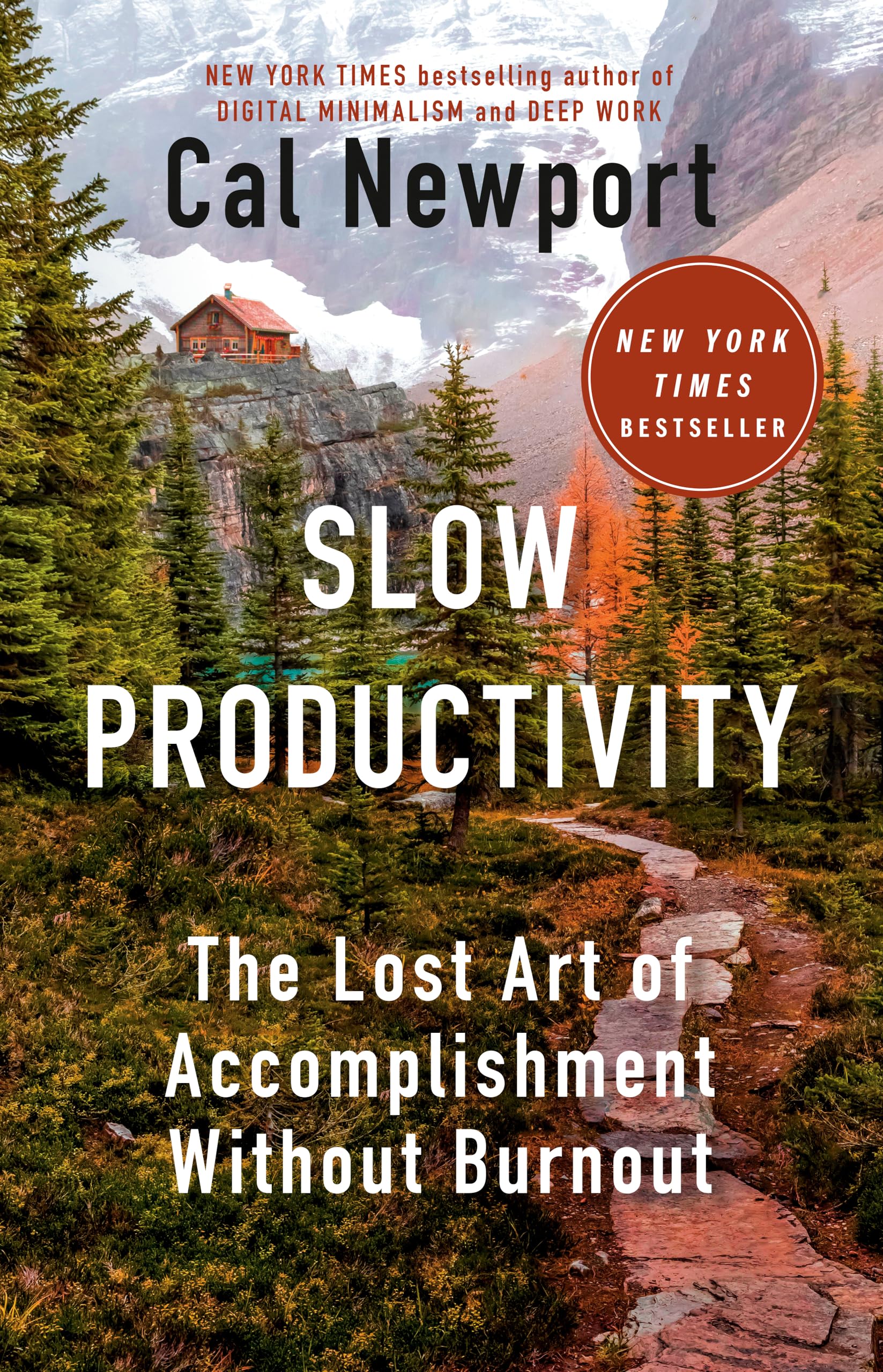
Slow Productivity: The Lost Art of Accomplishment Without Burnout
About This Book
In Slow Productivity, Cal Newport diagnoses a crisis in knowledge work: we have no agreed-upon definition of "productivity," so we default to what he calls pseudo-productivity — using visible activity (emails, meetings, busyness) as a crude proxy for real value. This visible-activity heuristic, inherited from factory-era thinking and amplified by email and Slack, drives the chronic overload and burnout wearing workers down.
Newport offers an alternative philosophy built on three principles.
- Do fewer things — reduce obligations to the point where you can accomplish them with time to spare, since every commitment carries an "overhead tax" of administrative chores that compounds and slows your core work.
- Work at a natural pace — let important work unfold over sustainable timelines, with variation in intensity, rather than grinding at constant frantic urgency.
- Obsess over quality — focus on producing impressive results, which over time earns you the freedom and credibility to work more sustainably.
Drawing on figures like John McPhee, Jane Austen, Galileo, Lin-Manuel Miranda, Ira Glass, and the Slow Food movement, Newport argues that genuine accomplishment is measured at the scale of years, not days. He supplies concrete tactics: scheduling projects on your calendar, limiting missions and daily goals to one major project, simulating "pull" workflows with holding tanks and active lists, doubling timelines, working in cycles, building rituals and dedicated work spaces, and containing small tasks via autopilot scheduling and office hours.
The through-line: slowing down isn't about protesting work — it's about finding a better way to do it. As McPhee put it, a drop in the bucket each day eventually fills it. Newport reframes productivity as something humane and durable rather than performative.
Key Takeaways
- 1.Pseudo-productivity — equating visible activity with real value — is the hidden engine behind chronic overload and burnout.
- 2.Every commitment carries an overhead tax of emails and meetings, so doing fewer things can paradoxically produce more results.
- 3.Working at a natural pace with varied intensity, not constant urgency, is both more humane and more economically effective for cognitive work.
- 4.An obsession with quality transforms simplicity from an option into an imperative — once you commit to doing something well, busyness becomes intolerable.
- 5.Productivity should be judged at the scale of years, not days; like McPhee's bucket, modest daily drops accumulate into great work.
- 6.Concrete control over your time — scheduling projects on your calendar and quantifying your workload — makes saying no defensible and sustainable.
- 7.Slowing down isn't about protesting work; it's about finding a better way to do it.
Top Highlights
this philosophy rejects busyness, seeing overload as an obstacle to producing results that matter, not a badge of pride. It also posits that professional efforts should unfold at a more varied and humane pace, with hard periods counterbalanced by relaxation at many different timescales, and that a focus on impressive quality, not performative activity, should underpin everything.
Highlighted by 6 people
PSEUDO-PRODUCTIVITY The use of visible activity as the primary means of approximating actual productive effort.
Highlighted by 6 people
PRINCIPLE #1: DO FEWER THINGS Strive to reduce your obligations to the point where you can easily imagine accomplishing them with time to spare. Leverage this reduced load to more fully embrace and advance the small number of projects that matter most.
Highlighted by 6 people · 1 left a note
A philosophy for organizing knowledge work efforts in a sustainable and meaningful manner, based on the following three principles:
Highlighted by 5 people
As the twentieth century progressed, this visible-activity heuristic became the dominant way we began thinking about productivity in knowledge work.
Highlighted by 5 people · 1 left a note
KNOWLEDGE WORK (GENERAL DEFINITION) The economic activity in which knowledge is transformed into an artifact with market value through the application of cognitive effort.
Highlighted by 5 people
To embrace slow productivity, in other words, is to reorient your work to be a source of meaning instead of overwhelm, while still maintaining the ability to produce valuable output.
Highlighted by 5 people
SIMULATED PULL, PART 2: INTAKE PROCEDURE
Highlighted by 5 people · 1 left a note
Obsess over the quality of what you produce, even if this means missing opportunities in the short term. Leverage the value of these results to gain more and more freedom in your efforts over the long term.
Highlighted by 5 people
The relentless overload that’s wearing us down is generated by a belief that “good” work requires increasing busyness—faster responses to email and chats, more meetings, more tasks, more hours.
Highlighted by 4 people
AI Review
Based on highlights from 11 readers, this is a strongly resonant book whose core framework — pseudo-productivity and the three principles — was repeatedly highlighted by the majority of readers, signaling clear consensus on its value.
Pros
- +Crisp, memorable central concept of pseudo-productivity that names a widely felt problem
- +Three clear, actionable principles: do fewer things, work at a natural pace, obsess over quality
- +Rich historical and biographical examples (McPhee, Austen, Galileo, Slow Food) that make abstract ideas vivid
- +Concrete tactics like the overhead tax, project scheduling, pull workflows, and doubling timelines
- +A genuinely humane reframe of productivity as sustainable rather than performative
Cons
- −Many strategies assume a degree of schedule autonomy that not all employees enjoy
- −Historical digressions can feel slow to readers seeking immediate practical advice
- −Some ideas overlap heavily with Newport's earlier Deep Work
Glasp AI analysis based on highlights from 11 readers.
Who Should Read This
This book is for knowledge workers — writers, programmers, marketers, academics, consultants — who feel chronically overloaded yet suspect busyness isn't producing their best work. It's especially valuable for freelancers, entrepreneurs, and managers with control over their schedules, and for anyone recovering from or fearing burnout. Readers of Newport's Deep Work will find a natural continuation. Those wanting purely tactical hacks may find the historical detours slow, but anyone seeking a sustainable philosophy of work will benefit.
Frequently Asked Questions
What is Slow Productivity about?
Who is this book for?
What are the key lessons?
What does Newport mean by pseudo-productivity?
How is this different from Deep Work?
Is it worth reading?
Do you need a flexible job to apply these ideas?
How to Apply What You Read
- 1.Schedule each new project on your calendar as you would a meeting; if there's no room, decline it or cancel something else.
- 2.Limit your active projects to three at most and work on at most one major project per day, using a holding tank for the rest.
- 3.Double your initial time estimates for important projects to escape the trap of unjustified optimism and frantic deadlines.
- 4.Contain small tasks with autopilot scheduling, office hours, and synchronization rituals so they stop eating your core work time.
- 5.Build distinctive rituals and dedicated work spaces, and pair intense work periods with corresponding rest to create sustainable seasonality.
Discussion Questions
- Q1.How does pseudo-productivity show up in your own work, and what visible-activity habits could you let go of?
- Q2.Which of the three principles — do fewer things, work at a natural pace, or obsess over quality — feels hardest to adopt in your situation, and why?
- Q3.Newport argues productivity should be measured over years, not days. How might that reframe change the way you evaluate your own progress?
- Q4.What is the real source of your overload — external demands, or your own anxiety acting as the fiercest taskmaster?
- Q5.How much autonomy do you actually have over your schedule, and which slow-productivity tactics could you realistically implement anyway?
- Q6.Where in your life have you confused efficiency with frenzy, and what would a slower, more deliberate approach look like?
- Q7.If you committed to obsessing over the quality of one core activity, what would you have to stop doing to make room for it?
Recommended Books


Revisit Your Highlights, Deepen Your Understanding
Import your Kindle highlights to review, organize, and share the ideas that matter most to you.
Get the free browser extension