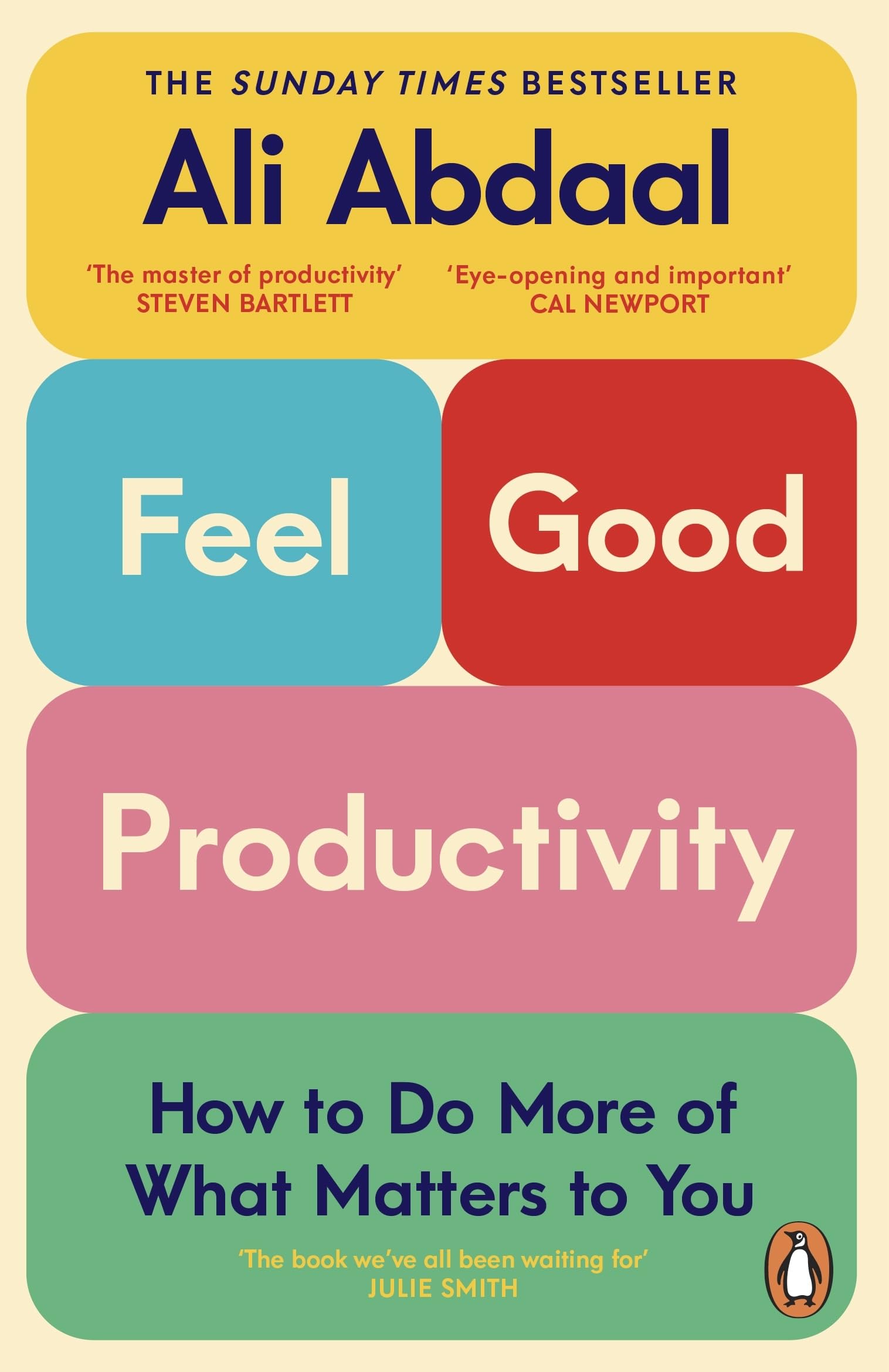
Feel-Good Productivity: How to Do More of What Matters to You (English Edition)





About This Book
Feel-Good Productivity by Ali Abdaal argues for a radical inversion of how we usually think about getting things done: success doesn't lead to feeling good; feeling good leads to success. Drawing on positive psychology — especially Barbara Fredrickson's broaden-and-build theory and the role of "feel-good hormones" (endorphins, serotonin, dopamine, oxytocin) — Abdaal makes the case that positive emotions create a virtuous cycle of energy, focus, creativity, and achievement.
The book is organized around a clear three-part framework.
- Energisers (Part 1): play, power, and people — the sources of positive emotion that fuel productivity.
- Blockers (Part 2): uncertainty, fear, and inertia — the obstacles behind procrastination.
- Sustainers (Part 3): conserve, recharge, and align — the practices that prevent the three types of burnout (overexertion, depletion, and misalignment).
Practical, repeatable tactics anchor each idea. Readers are drawn to the spirit of play: approaching work with a sense of adventure, finding daily "side quests," and asking "What would this look like if it were fun?" Abdaal distinguishes seriousness from sincerity and encourages lowering the stakes by reframing failure as data. For power, he draws on self-efficacy and self-determination theory, championing intrinsic motivation, "flipping the confidence switch," beginner's mind (shoshin), and learning by teaching. For people, he highlights vicarious mastery, the helper's high, and working in synchrony.
Tactical tools recur throughout: NICE goals, the five-minute rule, the "bias to action," "hell yeah or no," the Reitoff principle, and alignment quests tied to a wheel-of-life vision. The throughline is that wellbeing comes first and drives motivation second — a method for doing more of what genuinely matters to you, sustainably.
Key Takeaways
- 1.Feeling good leads to success, not the other way around — positive emotions broaden thinking and build lasting resources via Fredrickson's broaden-and-build theory.
- 2.Play is the first energiser: approach work with adventure, find the fun, and lower the stakes by treating failures as data points rather than verdicts.
- 3.Curiosity and side quests make work more enjoyable and help you focus longer — asking "What's today's side quest?" opens unexpected, valuable avenues.
- 4.Power comes from within: intrinsic motivation, self-efficacy, and a "choose to" mindset are far more sustainable than external rewards or coercion.
- 5.People energise us through vicarious mastery, the helper's high, working in synchrony, and teaching others — you can be a guide, not a guru.
- 6.Procrastination stems from three blockers — uncertainty, fear, and inertia — each beatable with reframing, affective labelling, and a bias to action.
- 7.Sustainable productivity requires actively conserving energy, genuinely recharging, and aligning work with your values to avoid the three burnouts.
Top Highlights
Curiosity doesn’t simply make our lives more enjoyable. It also allows us to focus longer. After painstakingly researching the biographies of some of history’s most pioneering minds, from Leonardo da Vinci to Steve Jobs, the writer Walter Isaacson summarised his findings thus:9 ‘Being curious about everything not only makes you more creative. It enriches your life.’ Curiosity doesn’t simply make our lives more enjoyable. It also allows us to focus longer.
Highlighted by 5 people
Curiosity doesn’t simply make our lives more enjoyable. It also allows us to focus longer.
Highlighted by 4 people
This is the ‘undoing hypothesis’: that positive emotions can ‘undo’ the effects of stress and other negative emotions. If stress is the problem, then feeling good might just be the solution.
Highlighted by 4 people
Those who cultivate positive emotions at work morph into better problem-solvers, planners, creative thinkers and resilient go-getters. They’re less stressed, attract higher evaluations from their superiors and show a higher degree of loyalty to their organisations.
Highlighted by 4 people
So, the first way to harness the potential of play is to integrate adventure into our lives.
Highlighted by 3 people
Seriousness is overrated. If you want to achieve more without ruining your life, the first step is to approach your work with a sense of play. There are three ways you can incorporate the spirit of play into your life. First, approach things with a sense of adventure. When you step into the right ‘play personality’, every day abounds with opportunities to see life as a game, filled with surprises and side quests. Second, find the fun. Remember Mary Poppins: there’s an element of fun in every task, even if it isn’t always obvious. Try asking yourself what this would look like if it were fun, and then build your projects around the answer. Third, lower the stakes. Failures are only failures when you think they are – and not every problem need be approached with such a straight face. So what would it mean to approach your work with less seriousness and more sincerity?
Highlighted by 3 people
All this means that these feel-good hormones are the starting point of a virtuous cycle. When we feel good, we generate energy, which boosts our productivity. And this productivity leads to feelings of achievement, which make us feel good all over again.
Highlighted by 3 people
Life is stressful. Play makes it fun. Play is our first energiser. Life is stressful. Play makes it fun. If we can integrate the spirit of play into our lives, we’ll feel better – and do more too.
Highlighted by 3 people
These are the eight ‘play personalities’ that Dr Brown distilled through his research. The Collector loves to gather and organise, enjoying activities like searching for rare plants, or rummaging around in archives or garage sales. The Competitor enjoys games and sports, and takes pleasure in trying their best and winning. The Explorer likes to wander, discovering new places and things they’ve never seen, through hiking, road tripping and other adventures. The Creator finds joy in making things, and can spend hours every day drawing, painting, making music, gardening and more. The Storyteller has an active imagination and uses their imagination to entertain others. They’re drawn to activities like writing, dance, theatre and role-playing games. The Joker endeavours to make people laugh, and may play by performing stand-up, doing improv, or just pulling a lot of pranks to make you smile. The Director likes to plan, organise and lead others, and can fit into many different roles and activities, from directing stage performances to running a company, to working in political or social advocacy. The Kinesthete finds play in physical activities like acrobatics, gymnastics and free running.
Highlighted by 3 people
I often think of my life as containing a series of side quests. Every day as I sit down to work, I look at my calendar and to-do list, and I ask myself: ‘What’s today’s side quest going to be?’ This question helps me shift my mindset from the obvious tasks that lie ahead to the potential alternative avenues they might take me down. It might prompt me to leave my office and spend a few hours working in a local coffee shop. Or it might encourage me to explore new software I could use to solve the problem I’m working on.
Highlighted by 3 people
AI Review
Based on highlights from 8 readers, this is a warmly received, highly quotable take on productivity, with strong consensus around the play, curiosity, and feel-good-emotions ideas. Glasp's analysis shows readers latched onto its memorable, immediately usable framing.
Pros
- +Strong reader consensus around the play and curiosity energisers, with multiple passages highlighted by half the readers
- +Memorable, actionable tools like the five-minute rule, side quests, and "What would this look like if it were fun?"
- +Clear, repeatable three-part structure (energisers, blockers, sustainers) that's easy to apply
- +Grounded in accessible positive psychology (broaden-and-build, self-determination, self-efficacy)
- +Reframes failure and burnout in a compassionate, low-stakes way
Cons
- −Concepts and studies are largely synthesized from existing work rather than original research
- −The relentlessly upbeat framing may feel light for readers wanting deeper academic rigor
Glasp AI analysis based on highlights from 8 readers.
Who Should Read This
Ideal for knowledge workers, students, creators, and entrepreneurs who feel busy yet drained and suspect that grind-harder advice isn't working. It suits readers curious about applying positive psychology to daily habits, anyone fighting procrastination or early-stage burnout, and fans of accessible, science-flavored self-improvement. No prior background is needed — Abdaal writes for beginners and explains each concept with stories and simple tools. Less suited to readers wanting dense academic rigor or entirely novel research.
Frequently Asked Questions
What is Feel-Good Productivity about?
Who is this book for?
What are the key lessons?
Is Feel-Good Productivity worth reading?
What is the difference between being serious and being sincere?
What are the three types of burnout described?
What practical techniques does the book offer?
How to Apply What You Read
- 1.Ask "What would this look like if it were fun?" before any draining task, and design a daily "side quest" to inject curiosity and play.
- 2.Apply the five-minute rule and the "next action step" question whenever inertia or procrastination sets in — just start, then decide.
- 3.Set NICE goals (near-term, input-based, controllable, energising) instead of distant, output-based targets.
- 4.Use "hell yeah or no" and opportunity-cost thinking to avoid overcommitment, and protect deeper rest with the Reitoff principle.
- 5.Define three daily alignment quests across health, work, and relationships, tied to a clear vision of who you want to become.
Discussion Questions
- Q1.Do you find it true in your own life that feeling good drives productivity, or does success have to come first for you to feel good?
- Q2.Which of the eight play personalities do you most identify with, and how could you bring it into your daily work?
- Q3.Where in your life are you being too serious when you could be more sincere — and what would lowering the stakes look like?
- Q4.How much of your motivation is intrinsic versus extrinsic, and where might that mismatch be quietly draining you?
- Q5.Which of the three blockers — uncertainty, fear, or inertia — most often stops you, and which tool from the book could counter it?
- Q6.Can you identify which type of burnout (overexertion, depletion, or misalignment) you're most at risk of, and why?
- Q7.How could working in synchrony with others, or teaching someone, change the way you experience your hardest tasks?
Recommended Books



Revisit Your Highlights, Deepen Your Understanding
Import your Kindle highlights to review, organize, and share the ideas that matter most to you.
Get the free browser extension