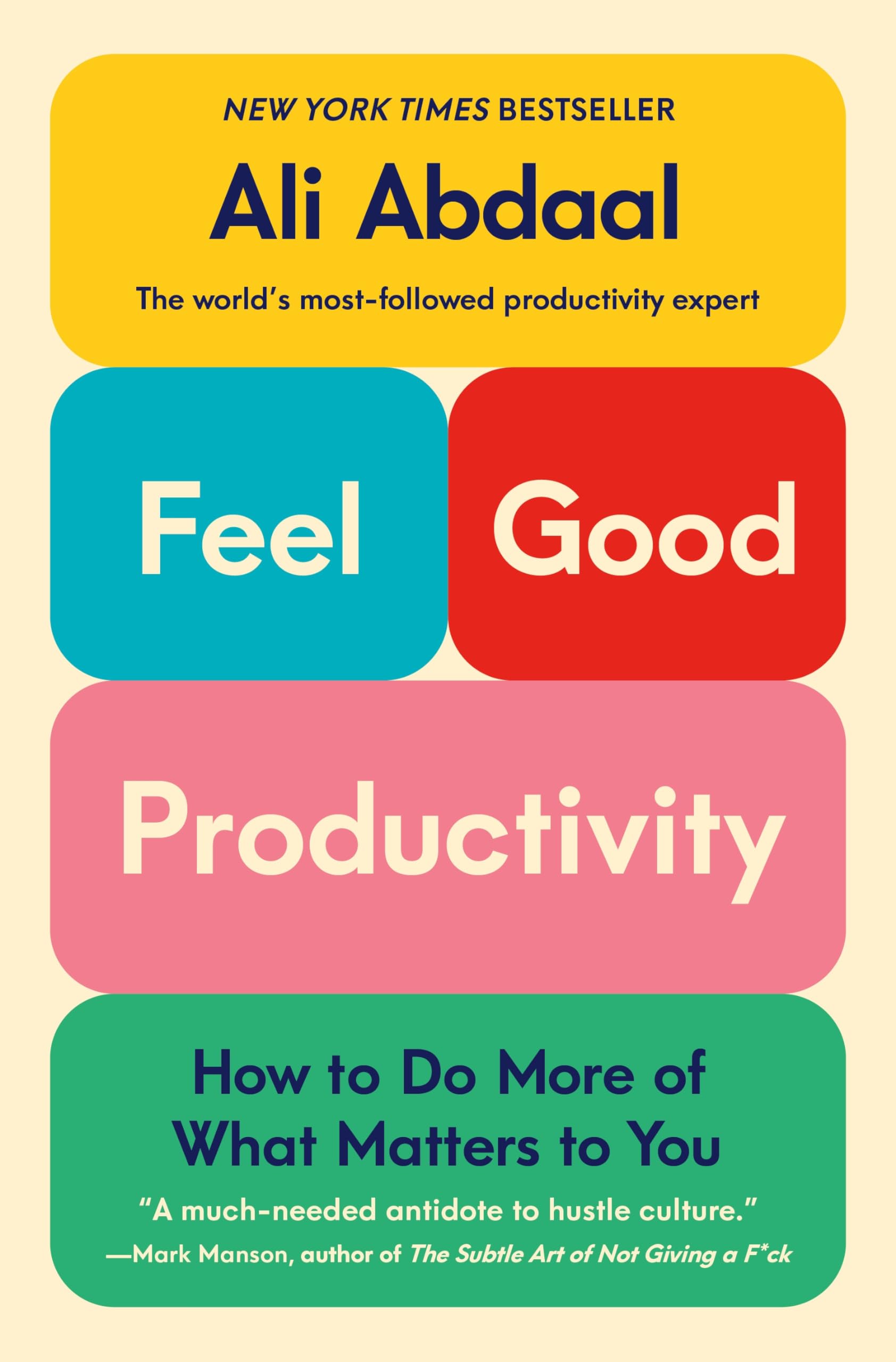
Feel-Good Productivity: How to Do More of What Matters to You
About This Book
Ali Abdaal’s central claim is simple but countercultural: productivity is not driven by suffering first and happiness later. Instead, feeling good is what makes sustained focus, creativity and meaningful output possible. The most-highlighted passages show strong reader resonance with the book’s reversal of the usual formula: success doesn’t lead to feeling good; feeling good leads to success.
The book is structured around a practical model. Part 1 introduces the science behind positive emotions and argues that they broaden awareness, reduce stress and build long-term resources like resilience, creativity and social connection. From there, Abdaal develops three core “energisers”:
- Play: bring more adventure, fun and low-stakes experimentation into work.
- Power: build self-efficacy through confidence, learning by doing and taking ownership of your process.
- People: use relationships, help-seeking, teamwork and positive communication as sources of energy.
The highlights suggest that readers especially valued the book’s tools for making work lighter without becoming careless. Memorable ideas include adopting a “play personality,” asking “What would this look like if it were fun?”, treating failure as data rather than defeat, and approaching work with “less seriousness and more sincerity.” Curiosity and “side quests” are framed as productivity tools, not distractions.
A second major thread is empowerment. Confidence is portrayed as learnable, not fixed. Readers repeatedly highlighted the “confidence switch,” vicarious mastery, beginner’s mind, the protégé effect, and the shift from “have to” to “choose to.” Together these ideas make productivity feel more agentic and less punitive.
The later structure, visible in the notes and summaries, expands into procrastination and burnout: uncertainty, fear and inertia block action, while overexertion, depletion and misalignment erode sustainability. Overall, the book argues that doing more of what matters requires designing a life that is energising, meaningful and emotionally sustainable.
Key Takeaways
- 1.Positive emotions are productive assets: they broaden thinking, reduce stress and build long-term resilience, creativity and social resources.
- 2.Play is not a distraction from serious work; it can make tasks more energising, enjoyable and sustainable.
- 3.Failure is a frame, not just an event: when you treat mistakes as data points, you keep experimenting instead of freezing.
- 4.Confidence is trainable through self-talk, observing others, practice and taking small ownership over your process.
- 5.Curiosity improves focus: side quests, beginner’s mind and playful exploration can deepen engagement rather than derail it.
- 6.Language shapes agency: shifting from “have to” to “choose to” can restore a sense of control and motivation.
- 7.People affect productivity emotionally: energising relationships, asking for help and communicating generously all support better work.
Top Highlights
No failure is ever just a failure. It’s an invitation to try something new.
Highlighted by 7 people
According to the broaden-and-build theory, positive emotions ‘broaden’ our awareness and ‘build’ our cognitive and social resources.
Highlighted by 6 people
Life is stressful. Play makes it fun.
Highlighted by 6 people
‘How can I approach this with a little less seriousness, and a little more sincerity?’
Highlighted by 6 people
Build refers to the long-term effects of positive emotions.
Highlighted by 5 people
Positive emotions are the fuel that drives the engine of human flourishing.
Highlighted by 5 people
This is the ‘undoing hypothesis’: that positive emotions can ‘undo’ the effects of stress and other negative emotions. If stress is the problem, then feeling good might just be the solution.
Highlighted by 5 people
Success doesn’t lead to feeling good. Feeling good leads to success.
Highlighted by 5 people
The Explorer likes to wander, discovering new places and things they’ve never seen, through hiking, road tripping and other adventures.
Highlighted by 5 people · 1 left a note
The Creator finds joy in making things, and can spend hours every day drawing, painting, making music, gardening and more.
Highlighted by 5 people · 2 left notes
AI Review
Glasp’s AI analysis of 14 reader highlights suggests a strongly positive consensus: readers repeatedly saved the book’s most actionable ideas on play, confidence and reframing failure. The highlight density around key passages indicates the book lands as both motivating and practically quotable.
Pros
- +Fresh productivity premise grounded in positive emotion rather than grind
- +Highly resonant, memorable lines about failure, play and confidence
- +Actionable mental reframes like “choose to,” “side quests,” and the confidence switch
- +Strong emphasis on curiosity, experimentation and intrinsic motivation
- +Helpful bridge between psychology research and everyday work habits
- +Encouraging tone that reduces shame around procrastination and failure
Cons
- −Some ideas are mindset reframes more than deeply original systems
- −Several concepts may feel familiar to readers of popular psychology and self-help
- −The highlights emphasize inspiration more than rigorous critique of limitations
Glasp AI analysis based on highlights from 14 readers.
Who Should Read This
This book is best for knowledge workers, students, creators, founders, managers and anyone who feels stuck between ambition and exhaustion. It’s especially useful if traditional productivity advice built on discipline, pressure and guilt has stopped working for you. You don’t need a psychology background, but you should be open to reframing work through wellbeing, play and self-efficacy rather than hustle alone. It also fits readers dealing with procrastination, self-doubt or early burnout.
Frequently Asked Questions
What is the book about?
Who is it for?
What are the key lessons?
Is it worth reading?
What are the Play Personalities?
How does the book suggest handling failure?
What does the book say about confidence?
How to Apply What You Read
- 1.Ask before your next dreaded task: “What would this look like if it were fun?”
- 2.Reframe one recent failure as a data point, then write down the next experiment it suggests.
- 3.Identify your likely play personality and redesign one routine task around it.
- 4.Switch your internal language from “have to” to “choose to” for a week and notice the effect on energy.
- 5.Teach someone a concept you are learning to activate the protégé effect and strengthen your own understanding.
Discussion Questions
- Q1.Why do so many people still believe productivity must come from pressure, even when positive emotion often works better?
- Q2.Which of the three energisers—play, power or people—seems most missing from your current work life?
- Q3.How might your relationship with failure change if you consistently treated it as information rather than defeat?
- Q4.What kind of play personality best fits you, and how could it realistically show up in your daily responsibilities?
- Q5.Does focusing on feeling good risk becoming avoidance, or can it genuinely lead to deeper discipline and better results?
- Q6.What is one area of your life where changing “have to” into “choose to” would make the biggest difference?
- Q7.How can teams create environments that are sincere and committed without becoming overly serious or high-stakes?
Recommended Books

Revisit Your Highlights, Deepen Your Understanding
Import your Kindle highlights to review, organize, and share the ideas that matter most to you.
Get the free browser extension