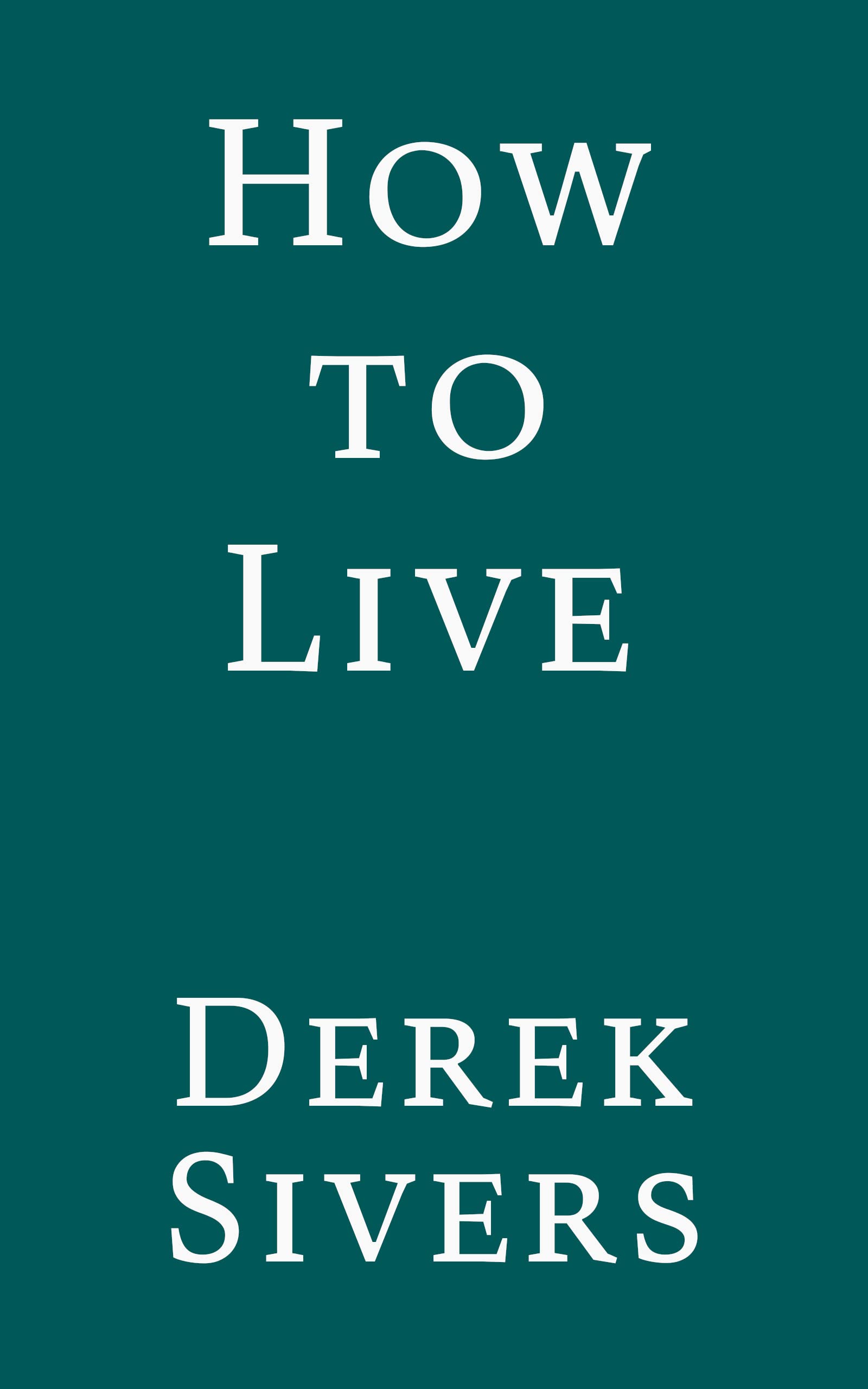
How to Live: 27 conflicting answers and one weird conclusion


About This Book
How to Live by Derek Sivers is a deliberately paradoxical book that offers 27 conflicting answers to the question of how to live — each chapter arguing its case so persuasively that it contradicts the others. The structure is the message: there is no single right way to live, yet each philosophy contains a usable truth.
Readers highlight several recurring themes that cut across the contradictions:
- Commitment over optionality: "decide" means "to cut off." Pick one path, irreversibly commit, and your divided self becomes powerful and focused.
- Mastery as the ultimate goal: the rich can't buy it, the impatient can't rush it, nobody can steal it. Pursue depth in one thing through daily ritual, not inspiration.
- Steer toward pain: everything good comes from discomfort, so use pain as a compass rather than avoiding it.
- Think long-term: humans are wired for the short term, so deliberately picture your future self and descendants; small actions compound over decades.
- Make memories: novelty is the antidote to time speeding up; document and turn experiences into stories so you can "live twice."
- Do nothing: silence, stillness, and removing beliefs that trouble you can dissolve most problems, since "most problems are really just situations."
Other chapters argue for full independence, spreading your seeds widely, valuing what is Lindy (timeless), laughing at life's absurdity, and being a great ancestor. Sivers presents each stance without hedging, trusting the reader to notice the friction.
The "weird conclusion" is that all answers are simultaneously true and false — wisdom lies in choosing the frame that serves your present moment. The book is less a prescription than a thinking tool: a set of lenses to try on, knowing each reveals something the others hide.
Key Takeaways
- 1.Commitment beats optionality — "decide" means "to cut off," and dedicating yourself to one choice makes it the best choice.
- 2.Mastery is the ultimate goal because no one can buy, rush, inherit, or steal it; pursue one thing through daily ritual, not inspiration.
- 3.Steer toward pain as a compass — everything good comes from discomfort, and choosing it strips away its power.
- 4.Think long-term: humans are wired for the short term, so deliberately picture your future self and let small actions compound over decades.
- 5.Combat the speeding-up of time with novelty — make memories, document them, and turn experiences into stories to "live twice."
- 6.Most problems are really just situations — change the belief or attitude rather than the circumstance.
- 7.The deepest truth is that all answers conflict and coexist — wisdom is choosing the frame that serves your present moment.
Top Highlights
People at the end of their life, who said they were the happiest with their life, were the ones who had spent the most time in the flow of fascinating work.
Highlighted by 4 people
Commit to your habits to make them rituals. If it’s not important, never do it. If it’s important, do it every day.
Highlighted by 3 people
Most of what people say and do is unnecessary. Most talk is just noise. The English word “noise” comes from “nausea”. Say nothing unless it must be said. People will appreciate your silence, and know that when you speak, it must be important. Shallow rivers are noisy. Deep lakes are silent. Silence is precious. Silence is the one thing that all religions have in common. Silence is the only way to hear quiet wisdom. Most trouble is caused by action. No action, no trouble. Most actions are a pursuit of emotions. You think you want to take action or own a thing. But what you really want is the emotion you think it’ll bring.
Highlighted by 3 people
When a problem is bothering you, it feels like you need to do something about it. Instead, identify what belief is really the source of your trouble. Replace that belief with one that doesn’t bother you. Then the problem is solved. Most problems are really just situations.
Highlighted by 3 people
understand something very counter-intuitive about goals. Goals don’t improve your future. Goals only improve your present actions. A good goal makes you take action immediately. A bad goal doesn’t. A goal shows what’s right and wrong. What moves you towards your goal is right. What doesn’t is wrong.
Highlighted by 3 people
You need ritual, not inspiration. Every day, no matter what, you must practice. Your practice ritual is your highest priority — an unbreakable commitment. Stubbornly protect this time against the demands of the world.
Highlighted by 3 people
But if you avoid pain, you avoid improvement. Avoid embarrassment, and you avoid success. Avoid risk, and you avoid reward.
Highlighted by 3 people
When you’re young, time goes slowly because everything is new. When you get older, time flies by, forgotten, because you’re not having as many new experiences. You need to prevent this. Monotony is the enemy. Novelty is the solution. Go make memories. Do memorable things. Experience the unusual. Pursue novelty. Replace your routines. Live in different places. Change your career every few years. These unique events will become anchors for your memories. Remember them all. Document everything, or you’ll eventually forget it. Nobody can erase your memories, but don’t lose them through neglect. Journal every day. Write down your activities, thoughts, and feelings for future reference. Video everything. Compile and edit them, so they’re appealing to watch.
Highlighted by 3 people · 1 left notes
You can’t be free without self-mastery. Your past indulgences and habits might be addictions. Quit a harmless habit for a month, just to prove you can.
Highlighted by 2 people
Focus your attention on the few things you’re committed to, and nothing else.
Highlighted by 2 people
AI Review
Based on highlights from 4 readers, this is a densely quotable book whose punchy, contradictory aphorisms resonate strongly — though its deliberate self-contradiction means readers must do the synthesizing.
Pros
- +Extremely quotable and concise — nearly every line is highlight-worthy
- +Forces genuine reflection through deliberate contradiction
- +Strong, repeatedly-highlighted themes of commitment and mastery
- +Practical reframing tools like steering toward pain and zooming out on problems
- +Fast to read yet rewards rereading from different angles
Cons
- −The conflicting answers can frustrate readers wanting one clear path
- −Aphoristic style sometimes oversimplifies complex life questions
- −A few prescriptions (e.g. climate-relocation, stage names) feel idiosyncratic
Glasp AI analysis based on highlights from 4 readers.
Who Should Read This
Ideal for readers who enjoy philosophy as a practical toolkit rather than a rigid doctrine — people wrestling with big life decisions about career, relationships, or where to live. It suits fans of Stoicism, minimalism, and self-direction who appreciate brevity and provocation over comfort. Coaches, entrepreneurs, and creatives chasing mastery will find usable frameworks. Less suited to readers wanting a single clear program; the deliberate contradictions can frustrate those seeking definitive answers.
Frequently Asked Questions
What is How to Live about?
Who is this book for?
What are the key lessons?
Is it worth reading?
Why does the book contradict itself on purpose?
What does Sivers mean by mastery being the best goal?
How does the book suggest handling problems and emotions?
How to Apply What You Read
- 1.Pick one commitment — a career, relationship, or craft — and irreversibly commit to it instead of keeping options open.
- 2.Ritualize a daily practice in the thing you want to master and protect that time as unbreakable.
- 3.Write down any problem that bothers you, identify the underlying belief, and replace it with one that doesn't trouble you.
- 4.Document your experiences daily and reshape memorable ones into stories you can retell.
- 5.Picture your future self and descendants when making decisions, and act now for long-term compounding benefit.
Discussion Questions
- Q1.Which of the 27 philosophies resonated most with you, and which felt most wrong?
- Q2.Do you agree that commitment, not better options, is what makes a choice great?
- Q3.Is steering toward pain genuinely wiser than avoiding it, or can it become self-punishment?
- Q4.How do you balance the book's call for total focus with its call to pursue novelty and many experiences?
- Q5.Is mastery truly the best goal in life, or does it crowd out other forms of fulfillment?
- Q6.Can most problems really be solved by changing a belief rather than the situation itself?
- Q7.What does the book's contradictory structure teach us about seeking single answers to life?
Recommended Books


Revisit Your Highlights, Deepen Your Understanding
Import your Kindle highlights to review, organize, and share the ideas that matter most to you.
Get the free browser extension