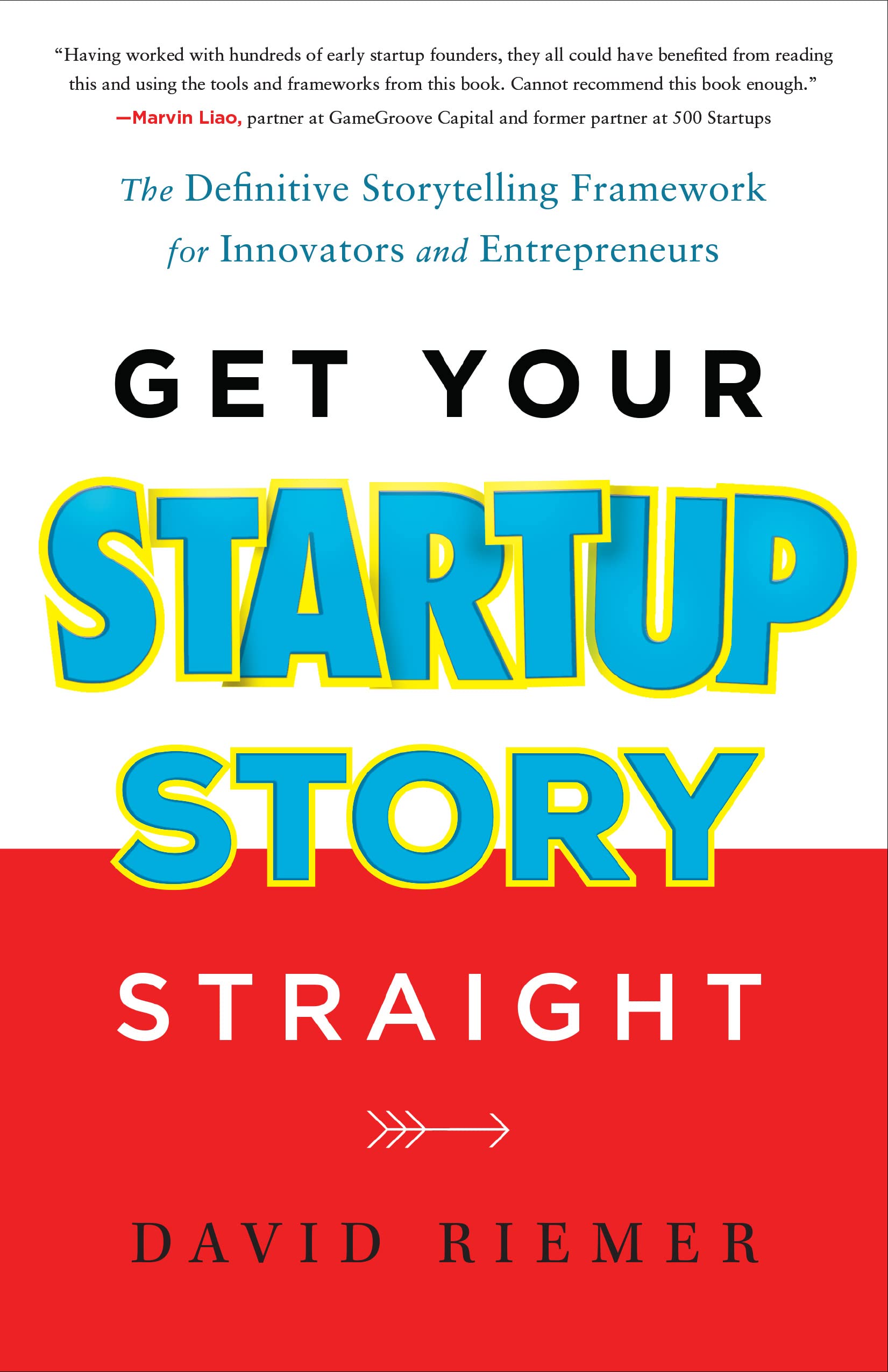
Get Your Startup Story Straight: The Definitive Storytelling Framework for Innovators and Entrepreneurs




About This Book
Get Your Startup Story Straight argues that storytelling is not a marketing afterthought but the strategic core of building a successful innovation. As one highlight puts it, "Story is strategy, and if the story isn't working, the strategy must change." Drawing on neuroscience, the author notes that narrative is how humans are hardwired to learn—information is up to twenty-two times more memorable when delivered in narrative form—and that an emotional hook triggers dopamine and cortisol responses that cement attention and memory.
The book's central contribution is a six-frame storyboard that maps classic dramatic structure onto innovation:
- The customer as protagonist
- Customer insights (intention and obstacles)
- The problem definition as central conflict
- The value proposition as aspiration
- How the product works as plot
- The competitive context as setting
Much of the guidance centers on starting with a deep understanding of the customer and their pain—"the greater the pain, the greater the opportunity for gain"—then framing a problem that is neither too broad nor too narrow, using techniques like the Three Whys and moving up and down the "ladder of abstraction."
The author insists investors and customers won't care about revenue models or market size until they believe you've found a real customer with a real problem you can solve. Innovators are encouraged to paint two worlds—the present and a brighter future their product unlocks—and to keep stories short, clear, and retellable. Throughout, examples from Bleacher Report, Evernote, Google, Facebook's origins, and failures like Google Wave illustrate the framework. The closing message is iterative: listen to customers, refine the narrative continuously, and treat your story as a living strategic document.
Key Takeaways
- 1.The six-frame storyboard turns abstract innovation into a relatable story with a protagonist, conflict, and resolution.
- 2.The customer is the protagonist—a deep understanding of their pain points reveals the precise problem worth solving.
- 3.Story is strategy: if your narrative isn't resonating with customers, the underlying strategy must change.
- 4.Investors don't care about revenue or market size until they believe you've found a real customer with a real problem you can solve.
- 5.Effective stories need an emotional hook, clear logic, and brevity—knowing what to leave out is half the art.
- 6.Innovators should paint two worlds—the present and a brighter future their product makes possible.
- 7.Narrative is biologically powerful: emotionally charged stories trigger dopamine and cortisol that boost memory and focus.
Top Highlights
The six frames of our storyboard are 1. the customer (protagonist) 2. customer insights (intention and obstacles) 3. the problem definition (central conflict) 4. the value proposition (aspiration) 5. how the product works (plot) 6. competitive context (setting)
Highlighted by 3 people
As they brought the life-saving drugs into the delivery room to save Amy, Matt made the statement that made me choke up when I heard it: “The best day of my life might become the worst.”
Highlighted by 2 people
Matt was embarrassed that he had cried in a professional setting.
Highlighted by 2 people
In Starbutter AI’s case, the customer is the millennial looking to build their credit and hopefully become a bit more sophisticated with their finances.
Highlighted by 2 people
Next you must describe how the product or service works. How does the product deliver the benefit?
Highlighted by 2 people
To improve your ability to frame your own story, we’ll go through each element of the storyboard in detail.
Highlighted by 2 people
If you want to go deep on the subject, read Steve Portigal’s Interviewing Users or Giff Constable’s Talking to Humans.
Highlighted by 2 people
Remarkably, no one had solved this problem until RIM grabbed hold of this story.
Highlighted by 2 people
Storyboard Element #3: Problem Definition (Central Conflict)
Highlighted by 2 people
One of the most popular tech products in our life provides an example.
Highlighted by 2 people
AI Review
Based on Glasp's analysis of highlights from 3 readers, this is a focused, practical framework that readers found clear and quotable, especially its six-frame storyboard.
Pros
- +A memorable six-frame storyboard mapping story structure onto innovation
- +Grounded in neuroscience explaining why narrative aids memory and attention
- +Practical tools like the Three Whys and the ladder of abstraction for problem framing
- +Concrete case studies from Bleacher Report, Evernote, Google, and others
- +Strong emphasis on customer-first thinking before business metrics
Cons
- −Small highlighter base means consensus signal is limited
- −Some examples may feel familiar to readers steeped in startup literature
Glasp AI analysis based on highlights from 3 readers.
Who Should Read This
This book is for entrepreneurs and intrapreneurs building new products who struggle to articulate what they do and why it matters. It suits founders preparing pitches for investors, product managers shaping go-to-market narratives, and innovators who have a technology but haven't yet defined their customer or problem. Readers comfortable with lean-startup and MVP concepts will get the most value, though the framework is accessible to beginners crafting their first pitch or origin story.
Frequently Asked Questions
What is the book about?
Who is it for?
What are the key lessons?
Is it worth reading?
Why does storytelling matter for startups?
What is the six-frame storyboard?
How does the book suggest framing a problem?
How to Apply What You Read
- 1.Build your own six-frame storyboard, defining your customer, insight, problem, value proposition, product, and competitors.
- 2.Interview real customers and use the Three Whys to uncover their deepest functional, social, and emotional needs.
- 3.Frame a right-sized problem using the ladder of abstraction so it is neither too broad nor too narrow for an MVP.
- 4.Craft a value proposition by completing the sentence "Now I can..." to capture the concrete benefit you unlock.
- 5.Refine your story continuously based on customer and competitor feedback, treating it as a living strategic document.
Discussion Questions
- Q1.Who is the protagonist of your startup story, and how deeply do you understand their pain?
- Q2.Is your problem framed too broadly or too narrowly to build an effective MVP?
- Q3.What is the single emotional hook that makes your audience care about your innovation?
- Q4.How does your value proposition complete the phrase "Now I can..." for your customer?
- Q5.If your story isn't resonating, what does that reveal about your strategy?
- Q6.What present-versus-future contrast best captures the world your product creates?
- Q7.Which of the six storyboard frames is currently weakest in how you tell your story?
Recommended Books
Revisit Your Highlights, Deepen Your Understanding
Import your Kindle highlights to review, organize, and share the ideas that matter most to you.
Get the free browser extension