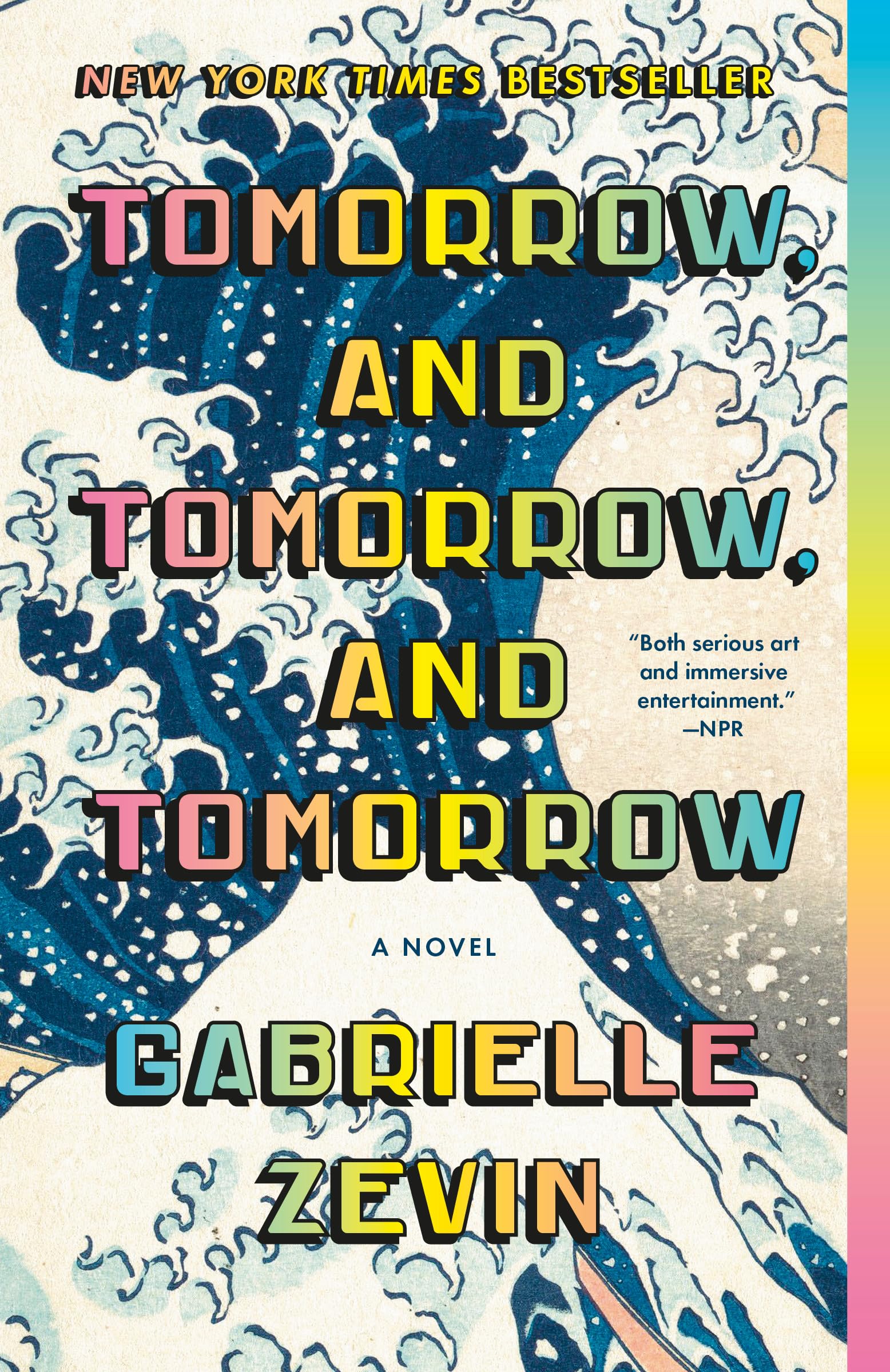
Tomorrow, and Tomorrow, and Tomorrow: A novel
About This Book
Tomorrow, and Tomorrow, and Tomorrow by Gabrielle Zevin follows the decades-spanning creative partnership between Sam Masur and Sadie Green, two friends who meet as children, reconnect as college students at Harvard and MIT, and go on to build acclaimed video games together. The novel uses game design as a lens to explore the deepest human themes: friendship, love, ambition, disability, grief, identity, and the longing for second chances.
At its heart, the book argues that play is among the most intimate acts two people can share — "to play requires trust and love." The games Sam and Sadie create (Ichigo, Both Sides, Mapleworld) become extensions of their inner lives, and their collaboration proves rarer and more enduring than romance. As one character insists, "true collaborators in this life are rare."
The title, drawn from Macbeth's soliloquy, is reframed as hope rather than despair: a game is "the possibility of infinite rebirth, infinite redemption. The idea that if you keep playing, you could win." The novel weaves recurring motifs:
- The artist whose taste exceeds their ability, who must "make things anyway"
- The contextual, shifting nature of identity (Sam's mixed-race experience)
- The "other life" of choices not made
- Failure as the necessary path to better work — "You try again. You fail better."
These themes are anchored in vivid character study: Sam's chronic pain and trauma, Sadie's bourgeois ambition and resentment, and Marx, the beloved producer who makes everything possible. Profoundly resonant with creators and entrepreneurs (many readers compare it to startup culture), the book ultimately offers a tender meditation on why we keep playing — and keep loving — despite loss.
Key Takeaways
- 1.Play is intimacy — to play with someone requires the same openness, trust, and vulnerability as love.
- 2.Every artist endures a period where taste exceeds ability; the only way through is to keep making things anyway.
- 3.Failure is generative — public failure creates quiet time to go back to work and "fail better."
- 4.Collaboration can surpass romance — true creative partners are rarer and more enduring than lovers.
- 5.Identity is contextual and fluid, shaped by place, language, and how others see you.
- 6.A game embodies infinite restarts — the hopeful belief that no loss is permanent and you can always begin again.
- 7.Much of life is happenstance and the roll of the die, yet meaning is found in continuing to play.
Top Highlights
There is a time for any fledgling artist where one’s taste exceeds one’s abilities. The only way to get through this period is to make things anyway.
Highlighted by 4 people
While Sadie experienced this period of indecision as stressful, Sam didn’t feel that way at all. The best part of this moment, he thought, is that everything is still possible.
Highlighted by 3 people
“You can watch if you want. I’m going to play until the end of this life.”
Highlighted by 3 people
“What is a game?” Marx said. “It’s tomorrow, and tomorrow, and tomorrow. It’s the possibility of infinite rebirth, infinite redemption. The idea that if you keep playing, you could win. No loss is permanent, because nothing is permanent, ever.”
Highlighted by 3 people
“And what is love, in the end?” Alabaster said. “Except the irrational desire to put evolutionary competitiveness aside in order to ease someone else’s journey through life?”
Highlighted by 3 people
To allow yourself to play with another person is no small risk. It means allowing yourself to be open, to be exposed, to be hurt. It is the human equivalent of the dog rolling on its back—I know you won’t hurt me, even though you can. It is the dog putting its mouth around your hand and never biting down. To play requires trust and love.
Highlighted by 2 people
To allow yourself to play with another person is no small risk. It means allowing yourself to be open, to be exposed, to be hurt. It is the human equivalent of the dog rolling on its back—I know you won’t hurt me, even though you can. It is the dog putting its mouth around your hand and never biting down. To play requires trust and love. Many years later, as Sam would controversially say in an interview with the gaming website Kotaku, “There is no more intimate act than play, even sex.”
Highlighted by 2 people
It is not possible to receive charity from a friend.”
Highlighted by 2 people
else’s game: to have the illusion of choice, without actual choice.
Highlighted by 2 people
“You aren’t just a gamer when you play anymore. You’re a builder of worlds, and if you’re a builder of worlds, your feelings are not as important as what your gamers are feeling. You must imagine them at all times. There is no artist more empathetic than the game designer.”
Highlighted by 2 people
AI Review
Based on Glasp's analysis of 14 readers' highlights, this is a deeply resonant, widely quoted novel whose meditations on creativity, friendship, and failure strike a powerful chord — especially among creators and founders.
Pros
- +Exceptionally quotable — readers repeatedly highlighted the same passages on play, failure, and love
- +Rich, layered exploration of creative partnership that readers found more compelling than romance
- +Strong personal identification — many readers saw themselves in Marx, Sam, or Sadie
- +Resonant with startup and Silicon Valley culture, giving it cross-audience appeal
- +Tender, philosophical treatment of grief, disability, and identity
Cons
- −Some characters' views (e.g., Sam's claims about play, cultural appropriation debates) provoke discomfort or pushback
- −Idea-heavy and reflective, which may feel slow to readers seeking strong plot momentum
Glasp AI analysis based on highlights from 14 readers.
Who Should Read This
Readers who love character-driven literary fiction about ambition, friendship, and creative partnership. It resonates especially with artists, designers, game developers, founders, and creators — many readers note its parallels to startup culture ("replace game with startup"). Anyone navigating long friendships, public failure, chronic pain, grief, or questions of mixed-race identity will find recognition here. No gaming knowledge is required; the games are a metaphor for life. Best for those who enjoy emotionally resonant, idea-rich novels over plot-driven thrillers.
Frequently Asked Questions
What is the book about?
Who is it for?
What are the key lessons?
Is it worth reading?
Why is the book called Tomorrow, and Tomorrow, and Tomorrow?
Is this really a book about video games?
Does the book address identity and disability?
How to Apply What You Read
- 1.Make things anyway, even when your skill hasn't yet caught up to your taste — completion teaches more than waiting.
- 2.Reframe failure as quiet time: return to work, attempt the next project, and aim to fail better each time.
- 3.Invest in your true collaborators — protect rare creative partnerships rather than chasing only romance or recognition.
- 4.Decide to remember the people and moments that matter, rather than leaving memory to happenstance.
- 5.Reconsider how you say "love" — reserve it for what you truly mean, as the novel's characters wrestle with.
Discussion Questions
- Q1.Do you agree with Sam's controversial claim that "there is no more intimate act than play, even sex"? Why or why not?
- Q2.Is the relationship between Sam and Sadie a love story, even though they never become romantic partners?
- Q3.How does the novel use video games as a metaphor for life, second chances, and grief?
- Q4.What does the book suggest about the relationship between trauma, ambition, and great art?
- Q5.How do Sam's experiences of mixed-race identity illustrate the idea that "the self is contextual"?
- Q6.Why do you think this book resonates so strongly with people in startup and creative industries?
- Q7.Which character did you identify with most — Sam, Sadie, or Marx — and what does that reveal about you?
Recommended Books



Revisit Your Highlights, Deepen Your Understanding
Import your Kindle highlights to review, organize, and share the ideas that matter most to you.
Get the free browser extension