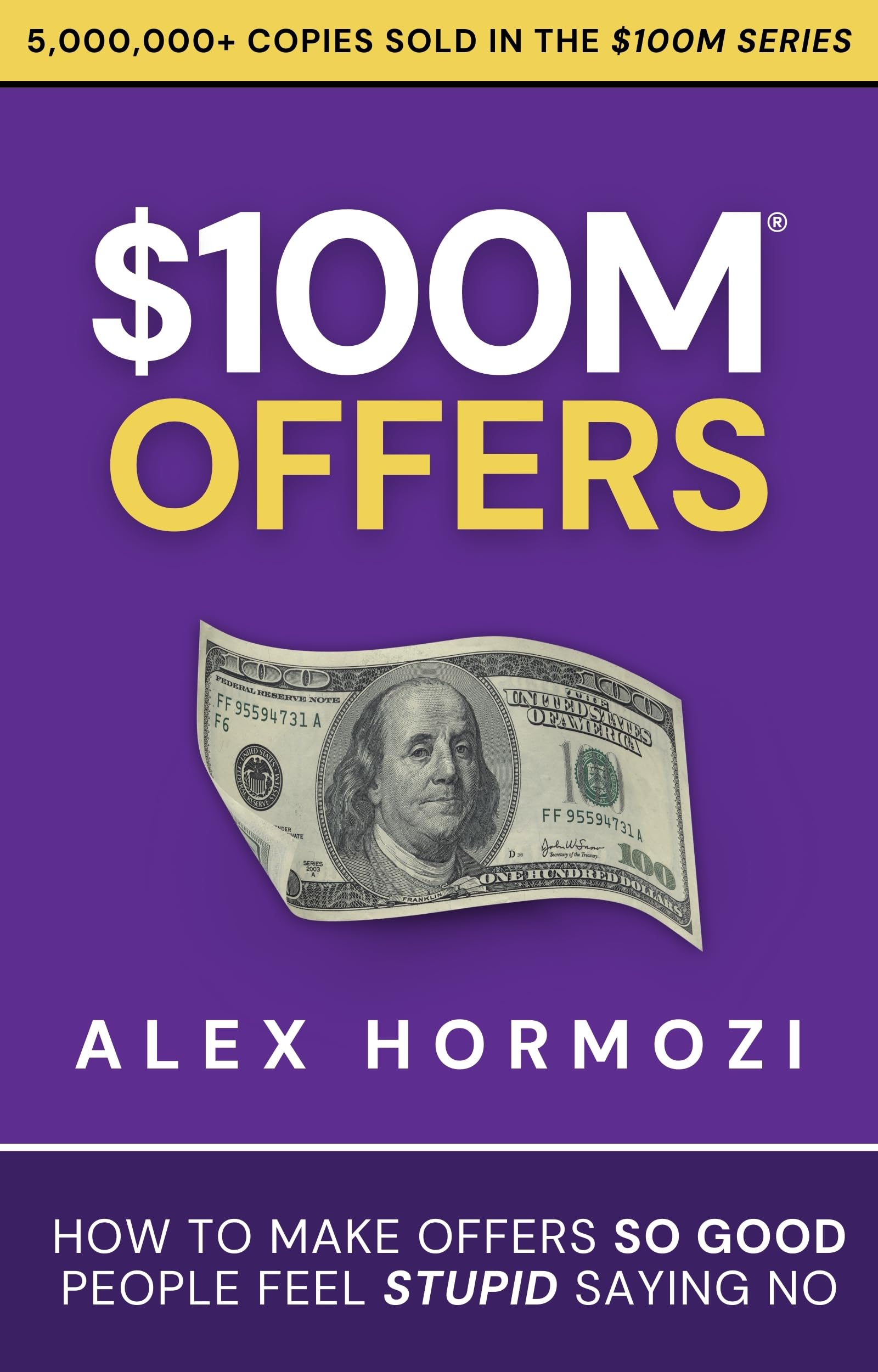
$100M Offers: How To Make Offers So Good People Feel Stupid Saying No (Acquisition.com $100M Series)
About This Book
Alex Hormozi’s $100M Offers argues that business growth is less about clever tactics and more about designing an offer so valuable, specific, and well-framed that prospects stop comparing you on price. Across the most-highlighted passages, readers consistently gravitated to one core idea: the offer is the lifeblood of a business because it drives the initial value exchange, and a great offer helps you get more customers, increase average purchase value, and generate repeat purchases.
The book’s central framework is the Value Equation. Hormozi says value rises when you increase:
- the dream outcome
- the perceived likelihood of achievement
And value rises further when you decrease:
- the time delay between purchase and result
- the effort and sacrifice required
A major theme in the highlights is that perception is reality. Readers repeatedly marked examples showing that people do not only pay for actual results; they pay for certainty, speed, ease, and the feeling that progress is happening now. That’s why “fast beats free,” early wins matter, and psychological solutions can outperform purely logical ones.
Hormozi also emphasizes market selection before offer design. He recommends choosing markets with massive pain, purchasing power, easy targeting, and growth, often within health, wealth, or relationships. From there, he advocates narrowing to a precise avatar, listing every friction point they face, converting those obstacles into solutions, and stacking high-value bonuses, guarantees, and delivery methods that make the offer hard to compare.
The book strongly rejects competing on price. Instead, it argues for premium pricing backed by real delivery, stronger messaging, and differentiated packaging that creates a “category of one.” The overall structure is practical: choose the right market, define the avatar, build the offer around their pains and desired outcomes, then enhance it with proof, urgency, scarcity, bonuses, and guarantees.
Key Takeaways
- 1.Value beats price when your offer is differentiated enough that prospects stop making direct comparisons.
- 2.People buy outcomes, but they stay when they experience early wins that prove they are on the right path.
- 3.The best markets combine massive pain, purchasing power, easy targeting, and growth.
- 4.If you can articulate a prospect’s pain precisely, your persuasion gets much stronger because people want to feel understood.
- 5.Fast beats free in many markets because buyers willingly pay to reduce waiting and friction.
- 6.Premium pricing works best when it is supported by real delivery, stronger commitment from customers, and a much larger value-to-price gap.
- 7.Offer creation improves when you list every obstacle the customer faces and systematically turn each one into a solution.
Top Highlights
It’s an offer you present to the marketplace that cannot be compared to any other product or service available, combining an attractive promotion, an unmatchable value proposition, a premium price, and an
Highlighted by 14 people · 1 left a note
Slam Offer only becomes valuable once the prospect perceives the increase in likelihood of achievement, perceives the decrease in time delay, and perceives the decrease in effort and sacrifice.
Highlighted by 13 people · 1 left a note
what does it take to grow? Thankfully, just three simple things:
Highlighted by 11 people
The degree of the pain will be proportional to the price you will be able to charge
Highlighted by 11 people
“Make people an offer so good they would feel stupid saying no.”
Highlighted by 9 people
Make people an offer so good they would feel stupid saying no.”
Highlighted by 9 people
The only way to conduct business is through a value exchange, a trade of dollars for value.
Highlighted by 9 people
always exist: Health, Wealth, and Relationships.
Highlighted by 9 people
‘I solve this type of problem for this specific type of person in this unique counter-intuitive way that reverses their deepest fear.”
Highlighted by 9 people
The only thing that beats “free” is “fast.”
Highlighted by 9 people · 1 left a note
AI Review
Glasp’s AI analysis of 71 reader highlights suggests strong consensus that this is a highly actionable business book with memorable frameworks readers want to reuse. The densest highlighting clusters around the value equation, niching, premium pricing, and offer construction, indicating unusually high practical resonance.
Pros
- +Highly actionable framework for building and pricing offers
- +Clear explanation of the four value drivers
- +Strong emphasis on differentiation over commodity pricing
- +Memorable lines and examples that readers repeatedly highlighted
- +Useful for messaging, copywriting, and market selection
- +Encourages experimentation and resilience instead of personalizing failure
- +Concrete tactics for bonuses, guarantees, urgency, and scarcity
Cons
- −Premium-pricing philosophy may feel aggressive or overly sales-driven to some readers
- −Some ideas rely heavily on perception and positioning, which may invite skepticism if execution is weak
- −Best suited to offer-based businesses; less tailored to purely operational or product-led contexts
Glasp AI analysis based on highlights from 71 readers.
Who Should Read This
This book is best for entrepreneurs, agency owners, consultants, coaches, freelancers, and small business operators who already have something to sell but struggle with pricing, differentiation, or conversions. It’s especially useful if prospects keep comparing you to cheaper alternatives.
It also fits marketers and copywriters who need a sharper framework for positioning, messaging, and offer design. Beginners can use it, but readers who already know the basics of sales and customer acquisition will likely extract the most value because the book is highly tactical and geared toward monetizable offers, not broad business theory.
Frequently Asked Questions
What is the book about?
Who is this book for?
What are the key lessons from the book?
What is a Grand Slam Offer?
What is the Value Equation in the book?
Does the book recommend lowering prices to win customers?
Is it worth reading?
How to Apply What You Read
- 1.Audit your current offer using the four value drivers: dream outcome, likelihood of achievement, time delay, and effort or sacrifice.
- 2.Define a narrower avatar with a specific painful problem, real buying power, and clear targeting channels.
- 3.List every objection, friction point, and next problem your prospect experiences before, during, and after using your offer.
- 4.Add bonuses, proof, or guarantees that directly answer those objections instead of defaulting to discounts.
- 5.Test new offer packaging, messaging angles, and delivery methods repeatedly before assuming the market is the problem.
Discussion Questions
- Q1.Which part of the Value Equation is weakest in your current offer: dream outcome, certainty, speed, or ease?
- Q2.When does premium pricing genuinely improve customer results, and when can it become empty positioning?
- Q3.How can a business reduce the perception of time delay even when the real delivery timeline does not change?
- Q4.What are examples in your industry where competitors have become commodities, and how could they create a category of one instead?
- Q5.How narrow should a niche be before focus becomes a strength rather than a limitation?
- Q6.Which is more persuasive in your market: stronger proof of success, lower effort for the buyer, or faster wins?
- Q7.What bonuses or guarantees would actually solve real customer hesitation instead of merely inflating the offer?
Recommended Books
Revisit Your Highlights, Deepen Your Understanding
Import your Kindle highlights to review, organize, and share the ideas that matter most to you.
Get the free browser extension