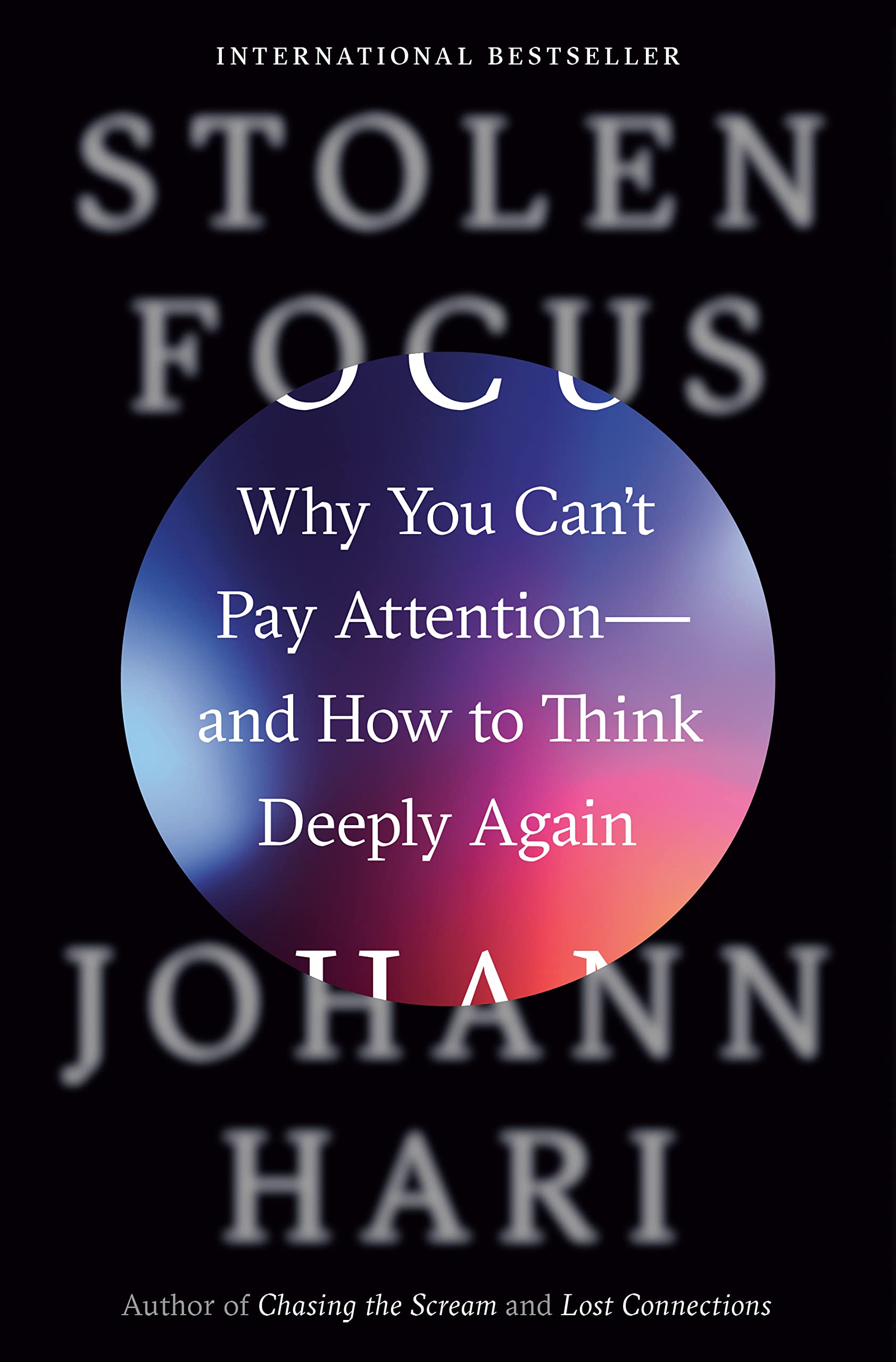
Stolen Focus: Why You Can't Pay Attention--and How to Think Deeply Again
About This Book
In Stolen Focus, Johann Hari argues that our collapsing ability to pay attention is not a personal failing but a systemic crisis with deep roots in how modern society is built. After a three-month digital detox in Provincetown, Hari travels the world interviewing leading experts to identify twelve causes of our "attention pathogenic culture."
The book's central distinction is between fragmentation, which makes us "smaller, shallower, angrier," and flow, which makes us "bigger, deeper, calmer." Drawing on B.F. Skinner's behaviorism and Mihaly Csikszentmihalyi's research on flow states, Hari shows how Silicon Valley deliberately engineered apps to maximally grab and hold our attention—their business model is "screen time, not life time."
Hari catalogs causes including the acceleration of information ("drinking from a fire hose"), the myth of multitasking, sleep deprivation, the collapse of sustained reading, the suppression of mind-wandering, surveillance technology, stress-induced hypervigilance, poor diets, pollution, the rise of ADHD, and the confinement of children. A recurring theme is cruel optimism—blaming individuals for problems with social causes, as with obesity or dieting.
Key insights include the idea that mind-wandering is not the enemy of attention but a different, necessary form of it; that reading fiction is an "empathy gym"; and that flow requires a single meaningful goal pursued at the edge of one's abilities.
Hari resists framing the issue as pro-tech versus anti-tech, insisting the real question is: What tech, designed for what purposes, in whose interests? He concludes that, like obesity, this crisis is human-made and can be unmade—but only through collective "attention rebellion," not individual willpower alone. As Baldwin said, nothing can be changed until it is faced.
Key Takeaways
- 1.The attention crisis is systemic, not personal—like obesity, it stems from a changed environment that makes deep focus require swimming upstream.
- 2.Flow is the antidote to distraction: choose one clearly defined, meaningful goal pursued at the edge of your abilities, and monotask.
- 3.Multitasking is a myth; the brain merely switches, incurring real costs in speed, accuracy, creativity, and memory—dropping IQ and performance measurably.
- 4.Tech companies deliberately engineer apps to maximize attention because their business model is screen time, not life time.
- 5.Mind-wandering is not the opposite of attention but a different, necessary form that fuels creativity and helps us make sense of our lives.
- 6.Sustained reading—especially of fiction—acts as an "empathy gym," and its collapse repatterns our consciousness toward shallowness.
- 7.The real debate isn't pro-tech versus anti-tech but: what tech, designed for what purposes, in whose interests?
Top Highlights
fragmentation, or flow. Fragmentation makes you smaller, shallower, angrier. Flow makes you bigger, deeper, calmer. Fragmentation shrinks us. Flow
Highlighted by 4 people
“Creativity is not [where you create] some new thing that’s emerged from your brain,” Nathan told me. “It’s a new association between two things that were already there.”
Highlighted by 3 people
In situations of low stress and safety, mind-wandering will be a gift, a pleasure, a creative force. In situations of high stress or danger, mind-wandering will be a torment.
Highlighted by 3 people
“You don’t know how to be present! You are missing your life! You’re afraid of missing out—that’s why you are checking your screen all the time! By doing that, you are guaranteeing you are missing out! You are missing your one and only life! You can’t see
Highlighted by 2 people
Through no fault of your own, there never seems to be enough stillness—enough cool, clear space—for you to stop and think.
Highlighted by 2 people
James Baldwin—the man who is, for my money, the greatest writer of the twentieth century—said: “Not everything that is faced can be changed, but nothing can
Highlighted by 2 people
at the moment, it is like we’re “drinking from a fire hose—there’s too much coming at us.” We are soaked in information.
Highlighted by 2 people
The increase in the volume of information is what creates the sensation of the world speeding up.
Highlighted by 2 people
“I was like—holy shit, this is a metaphor for the future.” If we don’t change course, he fears we are headed toward a world where “there’s going to be an upper class of people that are very aware” of the risks to their attention and find ways to live within their limits, and then there will be the rest of the society with “fewer resources to resist the manipulation, and they’re going to be living more and more inside their computers, being manipulated more and more.”
Highlighted by 2 people
But there’s a second way in which scientists have learned how this societal slamming on the accelerator is affecting our attention. It comes from studying what happens to focus not when we speed up, but when we deliberately slow down. One of the leading experts on this topic is Guy Claxton, professor of learning sciences at the University of Winchester, who I went to interview in Sussex, in England. He has analyzed what happens to a person’s focus if they engage in deliberately slow practices, like yoga, or tai chi, or meditation, as discovered in a broad range of scientific studies, and he has shown they improve your ability to pay attention by a significant amount. I asked him why. He said that “we have to shrink the world to fit our cognitive bandwidth.” If you go too fast, you overload your abilities, and they degrade. But when you practice moving at a speed that is compatible with human nature—and you build that into your daily life—you begin to train your attention and focus. “That’s why those disciplines make you smarter. It’s not about humming or wearing orange robes.” Slowness, he explained, nurtures attention, and speed shatters it.
Highlighted by 2 people
AI Review
Across 8 readers' highlights, Stolen Focus shows strong consensus around its core flow-versus-fragmentation argument and its critique of attention-engineering tech, with several passages resonating widely.
Pros
- +Compelling central distinction between flow and fragmentation that readers repeatedly highlighted
- +Reframes the attention crisis as a systemic rather than individual problem
- +Accessible journalistic narrative grounded in interviews with leading scientists
- +Memorable, quotable insights on mind-wandering, reading fiction as an "empathy gym," and flow states
- +Practical tools offered (pre-commitment, kSafe, time-boxing) alongside structural critique
- +Connects attention to broader stakes like democracy and child development
Cons
- −Some readers flagged skepticism toward parts of the evidence and how studies are framed
- −Sweeping breadth across twelve causes means some chapters rest on thinner science, as Hari himself acknowledges
- −Systemic solutions can feel aspirational and less actionable than the individual fixes
Glasp AI analysis based on highlights from 8 readers.
Who Should Read This
Anyone who feels their attention slipping—knowledge workers, students, parents, and chronic phone-checkers—will find both validation and explanation here. It suits readers interested in technology ethics, psychology, and public health who appreciate journalistic narrative built on expert interviews. Parents worried about children's screen time, focus, and ADHD diagnoses will value the chapters on childhood and play. Readers of Nicholas Carr's The Shallows or Cal Newport's work on deep work are a natural audience. No prior expertise needed—Hari writes accessibly.
Frequently Asked Questions
What is Stolen Focus about?
Who is the book for?
What are the key lessons?
Is it worth reading?
What does Hari mean by flow versus fragmentation?
Why does Hari say willpower isn't enough?
What does the book say about children and attention?
How to Apply What You Read
- 1.Practice pre-commitment using tools like website blockers or a phone safe to physically remove distractions for set periods.
- 2.Cultivate flow by setting aside everything else to pursue one meaningful goal at the edge of your abilities, rather than collapsing into passive rest.
- 3.Protect your sleep by removing screens and artificial light before bed and keeping your phone charging in another room.
- 4.Rebuild sustained reading by reading books slowly and deeply instead of skimming, and notice the difference in comprehension versus screens.
- 5.Join collective change by supporting reforms to technology's business models rather than relying on personal willpower alone.
Discussion Questions
- Q1.Hari distinguishes flow from fragmentation—where in your own life do you experience each, and what conditions create them?
- Q2.Do you find the comparison between the attention crisis and the obesity epidemic persuasive? Why or why not?
- Q3.If individual willpower is insufficient, what systemic or political changes would you actually support to protect attention?
- Q4.How has your own reading changed in the age of screens, and do you notice "screen inferiority" in your comprehension?
- Q5.Hari argues mind-wandering is essential, yet research says "a wandering mind is an unhappy mind"—how do you reconcile these claims?
- Q6.What message do the mediums you use most—books, Twitter, Instagram—embed, and how might they be shaping your consciousness?
- Q7.Some readers approached the book's evidence with skepticism; which claims did you find most and least convincing, and why?
Recommended Books





Revisit Your Highlights, Deepen Your Understanding
Import your Kindle highlights to review, organize, and share the ideas that matter most to you.
Get the free browser extension