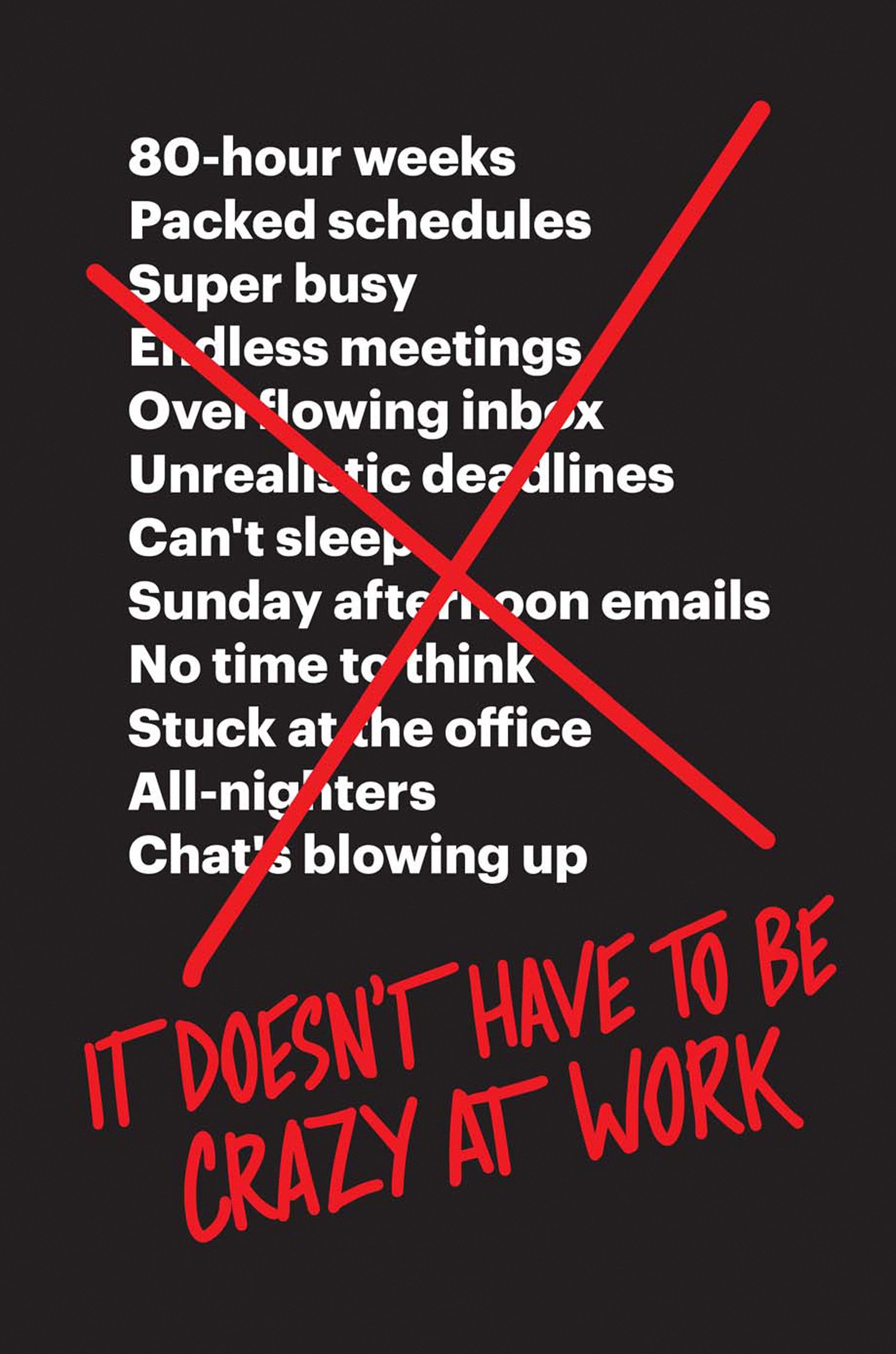
It Doesn’t Have to Be Crazy at Work





About This Book
It Doesn't Have to Be Crazy at Work by Jason Fried and David Heinemeier Hansson (the founders of Basecamp) is a manifesto against the cult of busyness, hustle, and overwork that dominates modern business culture. The core argument is simple: a calm company is not only possible but preferable, and it's built through deliberate choices rather than luck.
The authors dismantle several sacred cows of business orthodoxy:
- Goals are fake — most are artificial targets set for ego's sake, and chasing them erodes integrity.
- Comparison is the death of joy — obsessing over market share and competitors distracts from making a great product.
- Workaholism is a contagious disease, not a badge of honor; great work ethic means reliability and respect, not endless hours.
- 40 hours is enough — if it doesn't fit, get better at choosing what to do, not work longer.
They advocate treating the company itself as a product worth iterating on, protecting employees' uninterrupted attention, and replacing real-time chat pressure with asynchronous, considered communication ("Don't react, consider"). On hiring, they argue résumés are largely worthless—evaluate who people are and what they can actually do, often through paid real-world trial projects.
The book also offers concrete operational philosophy: fixed deadlines with flexible scope ("deadlines, not dreadlines"), the "trust battery" concept for relationships, manager-light organization, and generous benefits aimed at life outside work (sabbaticals, education stipends, charity matching).
The throughline is the discipline of "enough" and the power of no. Saying no is a precision instrument; saying yes accrues debt. Calm starts early and becomes habit—"later" is where good intentions go to die. Make the change now.
Key Takeaways
- 1.Overwork is a choice, not a requirement—creativity and impact don't yield to brute force or hours past the 14th.
- 2.Comparison and goals are traps; focus on a healthy, profitable business and a great product, and let market share be an outcome.
- 3.40 hours is enough—if work doesn't fit, get better at choosing what to do rather than working longer.
- 4.Protect uninterrupted attention by killing status meetings, shared calendars, and the tyranny of real-time chat; prefer considered, written, async communication.
- 5.Hire for who people are and what they can do through real, paid trial work—not résumés, pedigrees, or whiteboard riddles.
- 6.Saying no is a precision instrument while yes is debt that accrues interest; calm requires getting comfortable with enough.
- 7.Calm must start early and now—"later is where good intentions go to die," and culture is defined by what you actually do.
Top Highlights
What’s our market share? Don’t know, don’t care. It’s irrelevant. Do we have enough customers paying us enough money to cover our costs and generate a profit? Yes. Is that number increasing every year? Yes. That’s good enough for us. Doesn’t matter if we’re 2 percent of the market or 4 percent or 75 percent. What matters is that we have a healthy business with sound economics that work for us. Costs under control, profitable sales.
Highlighted by 4 people
Mark Twain nailed it: “Comparison is the death of joy.” We’re with Mark.
Highlighted by 4 people
When people focus on productivity, they end up focusing on being busy. Filling every moment
Highlighted by 4 people
You’re not very likely to find that key insight or breakthrough idea north of the 14th hour in the day. Creativity, progress, and impact do not yield to brute force.
Highlighted by 3 people
So you hereby have our permission to bury the hustle. To put in a good day’s work, day after day, but nothing more. You can play with your kids and still be a successful entrepreneur. You can have a hobby. You can take care of yourself physically. You can read a book. You can watch a silly movie with your partner. You can take the time to cook a proper meal. You can go for a long walk. You can dare to be completely ordinary every now and then.
Highlighted by 3 people
You can absolutely run a great business without a single goal. You don’t need something fake to do something real. And if you must have a goal, how about just staying in business? Or serving your customers well? Or being a delightful place to work? Just because these goals are harder to quantify does not make them any less important.
Highlighted by 3 people
The best companies aren’t families. They’re supporters of families. Allies of families. They’re there to provide healthy, fulfilling work environments so that when workers shut their laptops at a reasonable hour, they’re the best husbands, wives, parents, siblings, and children they can be.
Highlighted by 3 people
is that the further away you are from the fruit, the lower it looks. Once you get up close, you see it’s quite a bit higher than you thought. We assume that picking it will be easy only because we’ve never tried to do it before.
Highlighted by 3 people
First, you can’t land a job at Basecamp based on your résumé. CVs might as well be tossed in the garbage. We don’t really care where you went to school, or how many years you’ve been working in the industry, or even that much about where you just worked. What we care about is who you are and what you can do.
Highlighted by 3 people
Résumés aren’t work. Résumés may list the work they’ve done, but we all know that they are exaggerated and often bullshit.
Highlighted by 3 people
AI Review
Based on highlights from 6 readers, this is a highly quotable, consensus-driven manifesto whose punchy aphorisms resonate strongly—"comparison is the death of joy" and "goals are fake" were among the most-marked passages.
Pros
- +Strong reader consensus around its anti-hustle core message
- +Memorable, quotable one-liners that crystallize each idea
- +Concrete, actionable practices (flexible scope, trust battery, async communication)
- +Reframes work ethic as reliability and respect rather than hours
- +Refreshing permission to embrace "enough" over endless growth
Cons
- −Built almost entirely on Basecamp's specific experience, which may not generalize to all industries
- −Light on evidence beyond the founders' own anecdotes
Glasp AI analysis based on highlights from 6 readers.
Who Should Read This
Founders, entrepreneurs, and small-business owners feeling pressured to grow at all costs will find permission to do things differently. Managers and team leads who want to protect their people's attention and reduce burnout will gain concrete practices. Knowledge workers and remote teams drowning in chat notifications, meetings, and constant interruptions will recognize their pain and find alternatives. It's especially valuable for anyone questioning hustle culture and wanting a sustainable, calm approach to work and company-building.
Frequently Asked Questions
What is the book about?
Who is it for?
What are the key lessons?
Is it worth reading?
What does the authors mean by goals being fake?
How do they suggest handling deadlines and projects?
What is the "trust battery"?
How to Apply What You Read
- 1.Audit your calendar and to-do list, then create a list of "to-don'ts"—cut meetings, status updates, and busywork that isn't worth doing.
- 2.Replace real-time chat expectations with considered, written async communication: write up complete ideas and let people respond after reflection.
- 3.Fix project deadlines but keep scope flexible—separate must-haves from nice-to-haves and let projects shrink, not balloon.
- 4.Redesign your hiring to evaluate current ability through real, paid sample work rather than résumés and credentials.
- 5.Set reasonable working hours now and stick to them—model calm yourself, since workaholism spreads from the top.
Discussion Questions
- Q1.Do you agree that most business goals are "fake"? Where in your own work have artificial targets led to compromises?
- Q2.The authors say comparison is the death of joy—how much of your company's strategy is driven by competitors rather than your own customers?
- Q3.Could your team genuinely fit its work into 40 hours by cutting the unnecessary? What would you have to stop doing?
- Q4.How would replacing real-time chat with considered, asynchronous communication change the rhythm and stress of your workday?
- Q5.Is it fair to throw out résumés and judge candidates purely on current ability and trial work? What are the risks and benefits?
- Q6.The book claims "later is where good intentions go to die." What change toward calm have you been postponing, and why?
- Q7.How well does Basecamp's model translate to your industry, company size, or role—and where does it break down?
Recommended Books


Revisit Your Highlights, Deepen Your Understanding
Import your Kindle highlights to review, organize, and share the ideas that matter most to you.
Get the free browser extension