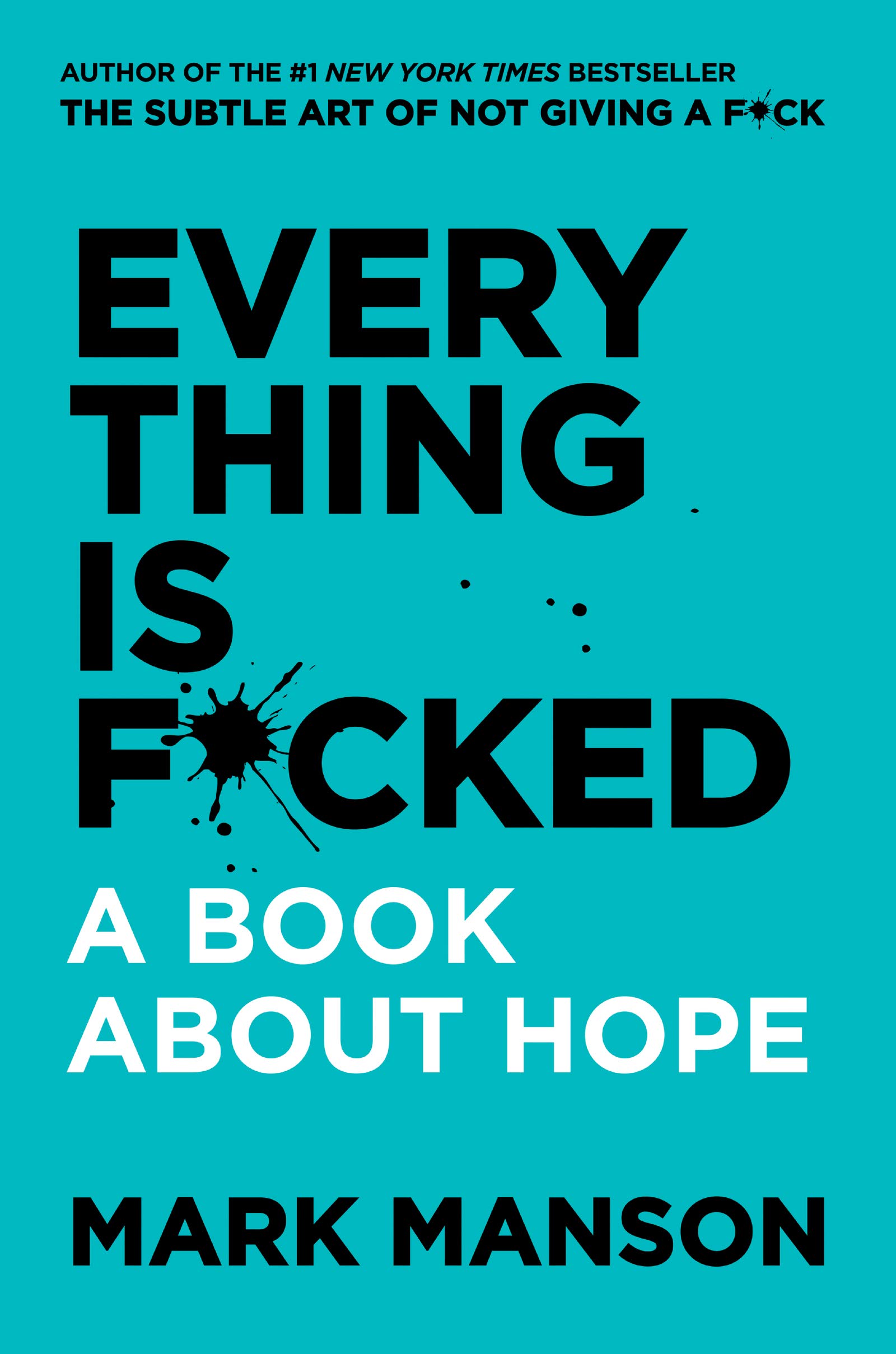
Everything Is F*cked: Two Transformative Guides to Finding Happiness Amidst Life's Chaos (The Subtle Art of Not Giving a F*ck (2 Book Series))
About This Book
Mark Manson's Everything Is F*cked argues that the opposite of happiness is not sadness or anger but hopelessness — "an endless gray horizon of resignation and indifference." Beneath all our striving lies the Uncomfortable Truth: one day we and everyone we love will die, and little of what we do will matter. To survive this, our minds manufacture hope, which requires three things: a sense of control, a belief in values, and a community. Lose any one, and you lose the others.
Manson then dismantles the "Classic Assumption" that reason should dominate emotion. Using the case of Elliot (a man who lost his emotions to a tumor and consequently lost his ability to decide), he shows that action is emotion. He frames the mind as a Thinking Brain and a Feeling Brain sharing a "Consciousness Car" — the Feeling Brain always drives, while the Thinking Brain can only influence it. Self-control is therefore an illusion that appears when both brains align. The Thinking Brain's true superpower is meaning control: reinterpreting feelings rather than fighting them.
The book introduces playful "Newton's Laws of Emotion": we equalize across moral gaps, our self-worth sums our emotions over time, and our values are stories that snowball into identity. The later chapters turn philosophical, drawing on Kant's Formula of Humanity, Nietzsche's master/slave morality, and the concept of antifragility.
Manson's provocative conclusion is that hope itself is transactional and can become destructive. The mature path is to act unconditionally — to treat people as ends, embrace pain rather than avoid it, and choose freedom through self-limitation. His closing advice: "Don't hope. Don't despair... Just be better."
Key Takeaways
- 1.The opposite of happiness is hopelessness — anger and sadness at least mean you still care about something.
- 2.Hope requires three things together: a sense of control, values worth pursuing, and a community that shares them.
- 3.Action is emotion — we don't do what we know we should because we don't feel like it, making self-control an emotional rather than rational problem.
- 4.The Thinking Brain cannot force the Feeling Brain, but it has meaning control: it can reinterpret feelings to change how we react.
- 5.Our values are stories about who deserves what, and these narratives snowball into our identity, which we defend like our physical body.
- 6.Growth comes from antifragility — engaging pain rather than avoiding it; numbing pain numbs everything that matters.
- 7.True freedom comes through self-limitation and acting unconditionally — treating yourself and others as ends, never merely as means.
Top Highlights
To build and maintain hope, we need three things: a sense of control, a belief in the value of something, and a community.
Highlighted by 6 people · 1 left a note
Hopelessness is the root of anxiety, mental illness, and depression. It is the source of all misery and the cause of all addiction.
Highlighted by 5 people
Equalization is present in every experience because the drive to equalize is emotion itself.
Highlighted by 5 people
belief that (a) there is potential for growth or improvement or salvation in the future, and (b) there are ways we can navigate ourselves to get there.
Highlighted by 4 people
Basically, we are the safest and most prosperous humans in the history of the world, yet we are feeling more hopeless than ever before.
Highlighted by 4 people
The overindulgence of emotion leads to a crisis of hope, but so does the repression of emotion.
Highlighted by 4 people
You may not have self-control, but you do have meaning control. This is your superpower. This is your gift. You get to control the meaning of your impulses and feelings.
Highlighted by 4 people
This network of value-based narratives is our identity.
Highlighted by 4 people
No, the opposite of happiness is hopelessness, an endless gray horizon of resignation and indifference.
Highlighted by 3 people
(that we must use our rational mind to dominate our emotions)
Highlighted by 3 people
AI Review
Based on Glasp's analysis of highlights from 9 readers, this is a resonant, heavily-quoted book whose core ideas about hope, emotion, and the Thinking/Feeling Brain consistently struck readers as memorable and useful.
Pros
- +Strong consensus around the central reframe that the opposite of happiness is hopelessness
- +The Thinking Brain vs. Feeling Brain model is vivid, memorable, and widely highlighted
- +Memorable, quotable prose — many passages were highlighted by multiple readers independently
- +Bridges psychology and philosophy (Kant, Nietzsche, antifragility, Buddhism) accessibly
- +Practical insight that self-control is emotional, not rational, with concrete bargaining tactics
Cons
- −The provocative "act without hope" thesis can feel bleak or contradictory
- −Heavy profanity and digressions (especially the AI chapter) may not land for everyone
- −Sweeping claims about politics, religion, and technology are more assertion than evidence
Glasp AI analysis based on highlights from 9 readers.
Who Should Read This
Readers who enjoyed The Subtle Art of Not Giving a F*ck and want a deeper, more philosophical follow-up. Ideal for anyone wrestling with purpose, anxiety, or self-control, those curious about the psychology of emotion and decision-making, and readers open to Kant, Nietzsche, and Stoic-Buddhist ideas delivered with profanity and humor. Less suited to readers seeking a tidy step-by-step self-help manual or those put off by strong language and bleak existential framing.
Frequently Asked Questions
What is Everything Is F*cked about?
Who is this book for?
What are the key lessons?
What is the Thinking Brain vs. Feeling Brain model?
What are Newton's Laws of Emotion?
Why does Manson say hope can be harmful?
Is it worth reading?
How to Apply What You Read
- 1.Stop fighting your emotions and instead ask your Feeling Brain how it feels, then bargain with small, emotionally rewarding steps toward better behavior.
- 2.Reexamine a painful past experience and rewrite the narrative around it, questioning whether you truly deserved the meaning you assigned.
- 3.Visualize your future self living the values you want, letting your Feeling Brain "try them on" until they feel believable.
- 4.Seek out healthy pain and discomfort deliberately — exercise, hard conversations, meditation — to build emotional antifragility.
- 5.Choose specific self-limitations (delete apps, set schedules, commit deeply to fewer things) to create real rather than fake freedom.
Discussion Questions
- Q1.Do you agree that the opposite of happiness is hopelessness rather than sadness? Why or why not?
- Q2.Which of the three pillars of hope — control, values, or community — feels most fragile in your own life?
- Q3.Can you recall a decision where your Feeling Brain clearly overrode your Thinking Brain? What happened?
- Q4.Manson claims all values are faith-based. Does this idea challenge or affirm your own beliefs?
- Q5.Is acting "without hope" and simply trying to be better actually possible, or is it a contradiction?
- Q6.How has avoiding pain or discomfort made some area of your life more fragile?
- Q7.What does treating people as "ends, not means" look like concretely in your relationships?
Recommended Books



Revisit Your Highlights, Deepen Your Understanding
Import your Kindle highlights to review, organize, and share the ideas that matter most to you.
Get the free browser extension