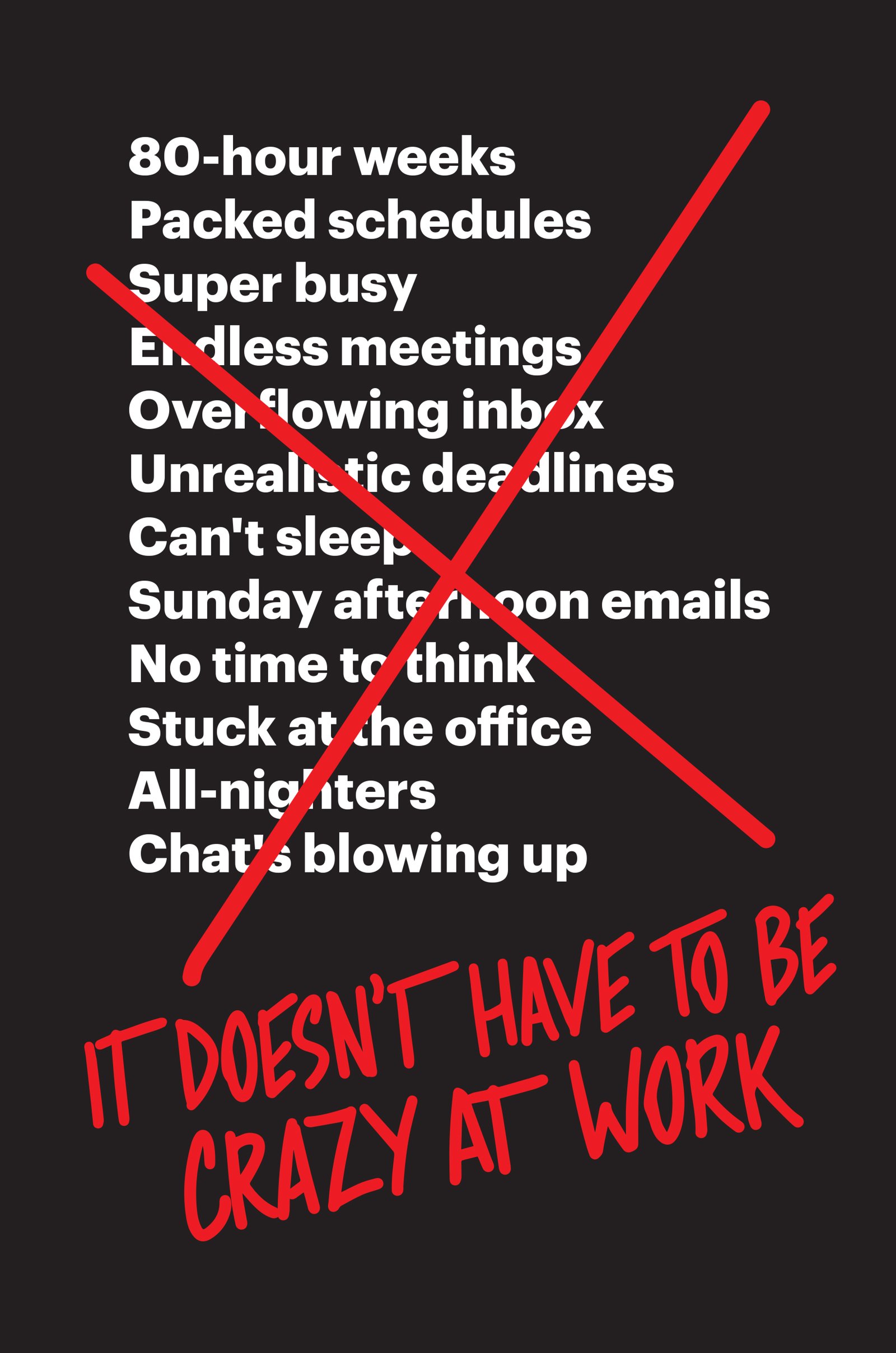
It Doesn't Have to Be Crazy at Work
About This Book
It Doesn't Have to Be Crazy at Work by Jason Fried and David Heinemeier Hansson (Basecamp founders) argues that the chaos, burnout, and "hustle" celebrated in modern business are not prerequisites for success — they're perversions of work. The book is a practical manifesto for building a calm company: one defined by 40-hour weeks, reasonable expectations, ample time off, protected attention, and profitability rather than growth-at-all-costs.
The authors diagnose two root causes of workplace crazy: the workday sliced into fragments by physical and virtual distractions, and an unhealthy obsession with endless growth. Their answer is "not more hours, it's less bullshit." Several themes recur across the highlights:
- Treat your company as a product that you iterate and improve, not a fixed entity.
- Replace busyness with effectiveness — measuring output by real work, not hours logged.
- Abandon arbitrary goals, refuse to compare with competitors, and reject war metaphors.
- Protect employees' time and attention as the scarcest resources, making meetings a last resort and favoring asynchronous, "eventual response" communication.
They share Basecamp's concrete practices: six-week work cycles followed by decompression, office hours for experts, deadlines with flexible scope (budgets, not estimates), small teams of three, transparent benchmarked pay, and benefits that send people home rather than trap them at the office.
The deeper message is one of restraint and choice. You don't have to change the world — set out to do good, fair work and go home at a reasonable hour. "Sustained exhaustion is not a badge of honor, it's a mark of stupidity." Ultimately, the book frames a calm company as a series of deliberate decisions: who you serve, who you say no to, and what you optimize for. Calm, they insist, is a destination you can choose.
Key Takeaways
- 1.A great work ethic is about being dependable, respectful, and not a bottleneck — not about being always available or perpetually overworked.
- 2.Effectiveness beats busyness: the goal is fewer occupied hours and more uninterrupted time, not a fuller schedule. Add "to-don'ts," not just to-dos.
- 3.Time and attention are the scarcest resources — fractured hours (4 × 15) are worthless compared to quality blocks (1 × 60), so protect them ruthlessly.
- 4.Arbitrary goals and competitor comparisons create stress without value; a healthy business with sound economics and happy people is enough.
- 5.Treat your company as a product to be iterated and improved, just like the things you make.
- 6.Discomfort is a signal, not a requirement for progress — suppressing it constantly erodes your morals and judgment.
- 7.You don't have to change the world; setting out to do good, fair work lifts an enormous burden and lets you go home at a reasonable hour.
Top Highlights
But when you think of the company as a product, you ask different questions: Do people who work here know how to use the company? Is it simple? Complex? Is it obvious how it works? What’s fast about it? What’s slow about it? Are there bugs? What’s broken that we can fix quickly and what’s
Highlighted by 4 people
Mark Twain nailed it: “Comparison is the death of joy.”
Highlighted by 4 people
Most of the time, if you’re uncomfortable with something, it’s because it isn’t right.
Highlighted by 4 people
If you can’t fit everything you want to do within 40 hours per week, you need to get better at picking what to do, not work longer hours. Most of what we think we have to do, we don’t have to do at all. It’s a
Highlighted by 4 people
The answer isn’t more hours, it’s less bullshit. Less waste, not more production. And far fewer distractions, less always-on anxiety, and avoiding stress.
Highlighted by 3 people
Calm is protecting people’s time and attention. Calm is about 40 hours of work a week.
Highlighted by 3 people
It begins with this idea: Your company is a product.
Highlighted by 3 people
We work on projects for six weeks at a time, then we take two weeks off from scheduled work to roam and decompress.
Highlighted by 3 people
Most of the time it’s way more boring than that.
Highlighted by 3 people
To put in a good day’s work, day after day, but nothing more.
Highlighted by 3 people
AI Review
Based on Glasp's analysis of highlights from 5 readers, this is a resonant, highly quotable manifesto whose core ideas about calm, attention, and rejecting hustle culture clearly struck a chord. Its punchy clarity is both its strength and its main limitation.
Pros
- +Strong reader consensus around the work ethic and company-as-product passages, each highlighted by all readers
- +Memorable, quotable principles like "Calm is..." and "Sustained exhaustion is not a badge of honor"
- +Backed by concrete Basecamp practices — six-week cycles, office hours, flexible-scope deadlines, transparent pay
- +Reframes effectiveness vs. busyness in a way readers found genuinely actionable
- +Short, accessible, and refreshingly anti-jargon
Cons
- −Practices are drawn from a single, atypical company and may not generalize to all industries or scales
- −Largely prescriptive and aphoristic — light on rigorous evidence or counterexamples
- −Readers seeking deep frameworks may find it more inspirational than instructional
Glasp AI analysis based on highlights from 5 readers.
Who Should Read This
Founders, executives, and managers who feel trapped by growth-at-all-costs culture and want a saner alternative. Knowledge workers and remote teams drowning in meetings, notifications, and fractured days will find concrete tactics for protecting their time. Also valuable for entrepreneurs questioning the hustle narrative and HR or operations leaders shaping company culture. No business background required — it reads as a short, accessible manifesto rather than a technical guide.
Frequently Asked Questions
What is It Doesn't Have to Be Crazy at Work about?
Who is the book for?
What are the key lessons?
Is it worth reading?
Why do the authors say they don't set goals?
How does Basecamp handle meetings and communication?
What does the book mean by treating your company as a product?
How to Apply What You Read
- 1.Audit your calendar and workday for fractured hours, then carve out continuous, interruption-free blocks for real work.
- 2.Replace status meetings with written async updates and make scheduling someone's time deliberately inconvenient.
- 3.Drop at least one arbitrary goal or competitor-comparison metric and refocus on serving customers and staying profitable.
- 4.Cap your work week at 40 hours by cutting unnecessary tasks rather than working longer; stop celebrating exhaustion.
- 5.Establish office hours for experts so questions queue up instead of constantly interrupting deep work.
Discussion Questions
- Q1.Which workplace norms that you currently accept as "normal" might actually be perversions of work that you could abandon?
- Q2.Do you agree that goals are "fake"? Can an organization truly thrive without targets, or does it depend on the context?
- Q3.How much of your typical workday is genuine, uninterrupted work versus distraction — and who is doing the dividing?
- Q4.Is the "company as a product" metaphor useful for your organization, and what "bugs" would you fix first?
- Q5.Where in your work do you confuse busyness with effectiveness, and what to-don'ts could you add?
- Q6.The authors say you don't need to change the world. Is that liberating or a lowering of ambition — and where do you land?
- Q7.How transferable are Basecamp's practices to companies of different sizes, industries, or growth stages?
Recommended Books




Revisit Your Highlights, Deepen Your Understanding
Import your Kindle highlights to review, organize, and share the ideas that matter most to you.
Get the free browser extension