
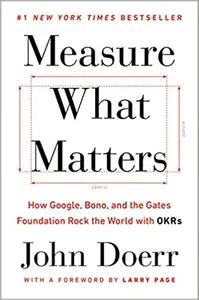
Measure What Matters: How Google, Bono, and the Gates Foundation Rock the World with OKRs
About This Book
Measure What Matters argues that great performance comes from disciplined execution, not just good ideas. John Doerr presents OKRs—Objectives and Key Results—as a practical system for turning ambition into measurable progress across companies, teams, and individuals.
At the core of the book is a simple distinction. An objective is what you want to achieve: significant, concrete, action-oriented, and ideally inspiring. Key results define how progress will be measured: specific, time-bound, aggressive yet realistic, and above all measurable. If a key result lacks a number or cannot be clearly scored, it is not doing its job. The book repeatedly stresses that completing all key results should mean the objective has been achieved.
From the highlights, the strongest themes are the four OKR “superpowers”:
- Focus: choose only a few priorities each cycle, typically three to five.
- Alignment: make goals visible so teams move in the same direction.
- Tracking: review progress frequently, score results, and adapt as conditions change.
- Stretching: set ambitious goals that push people beyond comfortable incrementalism.
Doerr also emphasizes that OKRs work best as a collaborative system, not a command-and-control tool. Roughly half of goals should come from the bottom up to preserve ownership and motivation. Transparency helps expose duplicate work, improve coordination, and deepen engagement. Leaders must communicate not only the what, but the why.
Another major thread is that OKRs are living goals, not rigid contracts. They can be updated, started, or stopped mid-cycle. Weekly or regular check-ins prevent “zombie goals,” while end-of-cycle scoring, self-assessment, and reflection turn execution into learning.
The broader message is managerial as much as procedural: organizations improve when they measure what matters, separate output from mere activity, and build a culture where data, reflection, autonomy, and shared purpose reinforce one another.
Key Takeaways
- 1.Execution matters more than ideas: the book’s core message is that organizations win by turning priorities into measurable action.
- 2.A strong OKR system forces leaders to choose a few high-leverage priorities instead of trying to focus on everything at once.
- 3.Transparency improves coordination because visible goals expose overlap, clarify dependencies, and invite help when progress stalls.
- 4.Bottom-up goal setting increases ownership; when people help shape goals, they are more motivated to follow through.
- 5.Hard, specific goals tend to outperform vague or easy ones, but ambition works best when paired with realism and context.
- 6.Regular check-ins and scoring keep goals alive; without them, plans drift away from reality and lose meaning.
- 7.Reflection after each cycle is essential because learning comes not just from experience, but from examining what the experience taught.
Top Highlights
Ideas are easy. Execution is everything.
Highlighted by 8 people · 1 left a note
Effective KRs are specific and time-bound, aggressive yet realistic. Most of all, they are measurable and verifiable.
Highlighted by 8 people
OKRs surface your primary goals. They channel efforts and coordination. They link diverse operations, lending purpose and unity to the entire organization.
Highlighted by 7 people
It is a collaborative goal-setting protocol for companies, teams, and individuals.
Highlighted by 5 people
Where an objective can be long-lived, rolled over for a year or longer, key results evolve as the work progresses.
Highlighted by 5 people
Second, specific hard goals “produce a higher level of output” than vaguely worded ones.
Highlighted by 5 people
Set goals from the bottom up. To promote engagement, teams and individuals should be encouraged to create roughly half of their own OKRs, in consultation with managers.
Highlighted by 5 people
Be patient;
Highlighted by 5 people
It is our choices . . . that show what we truly are, far more than our abilities.
Highlighted by 5 people · 1 left a note
Leaders must get across the why as well as the what. Their people need more than milestones for motivation. They are thirsting for meaning, to understand how their goals relate to the mission.
Highlighted by 5 people
AI Review
Glasp's AI analysis of 17 reader highlights suggests a strong consensus that this is a highly actionable management book. The most-saved passages center on clear definitions, measurable execution, alignment, and reflection, with notes showing practical interest rather than resistance.
Pros
- +Clear framework for distinguishing objectives from key results
- +Strong emphasis on measurable, unambiguous execution
- +Useful guidance on focus, alignment, and transparency
- +Encourages bottom-up ownership instead of pure top-down control
- +Practical advice on scoring, check-ins, and post-cycle reflection
- +Balances ambition with flexibility through stretch goals and mid-cycle updates
Cons
- −Can feel more operational than strategic for readers seeking broader management theory
- −Successful adoption appears to require multiple cycles and disciplined leadership support
- −The book strongly favors metric-driven systems, which may feel rigid in less measurable roles
Glasp AI analysis based on highlights from 17 readers.
Who Should Read This
This book is best for founders, executives, team leads, product managers, operations leaders, and HR managers who need a clearer way to set priorities and track execution. It is especially useful for scaling companies, cross-functional teams, and organizations frustrated by vague goals or annual performance reviews. You do not need deep prior knowledge, but readers responsible for planning, accountability, or organizational alignment will get the most value.
Frequently Asked Questions
What is the book about?
Who is the book for?
What are the key lessons of the book?
Is it worth reading?
How does the book define a good objective?
What makes a strong key result?
Does the book recommend rigid goal setting?
How to Apply What You Read
- 1.Audit your current goals and rewrite any vague objective into a clear what-plus-measure structure.
- 2.Limit your next cycle to three to five top objectives and no more than five key results per objective.
- 3.Publish team goals visibly so others can see priorities, dependencies, and progress.
- 4.Schedule weekly or biweekly check-ins to review scores, obstacles, and needed adjustments.
- 5.Reflect at the end of each cycle by scoring results, writing a short self-assessment, and capturing lessons for the next quarter.
Discussion Questions
- Q1.Why do so many organizations confuse activity with output, and how does that distort performance?
- Q2.What makes an objective inspiring without making it too vague to guide execution?
- Q3.How should leaders balance top-down direction with bottom-up ownership in goal setting?
- Q4.When does a stretch goal motivate a team, and when does it become discouraging or unrealistic?
- Q5.What are the risks of tying OKRs too closely to compensation or performance ratings?
- Q6.How much transparency around goals is helpful, and when might it create pressure or noise?
- Q7.What would change in your team if progress reviews and reflection became a normal part of every quarter?
Recommended Books




Revisit Your Highlights, Deepen Your Understanding
Import your Kindle highlights to review, organize, and share the ideas that matter most to you.
Get the free browser extension