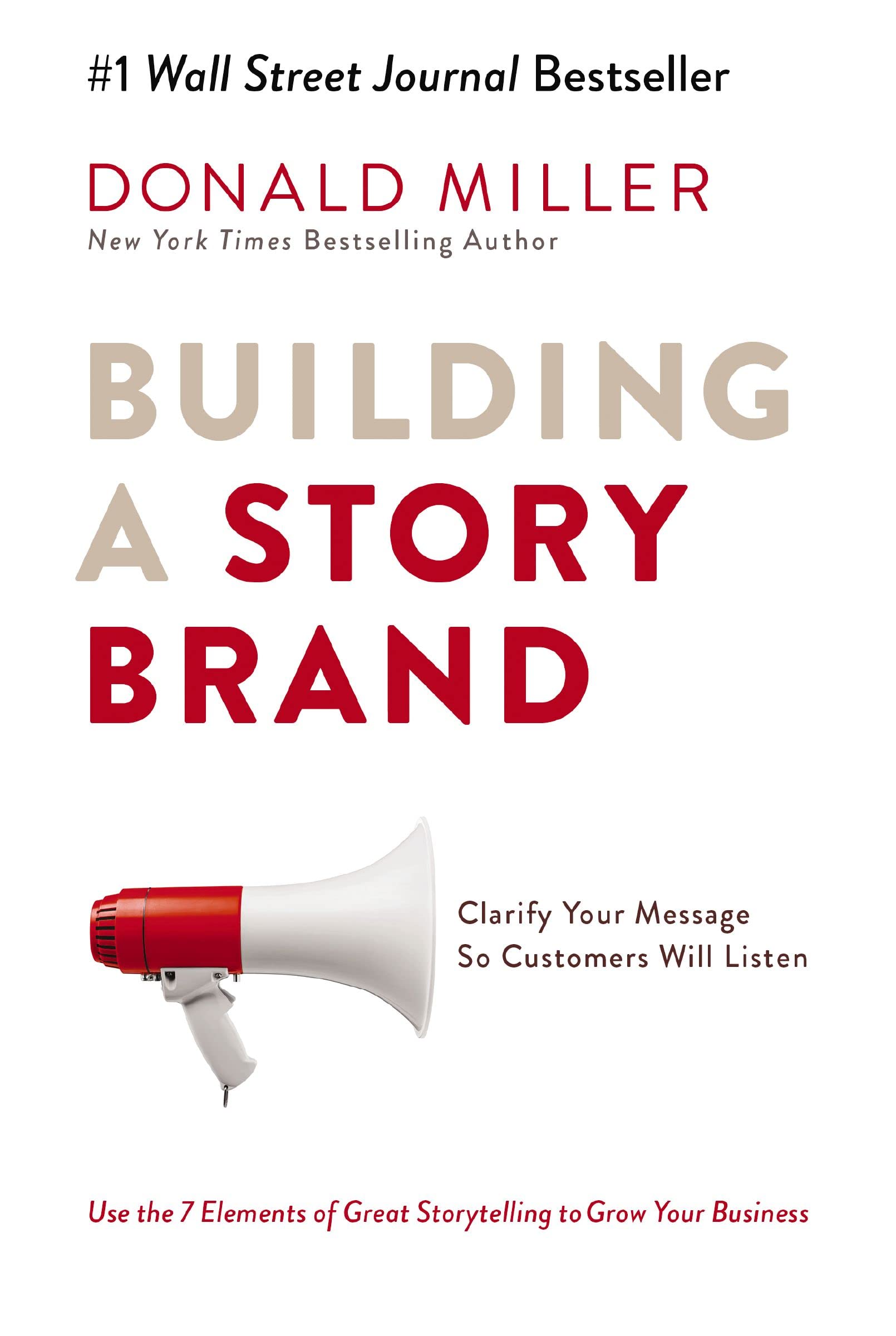
Building a StoryBrand: Clarify Your Message So Customers Will Listen
About This Book
Donald Miller’s Building a StoryBrand argues that most marketing fails not because the product is bad, but because the message is confusing. Readers most often highlighted two linked ideas: customers tune out brands that make them work too hard to understand an offer, and they pay attention when a message clearly shows how the offer helps them survive, thrive, belong, succeed, or become a better version of themselves.
The book structures marketing around a simple story framework. In Miller’s model, the customer is the hero, not the brand. The brand should act as the guide that understands the customer’s struggle, demonstrates authority, offers a plan, and calls them to action. This is the core shift that many readers found most resonant.
The framework itself is built around familiar story logic:
- A character wants something.
- That character faces a problem.
- A guide appears.
- The guide gives a plan.
- The guide calls the hero to act.
- The action helps avoid failure.
- The story ends in success.
From the highlights, several practical lessons stand out. First, customers should be able to answer within seconds: what you offer, how it improves their life, and what they should do next. Second, companies must address not only the customer’s external problem, but also the internal frustration and, when relevant, a larger philosophical wrong. Third, trust is built through empathy and authority, often supported by testimonials, statistics, logos, awards, and risk-reducing plans.
Overall, this is a playbook for clarifying websites, sales copy, brand positioning, and customer journeys. Its core claim is simple: people do not buy the objectively best product; they buy the one they can understand the fastest, and the one that clearly promises transformation.
Key Takeaways
- 1.Clarity beats cleverness: customers often choose the offer they can understand fastest, not necessarily the one with the most features.
- 2.Your customer is the hero of the story; your brand wins by acting as a trusted guide rather than the star.
- 3.People may describe external needs, but they are often more motivated by internal frustrations such as confusion, embarrassment, or self-doubt.
- 4.Effective messaging must show what is at stake: what failure looks like, what success looks like, and why the difference matters.
- 5.A strong brand message answers three questions quickly: what you offer, how it improves life, and what to do next.
- 6.Trust grows through a combination of empathy and authority, supported by proof like testimonials, logos, awards, and statistics.
- 7.Customers are drawn to transformation, so marketing should show not just a purchase, but the better identity or life outcome it enables.
Top Highlights
The first mistake brands make is they fail to focus on the aspects of their offer that will help people survive and thrive.
Highlighted by 9 people
The second mistake brands make is they cause their customers to burn too many calories in an effort to understand their offer.
Highlighted by 9 people
A CHARACTER who wants something encounters a PROBLEM before they can get it. At the peak of their despair, a GUIDE steps into their lives, gives them a PLAN, and CALLS THEM TO ACTION. That action helps them avoid FAILURE and ends in a SUCCESS.
Highlighted by 7 people · 1 left a note
Your customer should be the hero of the story, not your brand. This is the secret every phenomenally successful business understands.
Highlighted by 5 people
pretty websites don’t sell things. Words sell things. And if we haven’t clarified our message, our customers won’t listen.
Highlighted by 5 people · 1 left a note
easier it is for the brain to digest.
Highlighted by 5 people
All great stories are about survival—either
Highlighted by 5 people
In a story, audiences must always know who the hero is, what the hero wants, who the hero has to defeat to get what they want, what tragic thing will happen if the hero doesn’t win, and what wonderful thing will happen if they do.
Highlighted by 5 people
People don’t buy the best products; they buy the products they can understand the fastest.
Highlighted by 5 people
What most brands miss, however, is that there are three levels of problems a customer encounters. In stories, heroes encounter external, internal, and philosophical problems.
Highlighted by 5 people
AI Review
Glasp’s AI analysis of 20 reader highlights suggests strong consensus that this is a highly actionable marketing book with memorable, repeatable concepts. The densest highlight activity clusters around clarity, customer-centered messaging, and the StoryBrand framework, indicating unusually high practical resonance.
Pros
- +Clear, quotable core framework
- +Strong emphasis on customer as hero
- +Useful for websites, copy, and brand messaging
- +Memorable explanation of why confusion kills sales
- +Actionable guidance on calls to action and plans
- +Helpful distinction between external, internal, and philosophical problems
- +Practical trust-building tools like testimonials and social proof
Cons
- −Can feel formulaic if applied too rigidly
- −Some claims are presented with strong certainty
- −Examples occasionally repeat the same core idea
- −Best suited to messaging and positioning, not full-funnel marketing strategy
Glasp AI analysis based on highlights from 20 readers.
Who Should Read This
This book is best for small-business owners, marketers, consultants, copywriters, founders, agency teams, and anyone responsible for a website or sales messaging. It is especially useful if your offer is strong but prospects seem confused, disengaged, or slow to convert.
You do not need deep branding expertise to benefit. Readers building landing pages, case studies, email funnels, or service-based businesses will get the most immediate value, particularly if they need a simple framework for explaining what they do and why it matters to customers.
Frequently Asked Questions
What is the book about?
Who is it for?
What are the key lessons?
What is the StoryBrand framework?
Why does the book focus so much on simplicity?
What are the three levels of customer problems in the book?
Is it worth reading?
How to Apply What You Read
- 1.Rewrite your homepage so it clearly states what you offer, how it helps, and what action to take next.
- 2.Map your customer’s external, internal, and philosophical problems before writing any new sales copy.
- 3.Create one obvious direct call to action and pair it with a lower-risk transitional call to action, such as a guide or webinar.
- 4.Add trust signals like brief testimonials, relevant statistics, client logos, or guarantees to reduce buyer hesitation.
- 5.Draft a one-line brand message that positions the customer as the hero and your business as the guide.
Discussion Questions
- Q1.Why do so many brands instinctively position themselves as the hero, even when that weakens their message?
- Q2.Which matters more in buying decisions: solving the external problem or relieving the internal frustration behind it?
- Q3.How far can a storytelling framework be standardized before it starts making brands sound the same?
- Q4.What examples from your own work show the difference between clear messaging and noisy messaging?
- Q5.How can a company express authority without sounding self-centered or boastful?
- Q6.What kinds of products or industries fit the StoryBrand model especially well, and where might the framework be less effective?
- Q7.How should a brand balance simplicity with the need to communicate nuance in complex products or services?
Recommended Books


Revisit Your Highlights, Deepen Your Understanding
Import your Kindle highlights to review, organize, and share the ideas that matter most to you.
Get the free browser extension