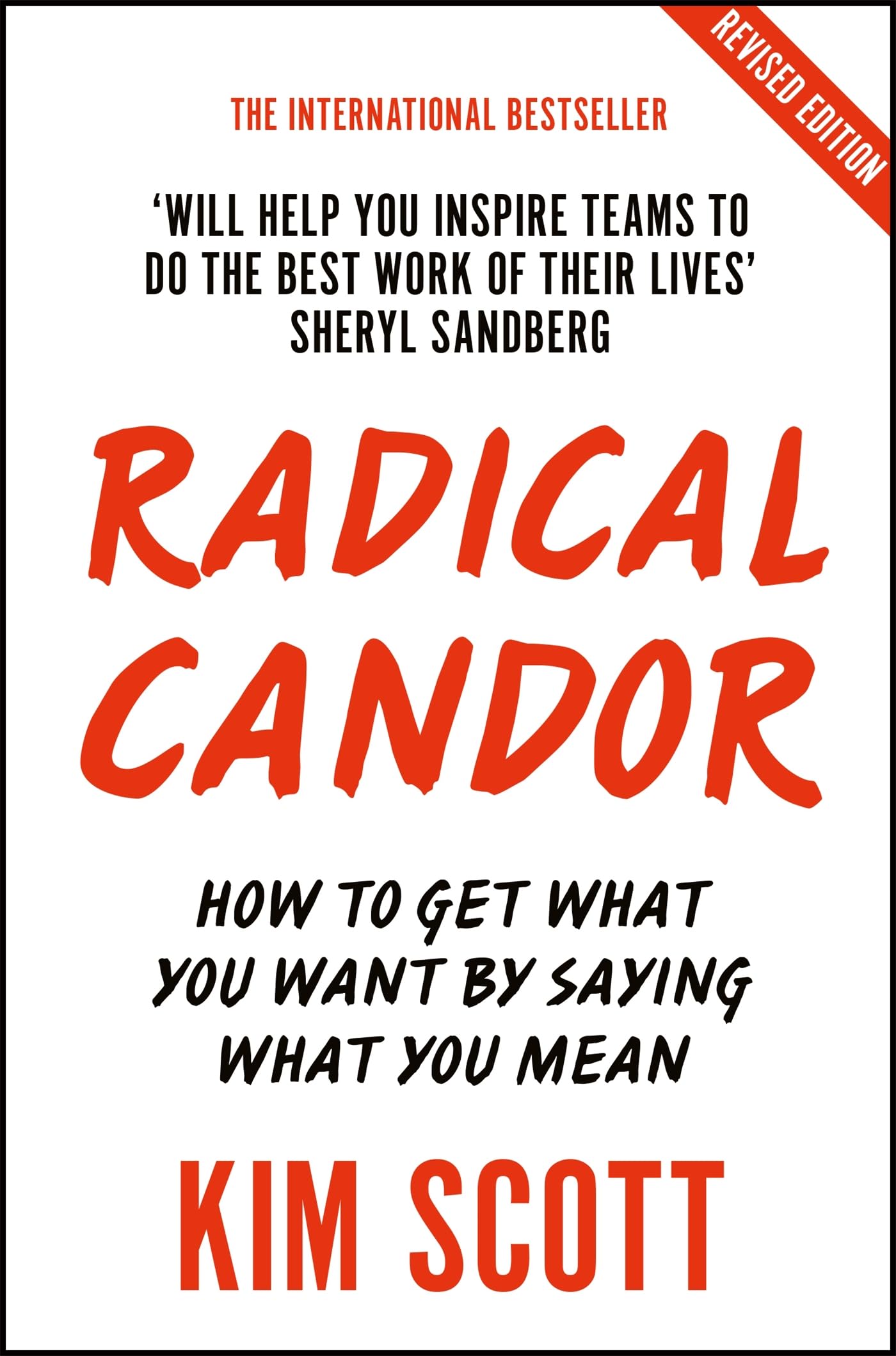
Radical Candor: How to Get What You Want by Saying What You Mean
About This Book
Radical Candor by Kim Scott argues that great management rests on building strong human relationships, and that the best bosses guide their teams along two simultaneous dimensions: Care Personally and Challenge Directly. When you do both at once, you get Radical Candor. Fail at either and you slide into one of three dysfunctional quadrants.
- Ruinous Empathy — caring but unwilling to criticize (the most common management mistake)
- Obnoxious Aggression — challenging without caring
- Manipulative Insincerity — neither caring nor challenging
Scott frames a boss's job around three responsibilities: creating a culture of guidance (praise and criticism), building a cohesive team by understanding what motivates each person, and driving results collaboratively. None of these is possible without trust.
Much of the book draws on Scott's experience at Apple and Google, with stories about Steve Jobs ("criticize the work, not the person"), Jony Ive, and the importance of soliciting criticism before dishing it out. She stresses that guidance should be humble, helpful, immediate, specific, praised in public, delivered in private, and never personalized. Praise should be as detailed as criticism, and rigid praise-to-criticism ratios are counterproductive.
On teams, Scott rejects the "potential" framing in favor of growth trajectory, distinguishing rock stars (excellent and content) from superstars (hungry to grow). Both are essential to a stable, high-performing team.
Crucially, Radical Candor is measured "at the listener's ear, not the speaker's mouth" — it is context-sensitive, not a license to be a jerk. The book's most reassuring claim is that candor, delivered with genuine care, usually produces gratitude rather than resentment, and happier, more successful teams.
Key Takeaways
- 1.Great management is built on strong relationships; authority and control alone won't fulfill a boss's responsibilities of guidance, team-building, and results.
- 2.Radical Candor is the intersection of caring personally and challenging directly—and it's measured by how the listener receives it, not by how bluntly you speak.
- 3.Ruinous Empathy—withholding criticism to avoid discomfort—causes the majority of management mistakes and ultimately harms the people you're trying to protect.
- 4.Criticize the work, not the person: avoid the fundamental attribution error by describing situation, behavior, and impact rather than labeling someone's character.
- 5.Ask for criticism before giving it, and reward candor visibly so people keep offering it; leaders must take feedback before they can credibly dish it out.
- 6.Replace the judgmental idea of "potential" with growth trajectory, recognizing that teams need both steady rock stars and ambitious superstars.
- 7.Give guidance immediately and informally—a two-to-three-minute conversation beats a scheduled meeting and prevents resentment from festering.
Top Highlights
compassion is empathy plus action.
Highlighted by 3 people
for every piece of subpar work you accept, for every missed deadline you let slip, you begin to feel resentment and then anger. You no longer just think the work is bad: you think the person is bad. This makes it harder to have an even-keeled conversation. You start to avoid talking to the person at all.
Highlighted by 3 people
Ultimately, though, bosses are responsible for results. They achieve these results not by doing all the work themselves but by guiding the people on their teams. Bosses guide a team to achieve results.
Highlighted by 3 people
relationships are core to your job. They determine whether you can fulfill your three responsibilities as a manager: 1) to create a culture of guidance (praise and criticism) that will keep everyone moving in the right direction; 2) to understand what motivates each person on your team well enough to avoid burnout or boredom and keep the team cohesive; and 3) to drive results collaboratively. If you think that you can do these things without strong relationships, you are kidding yourself.
Highlighted by 3 people
The most surprising thing about Radical Candor may be that its results are often the opposite of what you fear. You fear people will become angry or vindictive; instead they are usually grateful for the chance to talk it through.
Highlighted by 3 people
Only when you actually care about the whole person with your whole self can you build a relationship.
Highlighted by 3 people
The hardest part of building this trust is inviting people to challenge you, just as directly as you are challenging them. You have to encourage them to challenge you directly enough that you may be the one who feels upset or angry.
Highlighted by 3 people
when giving praise, investigate until you really understand who did what and why it was so great. Be as specific and thorough with praise as with criticism. Go deep into the details.
Highlighted by 3 people
learning how to help people create a habit of Radical Candor.
Highlighted by 2 people
It was productive and collaborative. It was free. It was driving to the best answer. How had Larry achieved that? I
Highlighted by 2 people
AI Review
Based on Glasp's analysis of highlights from 8 readers, Radical Candor resonates strongly for its memorable framework and practical guidance on a skill most managers find genuinely hard. Reader consensus clusters around its core ideas of caring personally while challenging directly.
Pros
- +A simple, sticky two-dimensional framework that readers repeatedly highlight and quote
- +Concrete, actionable techniques for soliciting criticism, giving praise, and delivering immediate feedback
- +Memorable stories from Apple and Google (Steve Jobs, Jony Ive) that illustrate the principles
- +Reframes "potential" as growth trajectory, distinguishing rock stars from superstars
- +Directly names the trap of Ruinous Empathy that most managers fall into
- +Emphasizes that candor is measured at the listener's ear, guarding against the "jerk" misreading
Cons
- −Heavily anchored in Silicon Valley tech culture, which may not transfer cleanly to every industry
- −Treatment of gender, race, and power imbalances is acknowledged but largely deferred to a future book
- −Some readers may find the frameworks and acronyms repetitive across chapters
Glasp AI analysis based on highlights from 8 readers.
Who Should Read This
This book is for new and experienced managers, team leads, founders, and executives who struggle with giving honest feedback or fear that being kind means avoiding hard conversations. It's especially valuable for those stuck in Ruinous Empathy—pleasant bosses whose teams never hear the truth. Individual contributors aspiring to leadership, HR and people-operations professionals designing feedback and promotion systems, and anyone who manages relationships "up, down, and sideways" will benefit. No prior management theory is required.
Frequently Asked Questions
What is Radical Candor about?
Who is the book for?
What are the key lessons?
What is Ruinous Empathy?
Does Radical Candor mean being harsh or blunt?
What's the difference between rock stars and superstars?
Is it worth reading?
How to Apply What You Read
- 1.Solicit criticism from your team first—ask "What could I do or stop doing that would make it easier to work with me?"—and resist defending yourself when you hear it.
- 2.Reward candor immediately: thank people publicly, act on feedback you agree with, and explain clearly when you don't.
- 3.Deliver praise and criticism in 2–3 minutes right away, in person, praising in public and criticizing in private, and describing specific behavior rather than the person.
- 4.Have career conversations to learn each person's growth trajectory and life goals, then assign roles and opportunities that fit what they actually want.
- 5.Audit your own behavior against the four quadrants regularly, treating it as a compass for individual conversations rather than a label for yourself or others.
Discussion Questions
- Q1.Think of a time you withheld honest feedback to avoid discomfort. What was the long-term cost of that Ruinous Empathy?
- Q2.How do you personally balance caring about someone as a whole person with the hierarchy and authority of being their boss?
- Q3.Scott says candor is measured at the listener's ear, not the speaker's mouth. How might the same feedback land differently depending on who delivers it and to whom?
- Q4.The book acknowledges that gender, race, and cultural differences make Radical Candor riskier for some people. How does that affect who can safely practice it in your workplace?
- Q5.Are you better at giving praise or criticism, and how specific and detailed is each? What would it take to investigate praise as thoroughly as criticism?
- Q6.Do you have rock stars on your team who are quietly excellent but not seeking promotion? Are you honoring them or pushing them toward roles they don't want?
- Q7.What concrete system could you put in place—like Toyota's red box—to invite criticism upward and make it safe for people to challenge you?
Recommended Books








Revisit Your Highlights, Deepen Your Understanding
Import your Kindle highlights to review, organize, and share the ideas that matter most to you.
Get the free browser extension