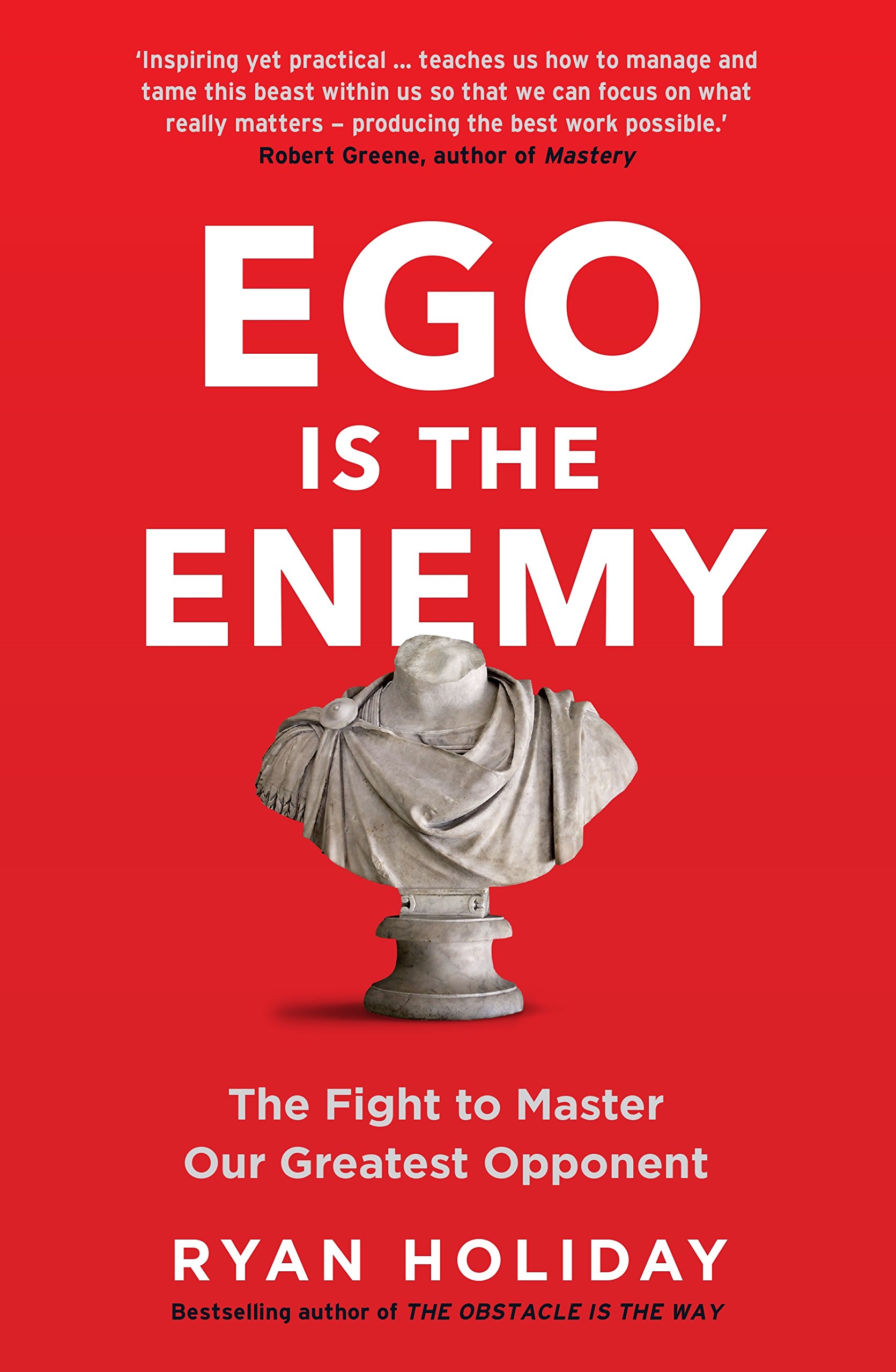
Ego is the Enemy: The Fight to Master Our Greatest Opponent (The Way, the Enemy and the Key)




About This Book
Ego is the Enemy by Ryan Holiday argues that the single greatest obstacle to achievement and fulfillment is not external competition but the ego within—"an unhealthy belief in our own importance" that exceeds the bounds of confidence and talent. Drawing on Stoic philosophy and a gallery of historical figures (William Tecumseh Sherman, Eleanor Roosevelt, Jackie Robinson, Benjamin Franklin, John Boyd, Bill Walsh), Holiday shows how ego deceives us, separates us from reality, and ultimately sabotages the very success we crave.
The book is organized around three recurring life stages.
- Aspire — be humble before bad habits take hold
- Success — be gracious so achievement doesn't corrupt
- Failure — be resilient so setbacks don't destroy you
Across these phases, Holiday returns to core themes: talk depletes the energy we need for doing ("talking and doing fight for the same resources"); silence and quiet work are signs of strength, not weakness; we must remain perpetual students who actively seek harsh feedback and update our self-appraisal downward; and we should pursue purpose rather than passion or recognition.
John Boyd's famous challenge—"To be or to do?"—anchors the argument: will you chase status, promotion, and validation, or will you do meaningful work even at personal cost? Holiday insists ego is manageable and directable, not a force we must satiate. The antidote is rock-hard humility paired with earned confidence, relentless self-assessment, and an action-and-education focus over status-seeking. The closing message is to act small while thinking big, to clear the path for others (the "canvas strategy"), and to define success—as John Wooden did—as the peace of mind that comes from knowing you did your best.
Key Takeaways
- 1.The ego is "a conscious separation from" reality—it inhibits success by blocking honest connection to the world, feedback, and our own true abilities.
- 2.Talk depletes us: talking and doing fight for the same resources, and verbalizing goals can fool us into feeling we've already made progress.
- 3.Success demands choosing purpose over passion and recognition—asking "What do I want to accomplish?" rather than "Who do I want to be?"
- 4.Mastery requires being a perpetual student: actively seeking harsh feedback and updating your self-appraisal downward, since "the pretense of knowledge is our most dangerous vice."
- 5.The book maps to three stages—be humble in aspiration, gracious in success, and resilient in failure—so ego doesn't wreck you at any point.
- 6.True confidence is earned, while ego is stolen and self-anointed; humility and earned confidence can hold weight where ego collapses.
- 7.Doing great work means acting small while thinking big—iterative progress, quiet effort, and clearing the path for others rather than chasing the limelight.
Top Highlights
We will learn that though we think big, we must act and live small in order to accomplish what we seek. Because we will be action and education focused, and forgo validation and status, our ambition will not be grandiose but iterative—one foot in front of the other, learning and growing and putting in the time.
Highlighted by 6 people
Success requires a full 100 percent of our effort, and talk flitters part of that effort away before we can use it.
Highlighted by 6 people
In this course, it is not “Who do I want to be in life?” but “What is it that I want to accomplish in life?” Setting aside selfish interest, it asks: What calling does it serve? What principles govern my choices? Do I want to be like everyone else or do I want to do something different?
Highlighted by 6 people
“It is impossible to learn that which one thinks one already knows,” Epictetus says. You can’t learn if you think you already know. You will not find the answers if you’re too conceited and self-assured to ask the questions. You cannot get better if you’re convinced you are the best.
Highlighted by 6 people
If your purpose is something larger than you—to accomplish something, to prove something to yourself—then suddenly everything becomes both easier and more difficult. Easier in the sense that you know now what it is you need to do and what is important to you. The other “choices” wash away, as they aren’t really choices at all. They’re distractions. It’s about the doing, not the recognition. Easier in the sense that you don’t need to compromise. Harder because each opportunity—no matter how gratifying or rewarding—must be evaluated along…
Highlighted by 5 people
breakthroughs. After spending so much time thinking, explaining, and talking about a task, we start to feel that we’ve gotten closer to achieving it. Or worse, when things get tough, we feel we can toss the whole project aside because we’ve given it our best try, although of course we haven’t.
Highlighted by 5 people
One might say that the ability to evaluate one’s own ability is the most important skill of all. Without it, improvement is impossible. And certainly ego makes it difficult every step of the way. It is certainly more pleasurable to focus on our talents and strengths, but where does that get us? Arrogance and self-absorption inhibit growth. So does fantasy and “vision.”
Highlighted by 4 people
Those who know do not speak. Those who speak do not know. — LAO TZU
Highlighted by 4 people
We seem to think that silence is a sign of weakness. That being ignored is tantamount to death (and for the ego, this is true). So we talk, talk, talk as though our life depends on it.
Highlighted by 4 people
In actuality, silence is strength—particularly early on in any journey. As the philosopher (and as it happens, a hater of newspapers and their chatter) Kierkegaard warned, “Mere gossip anticipates real talk, and to express what is still in thought weakens action by forestalling it.”
Highlighted by 4 people
AI Review
Based on Glasp's analysis of highlights from 9 readers, Ego is the Enemy resonates strongly for its quotable wisdom and clear three-part framework. Consensus clusters tightly around humility, silence over talk, and the lifelong student mindset.
Pros
- +Memorable three-stage framework: Aspire, Success, Failure
- +Compelling counterintuitive insight that talk depletes the energy needed for doing
- +Rich historical examples (Sherman, Boyd, Roosevelt, Franklin) that make abstractions concrete
- +Grounded in Stoic philosophy with timeless, quotable passages
- +Practical emphasis on seeking harsh feedback and staying a perpetual student
Cons
- −Anecdotal and aphoristic style can feel repetitive across chapters
- −Light on systematic, step-by-step methods for actually overcoming ego
- −Some readers wanted more nuance on ego's positive uses and the role of empathy
Glasp AI analysis based on highlights from 9 readers.
Who Should Read This
This book is for ambitious high achievers—entrepreneurs, creatives, athletes, leaders, and students—who feel driven yet sense that craving validation may be holding them back. It speaks especially to those early in a journey tempted to talk rather than do, and to successful people whose past wins blind them to growth. Readers drawn to Stoic philosophy, self-discipline, and practical wisdom will find it most rewarding. No prior philosophy background is needed.
Frequently Asked Questions
What is Ego is the Enemy about?
Who is this book for?
What are the key lessons?
Is it worth reading?
What does "To be or to do?" mean?
Why does the book say talking is dangerous?
How is this different from typical self-help books?
How to Apply What You Read
- 1.Practice silence: stop announcing your goals and resist the urge to talk about your work—pour that energy into doing it instead.
- 2.Seek out harsh feedback deliberately, especially when your brain insists you're doing great, and revise your self-assessment honestly.
- 3.Ask Boyd's question before each opportunity—"To be or to do?"—and choose meaningful work over status, recognition, or easy validation.
- 4.Stay a student by finding someone better to learn from, someone lesser to teach, and an equal to challenge you, as Frank Shamrock advises.
- 5.Redefine success as John Wooden did: peace of mind from knowing you made your best effort, rather than external praise or comparison to others.
Discussion Questions
- Q1.When in your life has ego cost you an opportunity or relationship—and did you recognize it at the time?
- Q2.Boyd asks "To be or to do?" Which path are you currently on, and what compromises does it require?
- Q3.Do you tend to talk about your goals or quietly work on them—and how has that affected your follow-through?
- Q4.Where might you need to update your self-appraisal downward in order to actually improve?
- Q5.How do you distinguish earned confidence from ego in yourself and in the people you admire?
- Q6.The book contrasts purpose with passion. What is your purpose, and is your passion serving it or distracting from it?
- Q7.How would your daily choices change if you defined success purely as the effort you put in rather than the recognition you receive?
Recommended Books

Revisit Your Highlights, Deepen Your Understanding
Import your Kindle highlights to review, organize, and share the ideas that matter most to you.
Get the free browser extension