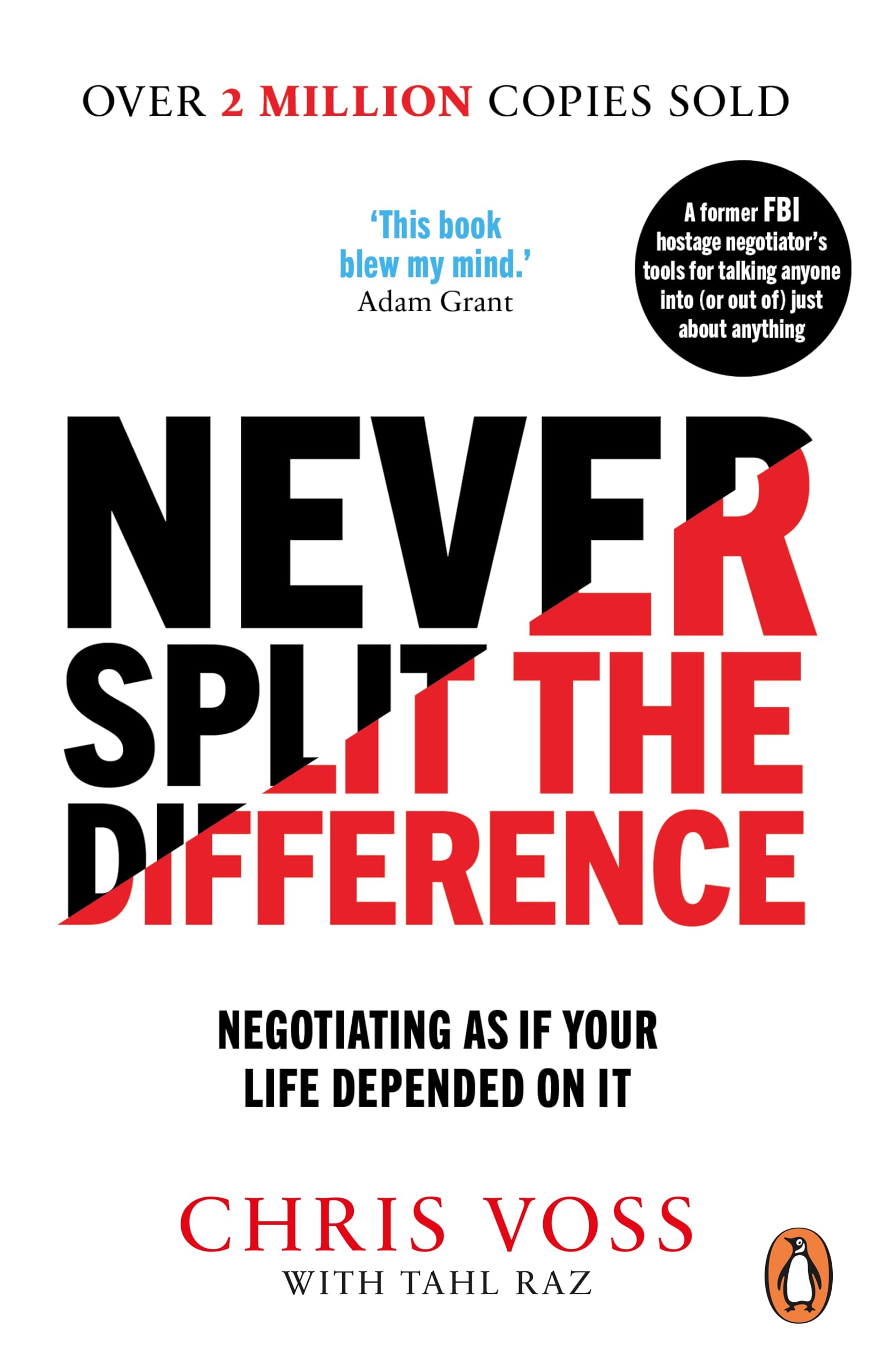
Never Split the Difference: Negotiating as if Your Life Depended on It
About This Book
Chris Voss argues that negotiation is not a logical contest or a polite compromise exercise. It is a process of discovery shaped by human emotion, hidden needs, and the other side’s desire to feel safe, understood, and in control. Across the most-highlighted passages, readers consistently focused on one core idea: before you can influence outcomes, you must get the other person talking long enough to reveal what they actually need.
The book’s central method is tactical empathy: active listening that validates emotions without necessarily agreeing with them. Voss presents negotiation as a sequence of emotional moves rather than a script of rational offers. Key tools include mirroring, labeling, summaries that trigger “that’s right,” and calibrated “what” and “how” questions that guide the conversation while giving the counterpart the illusion of control.
Several highlighted themes structure the book:
- Listen first to uncover needs beneath positions.
- Treat assumptions as hypotheses and use conversation to reveal surprises.
- Use voice intentionally, especially a calm, slow tone and a positive, playful default.
- Mirror and label emotions to reduce defensiveness and build trust.
- Welcome “No” because it creates safety and opens real dialogue.
- Avoid compromise for its own sake; splitting the difference often produces weak outcomes.
- Frame loss clearly because people are more motivated to avoid losses than pursue gains.
The highlights also show how strongly readers responded to Voss’s use of behavioral psychology, especially Kahneman’s System 1/System 2 model and loss aversion. His point is practical: emotions drive decisions first, and logic follows. That makes negotiation less about winning arguments and more about shaping the emotional conditions in which better decisions can happen.
In effect, the book reframes negotiation as communication with results—useful not only in hostage crises, but in salary talks, sales, management, family conflict, and everyday requests.
Key Takeaways
- 1.Negotiation is discovery, not debate; the goal is to uncover hidden wants, fears, and constraints.
- 2.People need to feel safe and in control before they will reveal what really matters to them.
- 3.Listening is the most effective concession because it lowers defensiveness and encourages the other side to think more clearly.
- 4.Mirroring, labeling, silence, and summaries help build rapport and often produce the crucial response: “That’s right.”
- 5.An early “Yes” can be counterfeit, while a well-timed “No” often opens a more honest conversation.
- 6.Tone and delivery matter as much as content; calm, positive voices create trust, while assertive tones create pushback.
- 7.Loss aversion is powerful, so leverage increases when the other side sees what they could lose by inaction.
Top Highlights
The goal is to identify what your counterparts actually need (monetarily, emotionally, or otherwise) and get them feeling safe enough to talk and talk and talk some more about what they want.
Highlighted by 10 people
Good negotiators, going in, know they have to be ready for possible surprises; great negotiators aim to use their skills to reveal the surprises they are certain exist.
Highlighted by 9 people
all starts with the universally applicable premise that people want to be understood and accepted. Listening is the cheapest, yet most effective concession we can make to get there. By listening intensely, a negotiator demonstrates empathy and shows a sincere desire to better understand what the other side is experiencing.
Highlighted by 7 people
But neither wants nor needs are where we start; it begins with listening, making it about the other people, validating their emotions, and creating enough trust and safety for a real conversation to begin.
Highlighted by 7 people
There are essentially three voice tones available to negotiators: the late-night FM DJ voice, the positive/playful voice, and the direct or assertive
Highlighted by 7 people
What were needed were simple psychological tactics and strategies that worked in the field to calm people down, establish rapport, gain trust, elicit the verbalization of needs, and persuade the other guy of our empathy.
Highlighted by 6 people
Mirroring, also called isopraxism, is essentially imitation. It’s another neurobehavior humans (and other animals) display in which we copy each other to comfort each other.
Highlighted by 6 people
for the FBI, a “mirror” is when you repeat the last three words
Highlighted by 6 people
It’s just four simple steps: Use the late-night FM DJ voice. Start with “I’m sorry …” Mirror. Silence. At least four seconds, to let the mirror work its magic on your counterpart. Repeat.
Highlighted by 6 people
Research shows that the best way to deal with negativity is to observe it, without reaction and without judgment. Then consciously label each negative feeling and replace it with positive, compassionate, and solution-based thoughts.
Highlighted by 6 people
AI Review
Glasp’s AI analysis of 16 reader highlights suggests a strong consensus that this is a highly actionable and memorable negotiation book. The most-saved passages cluster around practical tools for listening, emotional framing, and influence, with little evidence of negative reader reaction in the provided signal.
Pros
- +Highly actionable negotiation tactics readers repeatedly highlighted
- +Strong emphasis on listening and emotional intelligence over posturing
- +Memorable techniques like mirroring, labeling, and calibrated questions
- +Useful across business, sales, management, and personal life
- +Grounded in behavioral psychology and decision-making research
- +Clear reframing of “No” as a productive part of negotiation
Cons
- −Some tactics can feel manipulative if applied mechanically
- −The repeated hostage-negotiation framing may feel intense for some business readers
- −Less emphasis on collaborative win-win models than some readers may expect
Glasp AI analysis based on highlights from 16 readers.
Who Should Read This
This book is best for salespeople, founders, managers, recruiters, procurement professionals, freelancers, and anyone navigating salary discussions, client work, or difficult conversations at home. It’s especially useful for readers who default to logic, rush to compromise, or dislike conflict.
You do not need formal negotiation training. The ideas are accessible, but they reward people willing to practice conversation tactics such as mirroring, labeling, and calibrated questions in real situations.
Frequently Asked Questions
What is the book about?
Who is this book for?
What are the key lessons from the book?
Why does the book say never split the difference?
How does mirroring work in negotiation?
Why is No considered useful in this approach?
Is the book worth reading?
How to Apply What You Read
- 1.Practice mirroring by repeating the last one to three important words in low-stakes conversations.
- 2.Replace yes-oriented questions with calibrated “what” and “how” questions such as “How am I supposed to do that?”
- 3.Slow your pacing in difficult conversations and leave at least a few seconds of silence after a mirror or label.
- 4.Prepare an accusation audit by listing the negative things the other side may think about you before the conversation starts.
- 5.Notice your tone of voice and default to a warm, playful delivery unless you need calm authority.
Discussion Questions
- Q1.How does the book’s view of negotiation differ from traditional win-win or compromise-based models?
- Q2.Which tactic seems most useful in everyday life: mirroring, labeling, summaries, or calibrated questions? Why?
- Q3.When does encouraging “No” create better conversations, and when might it be misunderstood?
- Q4.Does the book offer ethical influence, manipulative persuasion, or some mix of both?
- Q5.How does the focus on emotion change the way you think about making decisions at work?
- Q6.What kinds of negotiations are most harmed by moving too fast?
- Q7.How can someone apply tactical empathy without sounding scripted or artificial?
Recommended Books






Revisit Your Highlights, Deepen Your Understanding
Import your Kindle highlights to review, organize, and share the ideas that matter most to you.
Get the free browser extension