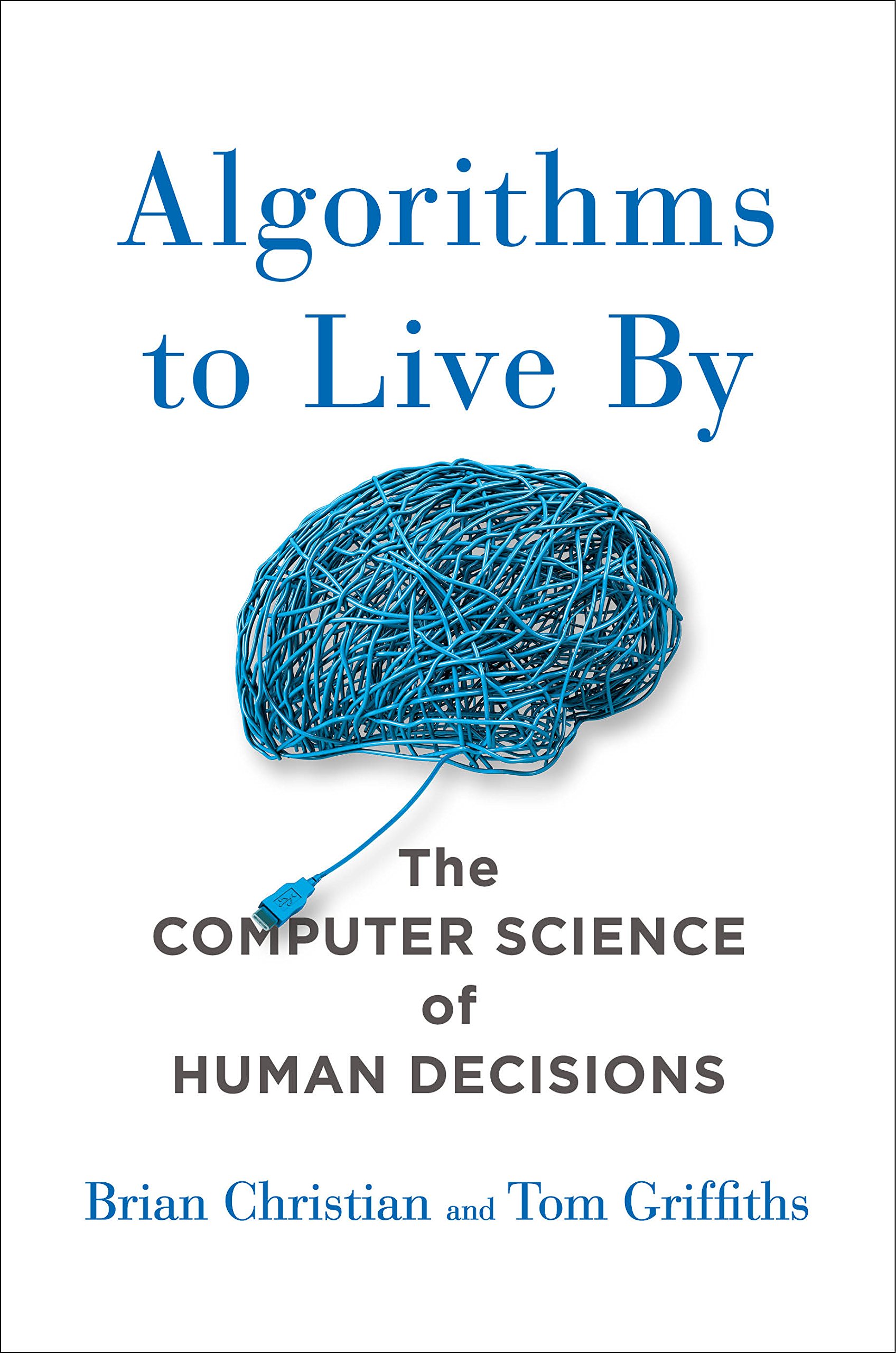
Algorithms to Live By: The Computer Science of Human Decisions
About This Book
Algorithms to Live By argues that the same computational problems computer scientists have spent decades solving are the very dilemmas humans face daily — from finding an apartment to choosing a partner to organizing a closet. Brian Christian and Tom Griffiths translate formal algorithms into practical wisdom, showing that an algorithm is simply "a finite sequence of steps used to solve a problem," older by far than computers themselves.
The book opens with optimal stopping and its famous 37% Rule: spend the first 37% of any search noncommittally calibrating, then leap at the first option that beats everything seen so far. This single framework explains apartment hunting, the "secretary problem," parking, and even serial monogamy. From there it moves through major domains:
- The explore/exploit tradeoff — when to try new things versus enjoy favorites, where the interval makes the strategy.
- Sorting and caching — why "scale hurts" and when messiness beats organization.
- Scheduling, overfitting, and relaxation — how thinking less and using approximations can improve decisions.
- Bayes's Rule, randomness, and game theory — how to predict, when to add jitter, and how protocol underpins human connection.
A recurring theme is that human "irrationality" often reflects the intrinsic difficulty of problems rather than buggy brains. Real-world computation requires "being comfortable with chance, trading off time with accuracy, and using approximations." The authors also distinguish process from outcome: follow the best possible process and you shouldn't blame yourself if luck doesn't cooperate. Ultimately the book reframes rationality itself — sometimes the optimal move is to relax, toss a coin, trust your instincts, and not look back.
Key Takeaways
- 1.The 37% Rule gives the optimal strategy for stopping problems: calibrate for the first 37%, then commit to the first option that beats your best so far.
- 2.In the explore/exploit tradeoff, nothing matters more than the interval — explore early when knowledge has time to pay off, exploit later when you're ready to enjoy what you've found.
- 3.Computer science distinguishes process from outcome: if you followed the best possible process, a bad result isn't your fault.
- 4.Real-world problem-solving requires being comfortable with chance, trading time for accuracy, and using approximations rather than exhaustive perfection.
- 5.Sometimes less is more — thinking and doing less (early stopping, regularization, broad strokes) yields better decisions under uncertainty.
- 6.Many human "errors" reflect the intrinsic difficulty of problems, not flawed brains; in slim pickings, the rational move is to lower your standards.
- 7.Treat searching and sorting wisely — "scale hurts," and a self-organizing mess can beat the effort of organizing everything.
Top Highlights
Optimal stopping tells us when to look and when to leap.
Highlighted by 5 people
human algorithm design
Highlighted by 4 people
tackling real-world tasks requires being comfortable with chance, trading off time with accuracy, and using approximations.
Highlighted by 4 people
Thirty-seven percent.
Highlighted by 3 people
a class of mathematical problems known as “optimal stopping” problems.
Highlighted by 3 people
Optimal stopping is the science of serial monogamy.
Highlighted by 3 people
“algorithm” comes from the name of Persian mathematician al-Khwārizmī, author of a ninth-century book of techniques for doing mathematics by hand.
Highlighted by 3 people
In any optimal stopping problem, the crucial dilemma is not which option to pick, but how many options to even consider.
Highlighted by 3 people
(A mathematician might say you have access only to the ordinal numbers—the relative ranks of the applicants compared to each other—but not to the cardinal numbers, their ratings on some kind of general scale.)
Highlighted by 3 people · 1 left a note
Look-Then-Leap Rule
Highlighted by 3 people
AI Review
Glasp's analysis of 13 readers' highlights shows strong, concentrated engagement around the book's core frameworks — especially optimal stopping and the explore/exploit tradeoff — signaling content readers found both memorable and immediately applicable.
Pros
- +Strong consensus: the 37% Rule and optimal stopping passages were highlighted by many readers, marking them as the book's standout ideas
- +Translates abstract computer science into concrete, everyday advice (apartments, parking, dating, closets)
- +Memorable, quotable principles like "the interval makes the strategy" and "don't look back"
- +Reframes human "irrationality" as a rational response to genuinely hard problems
- +Broad coverage spanning sorting, caching, scheduling, overfitting, Bayes, and game theory
Cons
- −Highlights cluster heavily in the early optimal-stopping chapters, suggesting later sections engaged readers less
- −Some technical material (Big-O, relaxation methods, distributions) may feel dense for casual readers
Glasp AI analysis based on highlights from 13 readers.
Who Should Read This
Ideal for curious generalists who enjoy popular science that bridges math and daily life — readers of Daniel Kahneman or Malcolm Gladwell. Useful for decision-makers, managers, and product thinkers wanting frameworks for choosing under uncertainty, and for students or professionals in computer science who want to see their field's concepts applied to human problems. No advanced math is required, though comfort with light quantitative reasoning helps. Anyone wrestling with when to commit, when to explore, and how to organize life will find concrete guidance here.
Frequently Asked Questions
What is Algorithms to Live By about?
Who is the book for?
What is the 37% Rule?
What is the explore/exploit tradeoff?
What are the key lessons of the book?
Is Algorithms to Live By worth reading?
Does the book require a math or programming background?
How to Apply What You Read
- 1.Apply the 37% Rule to your next big search — set an explicit looking phase, then be ready to commit decisively once it ends.
- 2.Match your explore-vs-exploit behavior to your time horizon: try new things when you'll have time to benefit, and savor favorites when the interval is short.
- 3.Resist revisiting passed-over options — treat the time already spent searching as a sunk cost and don't second-guess.
- 4.Simplify decisions under high uncertainty by using broad strokes, early stopping, or a pro-and-con list rather than over-optimizing.
- 5.Separate process from outcome when reviewing your choices — judge whether you used a sound strategy, not whether luck cooperated.
Discussion Questions
- Q1.Where in your own life have you stopped a search too early or held out too long, and how might the 37% Rule have changed your decision?
- Q2.Do you tend to over-explore or over-exploit? How does your current life interval shape that tendency?
- Q3.The book claims "gold digging" succeeds more often than a quest for love because objective criteria give fuller information. Do you find this framing useful or troubling?
- Q4.How comfortable are you separating process from outcome when judging your own decisions?
- Q5.When is embracing messiness or doing less genuinely smarter than organizing and optimizing?
- Q6.Which everyday problem in your life would benefit most from an algorithmic approach, and why?
- Q7.Does framing human behavior in computational terms feel illuminating or reductive to you?
Recommended Books

Revisit Your Highlights, Deepen Your Understanding
Import your Kindle highlights to review, organize, and share the ideas that matter most to you.
Get the free browser extension