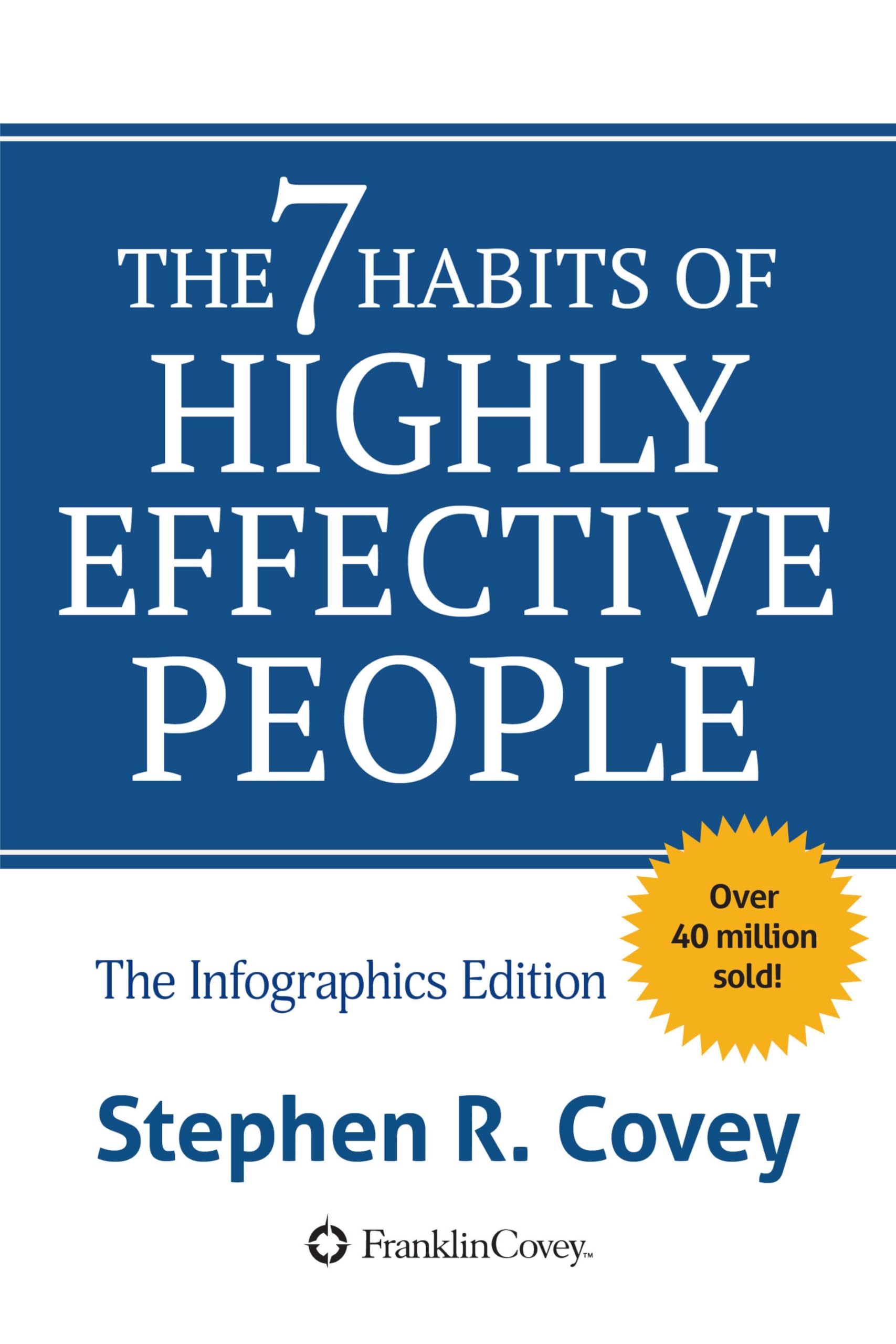
The 7 Habits of Highly Effective People: The Infographics Edition
About This Book
Stephen Covey’s book argues that lasting effectiveness does not come from image, charm, or quick self-improvement tactics. It comes from an inside-out change rooted in character, principles, and the way we see the world. The most-highlighted passages show strong reader interest in Covey’s contrast between the older Character Ethic—integrity, humility, courage, justice, patience—and the more modern Personality Ethic, which emphasizes public image, techniques, and positive presentation. Covey does not reject skills or positive thinking, but insists they are secondary to character.
A central idea is that behavior flows from deeper paradigms. We do not see the world as it is, but as we are conditioned to see it. So meaningful change requires examining the “map” we use to interpret reality, not just adjusting outward behavior. Readers especially resonated with the family example in which Covey and his wife stop trying to fix their son and instead change their perception of him. That shift leads from judgment and manipulation to respect, affirmation, and trust.
The book then organizes effectiveness as a developmental sequence:
- Dependence to independence through private victories and self-mastery.
- Independence to interdependence through cooperation, trust, and shared success.
- Ongoing renewal through continual growth.
Another heavily highlighted lesson is proactivity: human beings can choose their response rather than being driven by moods, circumstances, or other people. Covey links this to values, responsibility, and focus on the Circle of Influence rather than the Circle of Concern.
He also stresses balance. True effectiveness means preserving both results and the capacity to produce them, what he calls the P/PC Balance. Across parenting, work, relationships, and leadership, the message is consistent: no shortcut can replace principles, process, and character. Private victories come before public victories, and trust grows from what a person truly is, not what they pretend to be.
Key Takeaways
- 1.Character before technique: lasting effectiveness depends more on integrity and principles than on charm, image, or influence tactics.
- 2.Your behavior grows from your paradigms, so major life change requires changing how you see, not just what you do.
- 3.Proactivity means choosing your response based on values rather than letting feelings or circumstances dictate your actions.
- 4.Private victories come before public victories; self-mastery is the foundation for trust, teamwork, and healthy relationships.
- 5.Independence is important, but interdependence is the more mature goal in marriage, family, and organizational life.
- 6.Real effectiveness requires balancing results with the capacity to keep producing those results, not sacrificing one for the other.
- 7.Trust grows from what you truly are, and manipulation eventually undermines relationships even when the technique looks polished.
Top Highlights
Your attitude determines your altitude,
Highlighted by 4 people
Principles are not values. A
Highlighted by 4 people
We are what we repeatedly do. Excellence, then, is not an act, but a habit.
Highlighted by 4 people
Reactive people are driven by feelings, by circumstances, by conditions, by their environment.
Highlighted by 4 people
I’m busy—really busy. But sometimes I wonder if what I’m doing will make any difference in the long run. I’d really like to think there was meaning in my life, that somehow things were different because I was here.
Highlighted by 3 people
Character Ethic taught that there are basic principles of effective living, and that people can only experience true success and enduring happiness as they learn and integrate these principles into their basic character.
Highlighted by 3 people
after World War I the basic view of success shifted from the Character Ethic to what we might call the Personality Ethic.
Highlighted by 3 people
“Search your own heart with all diligence for out of it flow the issues of life.”
Highlighted by 3 people
The more aware we are of our basic paradigms, maps, or assumptions, and the extent to which we have been influenced by our experience, the more we can take responsibility for those paradigms, examine them, test them against reality, listen to others and be open to their perceptions, thereby getting a larger picture and a far more objective view.
Highlighted by 3 people
It becomes obvious that if we want to make relatively minor changes in our lives, we can perhaps appropriately focus on our attitudes and behaviors. But if we want to make significant, quantum change, we need to work on our basic paradigms.
Highlighted by 3 people
AI Review
Glasp’s AI analysis of 29 reader highlights suggests a strong consensus that this is a highly impactful personal-development classic. The highlights cluster around durable, quotable ideas on character, paradigm shifts, proactivity, and interdependence, with notes showing predominantly positive and reflective engagement.
Pros
- +Principle-centered framework for lasting effectiveness
- +Memorable distinction between Character Ethic and Personality Ethic
- +Strong emphasis on paradigm shifts rather than superficial behavior fixes
- +Actionable model of dependence, independence, and interdependence
- +Resonant lessons on proactivity and responsibility
- +Useful across work, parenting, leadership, and relationships
- +Highly quotable concepts such as Circle of Influence and P/PC Balance
Cons
- −Some ideas are repeated for emphasis
- −Can feel morally prescriptive to some readers
- −Examples and framing may feel dated in places
Glasp AI analysis based on highlights from 29 readers.
Who Should Read This
This book is best for managers, parents, team leaders, career professionals, and anyone who feels busy but not meaningfully effective. It is especially useful for readers tired of productivity hacks or surface-level self-help and ready to work on character, priorities, and relationships. No specialist background is required, but it helps if you are willing to reflect honestly on your habits, assumptions, and patterns with other people.
Frequently Asked Questions
What is the book about?
Who is the book for?
What are the key lessons?
What does Covey mean by the Character Ethic versus the Personality Ethic?
What is a paradigm in this book?
Why does the book emphasize proactivity so much?
Is it worth reading?
How to Apply What You Read
- 1.Audit your current habits and identify which are driven by values versus moods, pressure, or social approval.
- 2.Map one recurring problem by separating what is in your Circle of Influence from what is merely in your Circle of Concern.
- 3.Rewrite a key relationship assumption by asking how your perception of the other person may be shaping your behavior toward them.
- 4.Choose one promise to yourself this week and keep it to strengthen personal integrity and self-trust.
- 5.Invest in your production capability by scheduling regular renewal for your physical, mental, social, and reflective life.
Discussion Questions
- Q1.Which parts of your life are most influenced by the Personality Ethic rather than the Character Ethic?
- Q2.When have you tried to change behavior without changing the paradigm underneath it?
- Q3.What is one area where you are acting reactively instead of proactively?
- Q4.How do private victories show up before public victories in work or family life?
- Q5.Where do you see the tension between independence and interdependence in your relationships?
- Q6.What does balancing results and production capability look like in your current season of life?
- Q7.How might changing your perception of another person alter the way you treat them?
Recommended Books


Revisit Your Highlights, Deepen Your Understanding
Import your Kindle highlights to review, organize, and share the ideas that matter most to you.
Get the free browser extension