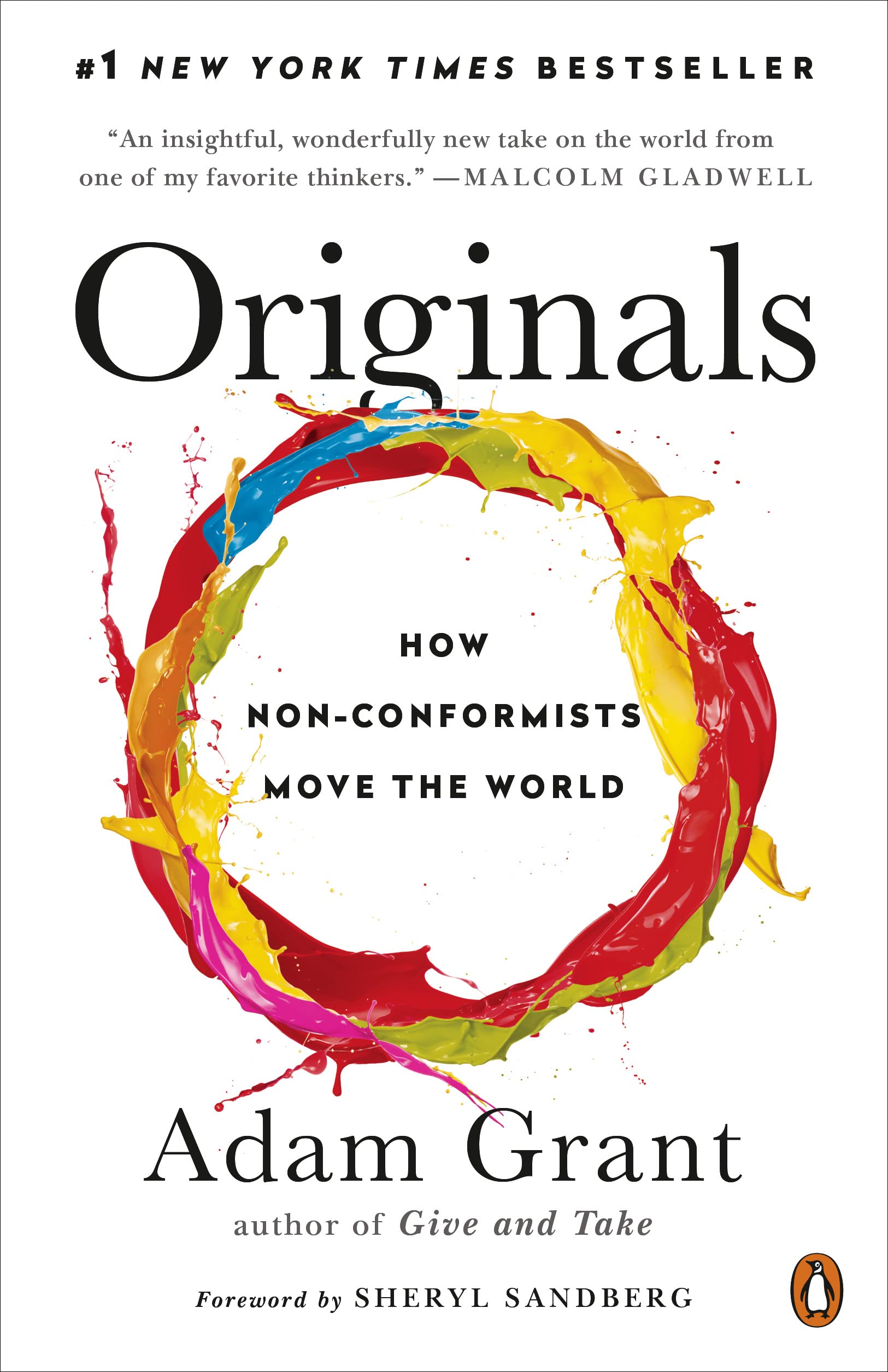
Originals: How Non-Conformists Move the World


About This Book
In Originals, organizational psychologist Adam Grant dismantles the myth that change-makers are fearless, risk-loving visionaries. Drawing on research and stories ranging from Warby Parker to Seinfeld, the Declaration of Independence to Martin Luther King, Jr., he argues that originality is far more accessible than we assume.
The book builds its case across several themes:
- Questioning defaults. Originality starts with curiosity and vuja de—seeing the familiar with fresh eyes. The hallmark of originals is rejecting the default and exploring whether a better option exists.
- Managing risk. Contrary to the "bearer of risk" image, successful entrepreneurs often keep their day jobs. A balanced risk portfolio—security in one area—frees you to be bold in another. Founders who kept day jobs had 33% lower odds of failure.
- Generating and selecting ideas. Quantity drives quality; even geniuses like Edison, Beethoven, and Picasso produced vast volumes of work. The real bottleneck isn't creativity but idea selection, where fellow creators—not managers or test audiences—judge best.
- Communicating ideas. Leading with weaknesses disarms skeptics (the Sarick Effect), repetition breeds liking (mere exposure), and aligning your values with your audience's wins more allies.
- Timing, voice, and culture. First-mover advantage is overrated; conceptual sprinters and experimental marathoners peak at different ages. Speaking up requires status, not just power. Strong commitment cultures help startups survive but later breed groupthink and homogeneity.
Grant also explores how birth order, parenting that emphasizes values over rules, and praising character shape non-conformists. Throughout, he reframes fear as excitement and channels anger for victims into constructive action.
The central reassurance is that originals "grapple with fear, ambivalence, and self-doubt" just like everyone else—they simply act anyway, often nudged by others who see their potential.
Key Takeaways
- 1.The hallmark of originality is rejecting the default—questioning why things exist as they do, sparked by curiosity and vuja de.
- 2.Originals are not reckless gamblers; balancing risk (e.g., keeping a day job) provides the security that fuels bold creativity elsewhere.
- 3.The biggest barrier to originality isn't idea generation but idea selection—and fellow creators judge novel ideas far better than managers or test audiences.
- 4.Quantity drives quality: prolific output gives more variation and higher odds of a masterpiece, since even geniuses misjudge their own best work.
- 5.Persuading skeptics works better with powerless communication—leading with weaknesses, repeating ideas (mere exposure), and framing your values as a path to theirs.
- 6.Speaking up requires status, not just power; respect must be earned before influence is accepted.
- 7.Strong commitment cultures help startups survive but later breed groupthink and homogeneity, making diversity of thought essential.
Top Highlights
The starting point is curiosity: pondering why the default exists in the first place. We’re driven to question defaults when we experience vuja de, the opposite of déjà vu. Déjà vu occurs when we encounter something new, but it feels as if we’ve seen it before. Vuja de is the reverse—we face something familiar, but we see it with a fresh perspective that enables us to gain new insights into old problems.
Highlighted by 4 people
The hallmark of originality is rejecting the default and exploring whether a better option exists. I’ve spent more than a decade studying this, and it turns out to be far less difficult than I expected. The starting point is curiosity: pondering why the default exists in the first place. We’re driven to question defaults when we experience vuja de, the opposite of déjà vu. Déjà vu occurs when we encounter something new, but it feels as if we’ve seen it before. Vuja de is the reverse—we face something familiar, but we see it with a fresh perspective that enables us to gain new insights into old problems.
Highlighted by 4 people
The starting point is curiosity: pondering why the default exists in the first place. We’re driven to question defaults when we experience vuja de, the opposite of déjà vu. Déjà vu occurs when we encounter something new, but it feels as if we’ve seen it before. Vuja de is the reverse—we face something familiar, but we see it with a fresh perspective that enables us to gain new insights into old problems.
Highlighted by 4 people
himself as a sculptor, not a painter, and found the task so overwhelming that he fled to Florence. Two years would pass before he began work on the project, at the pope’s insistence. And astronomy stagnated for decades because Nicolaus Copernicus refused to publish his original discovery that the earth revolves around the sun. Fearing rejection and ridicule, he stayed silent for twenty-two years, circulating his findings only to his friends. Eventually, a major cardinal learned of his work and wrote a letter encouraging Copernicus to publish it. Even then, Copernicus stalled for four more years. His magnum opus only saw the light of day after a young mathematics professor took matters into his own hands and submitted it for publication. Almost half a millennium later, when an angel investor offered $250,000 to Steve Jobs and Steve Wozniak to bankroll Apple in 1977, it came with an ultimatum: Wozniak would have to leave…
Highlighted by 3 people
The gifted learn to play magnificent Mozart melodies and beautiful Beethoven symphonies, but never compose their own original scores. They focus their energy on consuming existing scientific knowledge, not producing new insights.
Highlighted by 3 people
At work, our sense of commitment and control depends more on our direct boss than on anyone else. When we have a supportive boss, our bond with the organization strengthens and we feel a greater span of influence.
Highlighted by 3 people
Déjà vu occurs when we encounter something new, but it feels as if we’ve seen it before.
Highlighted by 3 people
“Nothing in the cost of goods justified the price.” Taking advantage of its monopoly status, Luxottica was charging twenty times the cost. The default wasn’t inherently legitimate; it was a choice made by a group of people at a given company. And this meant that another group of people could make an alternative choice. “We could do things differently,” Dave suddenly understood. “It was a realization that we could control our own destiny, that we could control our own prices.” When we become curious about the dissatisfying defaults in our world, we begin to recognize that most of them have social origins: Rules and systems were created by people. And that awareness gives us the courage to contemplate how we can change them. Before women gained the right to vote in America, many “had never before considered their degraded status as anything but…
Highlighted by 3 people
The least favorite students were the non-conformists who made up their own rules. Teachers tend to discriminate against highly creative students, labeling them as troublemakers. In response, many children quickly learn to get with the program, keeping their original ideas to themselves.
Highlighted by 3 people
Originality is taking the road less traveled, championing a set of novel ideas that go against the grain but ultimately make things better.
Highlighted by 3 people
AI Review
Across 14 readers' highlights, Originals earns strong, broad-based engagement—readers repeatedly flagged its core ideas about questioning defaults, hedging risk, and idea selection, signaling a resonant and quotable book.
Pros
- +Counterintuitive, research-backed claims that overturn popular myths about risk and genius
- +Memorable case studies—Warby Parker, Seinfeld, the Segway—that readers highlighted heavily
- +Genuinely actionable tactics like the Sarick Effect, mere exposure, and reframing fear as excitement
- +Reassuring message that originals feel the same fear and doubt as everyone else
- +Wide thematic range spanning entrepreneurship, communication, parenting, and group culture
Cons
- −The sheer breadth of studies and anecdotes can feel like a survey rather than a single tight argument
- −Some sections (birth order, group culture) sit loosely connected to the practical core readers gravitated toward
Glasp AI analysis based on highlights from 14 readers.
Who Should Read This
Ideal for entrepreneurs, intrapreneurs, managers, and team leaders who want to champion new ideas without betting the farm. Anyone hesitant to speak up at work—or who suspects "playing it safe" is holding them back—will find practical reassurance. Parents and educators interested in nurturing creative, ethically grounded children will value the chapters on birth order and character praise. Readers who enjoy Malcolm Gladwell or Daniel Kahneman, and fans of evidence-based behavioral science applied to everyday decisions, will feel right at home. No prior background required.
Frequently Asked Questions
What is Originals about?
Who is the book for?
What are the key lessons?
Is it worth reading?
Does the book say successful entrepreneurs are big risk-takers?
What is the Sarick Effect and vuja de?
Why does the book emphasize quantity of ideas?
How to Apply What You Read
- 1.Question one default in your work or life this week by asking why it exists and whether a better alternative is possible.
- 2.Generate a large volume of ideas—aim for 25 options before settling—then seek feedback from peers rather than managers.
- 3.Lead with the weaknesses of your next proposal to disarm skeptics, build trust, and appear more discerning.
- 4.Reframe pre-pitch anxiety as excitement and link your idea to values your audience already holds.
- 5.Hedge your risk by keeping security in one domain before going all-in on an original venture.
Discussion Questions
- Q1.Which default in your own life have you accepted without questioning, and what might change if you saw it with fresh eyes?
- Q2.Do you agree that keeping a day job makes entrepreneurs more successful, or does it risk diluting commitment?
- Q3.When have you stayed silent about an idea or concern at work, and what held you back—power, status, or fear?
- Q4.Is the advice to "lead with your weaknesses" always wise, or are there situations where it would backfire?
- Q5.How should organizations balance the survival benefits of a strong commitment culture against the dangers of groupthink?
- Q6.The book claims quantity is the path to quality—does this match your own experience with creative or professional work?
- Q7.How do parenting choices around rules versus values shape whether children become conformists or originals?
Recommended Books

Revisit Your Highlights, Deepen Your Understanding
Import your Kindle highlights to review, organize, and share the ideas that matter most to you.
Get the free browser extension