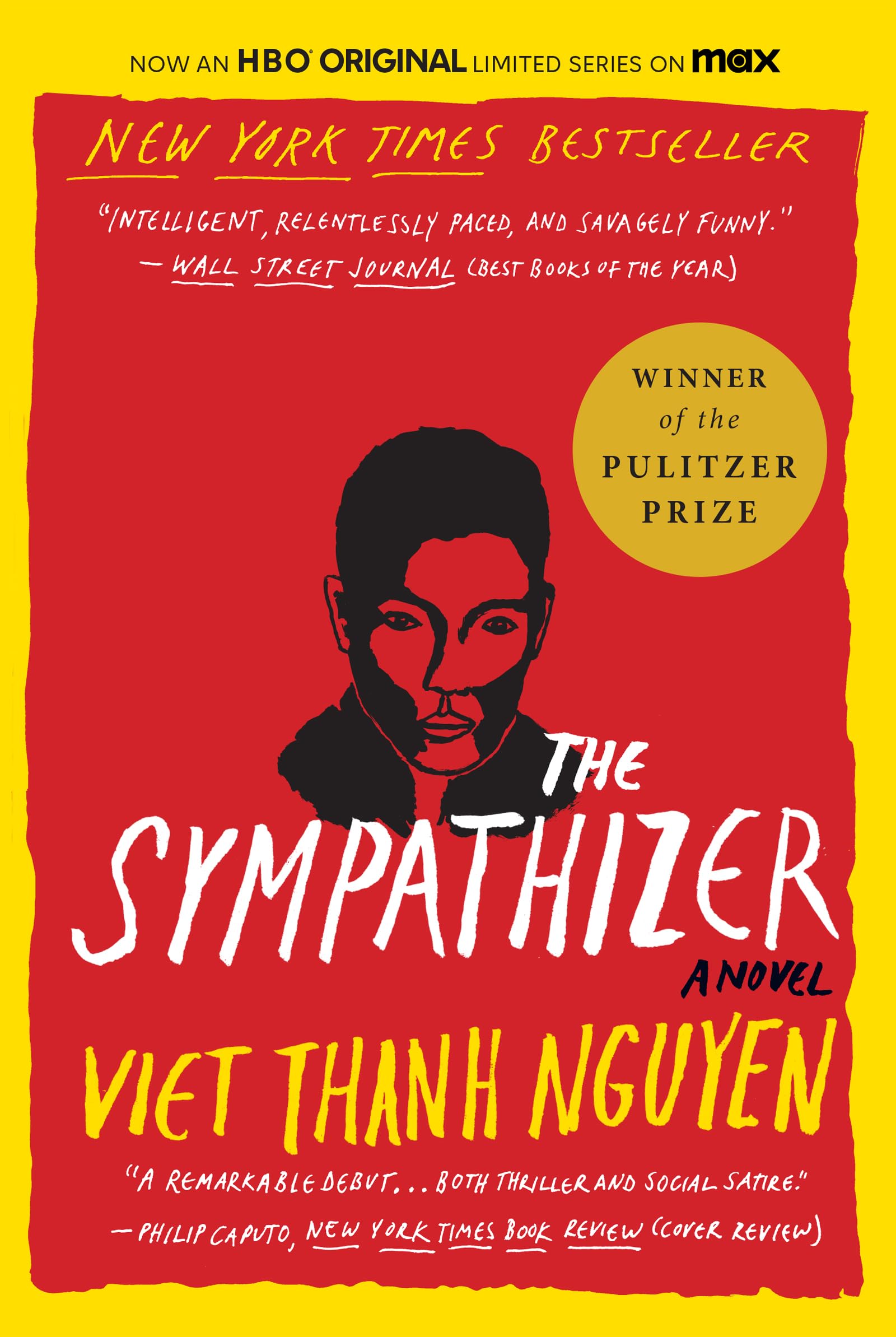
The Sympathizer: A Novel (Pulitzer Prize for Fiction)


About This Book
The Sympathizer is the confession of an unnamed narrator who describes himself as a man of two faces and two minds, a Vietnamese communist sleeper agent embedded in the South Vietnamese army during and after the fall of Saigon. The opening declaration—"I am simply able to see any issue from both sides"—announces the novel's central preoccupation: the burden of dual sympathy, where the talent for seeing both perspectives becomes a hazard that possesses rather than serves its bearer.
Written as a forced confession to an unseen commandant, the narrative follows the spy from the chaotic evacuation of Saigon to exile in America, where he reports on the General's exile community, consults on a Hollywood war film, and is finally returned to a Vietnam where the revolution he served has betrayed its own ideals.
Nguyen weaves several threads through the highlights:
- The corrosive cost of divided loyalty and the assassination of men who may be innocent.
- A scathing critique of American power, the "pursuit of happiness" as merely a lottery ticket, and Hollywood's monopoly on representation.
- The tragedy, in Hegel's sense, of right versus right rather than right versus wrong.
The book builds toward a brutal interrogation and the narrator's enlightenment that "nothing" is both the answer and the trap—that a revolution waged for independence and freedom can render those very things "worth less than nothing." Blending spy thriller, immigrant narrative, and political philosophy with mordant wit, The Sympathizer interrogates colonialism, refugee identity, friendship, and the betrayals embedded in every ideal.
Key Takeaways
- 1.The narrator's defining trait is dual sympathy—the ability to see every issue from both sides, which becomes a burden rather than a virtue.
- 2.Moral conflict in the novel is Hegelian tragedy: not right versus wrong, but right versus right, leaving no clean choices.
- 3.Representation is power—Hollywood and the West exploit by imagining and depicting others, leaving the Vietnamese "struck dumb."
- 4.The American "pursuit of happiness" is reframed as a zero-sum lottery, a guaranteed opportunity rather than a guaranteed outcome.
- 5.Revolutions can curdle: those who seize power in the name of freedom often deny it to others, repeating the imperialism they opposed.
- 6.Identity for the displaced is irreducibly double—refugees and exiles do not simply blend into a melting pot but live perpetually in-between.
- 7.The novel's grim subject matter is carried by dark wit, treating torture, war, and exile with unsettling humor.
Top Highlights
I confess that I admired him, even though he was my enemy. It is always better to admire the best among our foes rather than the worst among our friends.
Highlighted by 6 people
What am I dying for? he cried back. I’m dying because this world I’m living in isn’t worth dying for! If something is worth dying for, then you’ve got a reason to live.
Highlighted by 4 people
As Hegel said, tragedy was not the conflict between right and wrong but right and right, a dilemma none of us who wanted to participate in history could escape. The major had the right to live, but I was right to kill him. Wasn’t I? When Claude and I left near midnight, I came as close as I could to broaching the subject of my conscience with him. As we smoked farewell cigarettes on the sidewalk, I asked the question that I imagined my mother asking of me: What if he’s innocent? He
Highlighted by 4 people
Disarming an idealist was easy. One only needed to ask why the idealist was not on the front line of the particular battle he had chosen. The question was one of commitment, and I knew, even if he did not, that I was one of the committed. He looked at his bare feet, ashamed, but for some reason this had no effect on Ms. Mori. She only glanced at him with understanding, but when she
Highlighted by 4 people
(Nothing, the General muttered, is ever so expensive as what is offered for free.)
Highlighted by 4 people
Whatever people say about the General today, I can only testify that he was a sincere man who believed in everything he said, even if it was a lie, which makes him not so different from most.
Highlighted by 4 people
But for now, we are well and truly fucked. What kind of toast is right for that? The words came to me after a moment. Here’s blood in your eye, I said. Damn right. I forget from whom I learned this toast, or even what it meant, except that I had acquired it sometime during my years in America.
Highlighted by 3 people
In these situations it is better to flirt and play, allowing everyone the opportunity to pretend to be happy for so long that they might actually feel such happiness. And it was a pleasure just to look at them!
Highlighted by 3 people
One must be grateful for one’s education no matter how it arrives.
Highlighted by 3 people
The paper with which the West wiped itself was softer than the paper with which the rest of the world blew its nose, although this was only a metaphorical comparison. The rest of the world would have been stunned at the luxurious idea of even using paper to blow one’s nose. Paper was for writing things like this confession, not for mopping up excretions. But those strange, mysterious Westerners had exotic ways and wonders, symbolized in Kleenex and double-ply toilet paper.
Highlighted by 3 people
AI Review
Across 11 readers' highlights, Glasp's analysis finds strong consensus around the novel's central meditation on divided loyalty and its quotable, philosophically charged prose. A demanding but resonant work that rewards close reading.
Pros
- +Unforgettable opening premise of a man of two minds that sustains the entire narrative
- +Densely quotable prose, with many passages highlighted by multiple readers
- +Sharp political and postcolonial critique of American power and Hollywood representation
- +Genuine moral complexity rooted in Hegel's "right versus right" tragedy
- +Dark, mordant wit that leavens grim subject matter
Cons
- −Graphic depictions of torture and violence, especially in the final act
- −Dense allusion and digression that some readers may find demanding
Glasp AI analysis based on highlights from 11 readers.
Who Should Read This
Readers drawn to literary fiction that doubles as political philosophy will find this rewarding. It suits anyone interested in the Vietnam War from a Vietnamese perspective, the refugee and immigrant experience, and postcolonial critiques of American power and Hollywood representation. Fans of unreliable narrators, espionage with intellectual weight, and dark satire in the vein of Greene or Conrad should read it. Be prepared for graphic violence, dense allusion, and morally uncomfortable territory.
Frequently Asked Questions
What is The Sympathizer about?
Who is it for?
What are the key lessons of the book?
Is it worth reading?
Why is the narrator called a "man of two minds"?
How does the book critique America?
What does the ending reveal?
How to Apply What You Read
- 1.Reflect on a situation where you can genuinely see both sides, and ask whether that sympathy clarifies or paralyzes your judgment.
- 2.Read further into the Vietnamese and refugee perspectives on the war to balance Western-dominated narratives.
- 3.Question how the media and films you consume represent marginalized groups and who profits from that representation.
- 4.Discuss the book's central paradox about independence and freedom with others to test your own convictions.
- 5.Notice the dark humor woven through the violence and consider why Nguyen chose satire as his vehicle.
Discussion Questions
- Q1.Is the narrator's ability to see both sides ultimately a talent or a curse, and how does the novel answer that question?
- Q2.How does the book reframe the "pursuit of happiness" and the American Dream from an outsider's perspective?
- Q3.When does the assassination of a possibly innocent man become murder rather than tragedy, according to the characters—and do you agree?
- Q4.What is Nguyen arguing about who gets to represent whom, through the Hollywood film subplot?
- Q5.How does the novel's claim that revolutionaries become imperialists challenge the way we think about liberation movements?
- Q6.What is the significance of the word "nothing" in the narrator's final enlightenment?
- Q7.How does the blood brotherhood of the three friends illuminate the personal costs of political conviction?
Recommended Books
Revisit Your Highlights, Deepen Your Understanding
Import your Kindle highlights to review, organize, and share the ideas that matter most to you.
Get the free browser extension