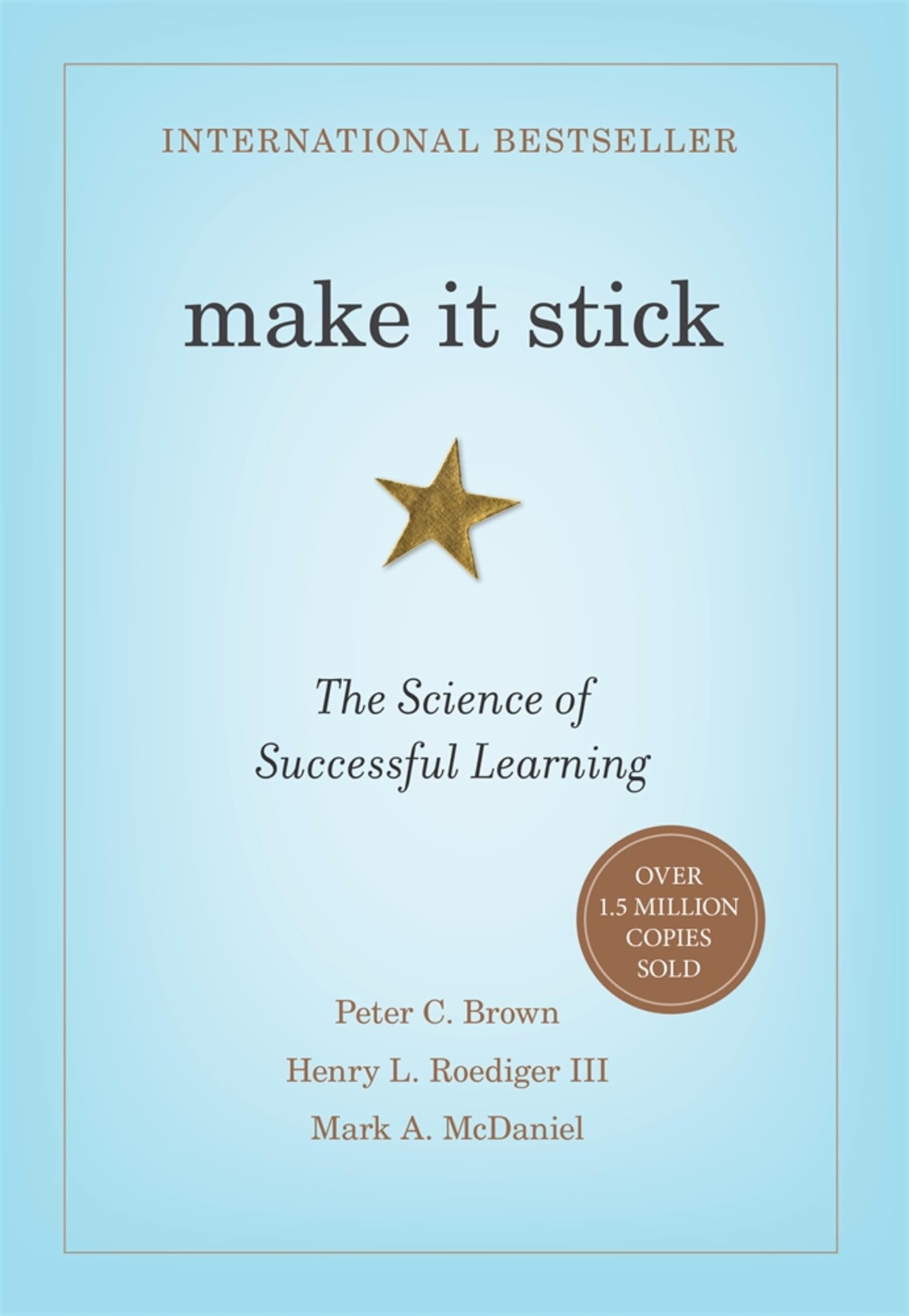
Make It Stick: The Science of Successful Learning
About This Book
Make It Stick argues that most people use study methods that feel productive but produce weak, short-lived learning. Across the most-highlighted passages, the book’s central claim is clear: durable learning depends less on rereading and cramming and more on retrieval practice, spacing, interleaving, elaboration, generation, and reflection.
The book repeatedly challenges the illusion that ease equals mastery. Readers strongly highlighted the idea that self-quizzing is one of the best habits a learner can build, because recalling from memory both reveals gaps in understanding and strengthens memory itself. Testing, in this framework, is not mainly a grading tool but a learning tool.
A second major thread is that effective learning is often effortful. Spacing study sessions, allowing some forgetting, and mixing different problem types make practice feel slower and less fluent, yet these “desirable difficulties” improve long-term retention and transfer. Interleaving helps learners distinguish underlying principles and choose the right strategy in unfamiliar situations.
The book also emphasizes meaning-making. Strong learners extract key ideas, organize them into mental models, connect new material to prior knowledge, and make the abstract concrete and personal. Elaboration—putting ideas in your own words and linking them to what you already know—deepens comprehension.
Finally, the book expands learning beyond memorization. Reflection after reading, lectures, or practice sessions turns experience into better future performance by asking questions such as what worked, what failed, and what to try next. Trying to solve a problem before being taught the answer also strengthens later learning, especially with corrective feedback.
Taken together, the highlighted structure suggests a practical playbook:
- Quiz yourself instead of rereading.
- Space and vary practice instead of cramming.
- Mix problem types instead of blocking them.
- Explain ideas in your own words and connect them to prior knowledge.
- Reflect, seek feedback, and treat errors as part of mastery.
The book’s message is that successful learning is a skill, and it can be trained.
Key Takeaways
- 1.Self-quizzing is one of the highest-value study habits because it both measures what you know and strengthens what you can later recall.
- 2.Learning that feels harder in the moment is often more durable, especially when practice is spaced and some forgetting has occurred.
- 3.Interleaving different problem types improves discrimination and helps you choose the right solution in unfamiliar situations.
- 4.Elaboration deepens understanding by forcing you to explain ideas in your own words and connect them to prior knowledge.
- 5.Trying to solve a problem before being shown the answer improves later learning, even if your first attempt is wrong, as long as feedback follows.
- 6.Reflection turns experience into learning by combining recall, interpretation, and planning for improvement.
- 7.Mastery requires both ready knowledge and an understanding of when and how to apply it.
Top Highlights
One of the best habits a learner can instill in herself is regular self-quizzing to recalibrate her understanding of what she does and does not know.
Highlighted by 8 people · 1 left a note
People who learn to extract the key ideas from new material and organize them into a mental model and connect that model to prior knowledge show an advantage in learning complex mastery.
Highlighted by 7 people
Learning is stronger when it matters, when the abstract is made concrete and personal.
Highlighted by 7 people
What are the key ideas? What are some examples? How do these relate to what I already know?
Highlighted by 6 people · 1 left a note
To be most effective, retrieval must be repeated again and again, in spaced out sessions so that the recall, rather than becoming a mindless recitation, requires some cognitive effort.
Highlighted by 5 people
Periodic practice arrests forgetting, strengthens retrieval routes, and is essential for hanging
Highlighted by 4 people
Trying to solve a problem before being taught the solution leads to better learning, even when errors are made in the attempt.
Highlighted by 4 people
if we stop thinking of testing as a dipstick to measure learning—if we think of it as practicing retrieval of learning from memory rather than “testing,” we open ourselves to another possibility: the use of testing as a tool for learning.
Highlighted by 4 people
Reflection is a form of retrieval practice (What happened? What did I do? How did it work out?), enhanced with elaboration (What would I do differently next time?).
Highlighted by 4 people · 1 left a note
Our understanding of the world is shaped by a hunger for narrative that rises out of our discomfort with ambiguity and arbitrary events.
Highlighted by 4 people · 1 left a note
AI Review
Glasp’s AI analysis of 15 reader highlights suggests a strong consensus that this is a highly actionable and memorable learning book. The most-saved passages cluster around practical strategies like self-quizzing, spaced retrieval, elaboration, and reflection, indicating both resonance and real-world usefulness.
Pros
- +Retrieval practice is explained as a practical daily habit, not just a theory.
- +Strong emphasis on transfer, not mere short-term recall.
- +Clear challenge to common but ineffective habits like rereading and cramming.
- +Actionable reflection prompts readers can use immediately.
- +Useful framework for teachers who want testing to function as learning.
- +Connects memory, mental models, and prior knowledge in a coherent way.
- +Encourages a growth-oriented view of effort, error, and feedback.
Cons
- −Some advice feels counterintuitive and may be hard to trust at first.
- −Frequent repetition of core ideas may feel redundant to some readers.
- −Highlights suggest broader side topics on memory and intelligence may feel less central than the core study strategies.
Glasp AI analysis based on highlights from 15 readers.
Who Should Read This
This book is best for students, teachers, trainers, coaches, and self-directed learners who want practical, evidence-based ways to remember more and apply knowledge better. It is especially useful for anyone preparing for exams, designing instruction, learning complex skills, or trying to replace cramming and rereading with methods that improve retention and transfer. No prior psychology background is required; the ideas are accessible and immediately usable in classrooms, workplaces, and independent study.
Frequently Asked Questions
What is the book about?
Who is it for?
What are the key lessons?
Is it worth reading?
Why does the book argue that rereading is weak compared with testing?
What does the book mean by desirable difficulties?
How does reflection fit into learning?
How to Apply What You Read
- 1.Replace one rereading session this week with a self-quiz from memory.
- 2.Space your study by revisiting material across several days instead of cramming it into one block.
- 3.Interleave at least two related topics or problem types in a single practice session.
- 4.Reflect after class or practice by answering: What were the key ideas, what worked, and what should I do differently next time?
- 5.Generate an answer or solution before looking it up, then compare your attempt with the correct version and note the gap.
Discussion Questions
- Q1.Why do strategies like rereading and blocked practice feel effective even when the book argues they are weaker for long-term learning?
- Q2.How can teachers use low-stakes quizzing without increasing fear or reducing learning to constant assessment?
- Q3.What kinds of mistakes are productive in learning, and when do difficulties become undesirable rather than helpful?
- Q4.How does connecting new material to prior knowledge change what we remember and how we apply it later?
- Q5.In what settings would interleaving be most valuable, and where might learners resist it most strongly?
- Q6.How can reflection be built into everyday work or school routines rather than treated as an extra task?
- Q7.What would it mean to design a class or personal study system around transfer instead of short-term performance?
Recommended Books


Revisit Your Highlights, Deepen Your Understanding
Import your Kindle highlights to review, organize, and share the ideas that matter most to you.
Get the free browser extension