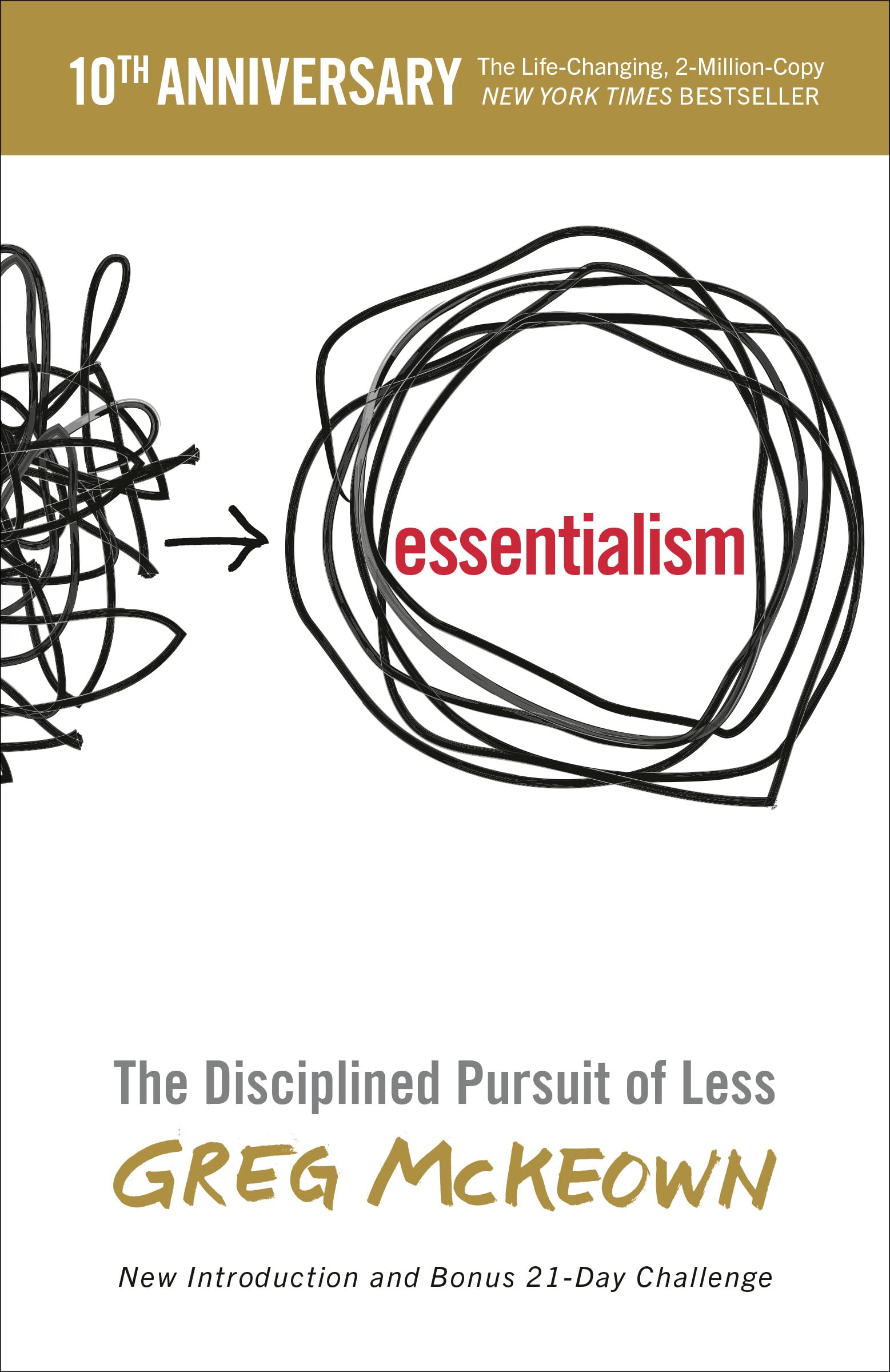
Essentialism: The Disciplined Pursuit of Less
About This Book
Greg McKeown’s Essentialism argues that the path to meaningful contribution is not doing more, but doing the right few things with full commitment. Across the most-highlighted passages, readers consistently gravitated to the book’s central promise: once you stop trying to please everyone and stop saying yes to everything, you can focus your time and energy on what matters most.
The book contrasts the Nonessentialist with the Essentialist. The Nonessentialist reacts, assumes everything is important, asks how to do both, and ends up busy but diluted. The Essentialist lives by design, not by default: choosing deliberately, distinguishing the vital few from the trivial many, eliminating nonessentials, and then removing obstacles so execution becomes smoother and almost effortless.
Its structure is practical and sequential.
- First, McKeown reframes mindset: you always retain the power to choose, almost everything is noise, and life is full of unavoidable trade-offs.
- Next, he shows how to explore and evaluate opportunities with stricter criteria, asking whether an activity will make the highest possible contribution toward your goal.
- Then he emphasizes elimination: if it isn’t a clear yes, it should often be a no, even when saying no is socially uncomfortable.
- Finally, he moves to execution: create space to think, sleep, play, journal, build buffers, define clear intent, identify the key bottleneck, and make progress through small wins.
A recurring warning is the paradox of success: success brings more options, options diffuse effort, and diffused effort can undermine the very clarity that created success in the first place. McKeown’s answer is the phrase readers repeatedly highlighted: less but better. Essentialism is therefore not minimalism for its own sake, but a disciplined method for making the wisest possible investment in a life aligned with purpose, talent, and real contribution.
Key Takeaways
- 1.Essentialism is not doing less for its own sake; it is doing the right things so your effort creates meaningful momentum.
- 2.If you do not prioritize your life deliberately, other people’s agendas will fill the space for you.
- 3.Most opportunities are merely good, while only a few are truly vital, so selective criteria matter more than enthusiasm.
- 4.Trade-offs are unavoidable; the better question is not how to do everything, but what you want to go big on.
- 5.Success can create new distractions, so clarity must be protected even after you become competent and in demand.
- 6.Saying no with grace is a core capability because elimination is what makes focus possible.
- 7.Execution improves when you remove obstacles, define clear intent, build buffers, and pursue small concrete wins.
Top Highlights
only once you give yourself permission to stop trying to do it all, to stop saying yes to everyone, can you make your highest contribution towards the things that really matter.
Highlighted by 12 people · 1 left a note
Instead of making just a millimeter of progress in a million directions he began to generate tremendous momentum towards accomplishing the things that were truly vital.
Highlighted by 11 people
only once you give yourself permission to stop trying to do it all, to stop saying yes to everyone, can you make your highest contribution towards the things that really matter.
Highlighted by 8 people
Less but better.
Highlighted by 8 people
Essentialism is not about how to get more things done; it’s about how to get the right things done.
Highlighted by 8 people
living by design, not by default. Instead of making choices reactively, the Essentialist deliberately distinguishes the vital few from the trivial many,
Highlighted by 8 people
If you don’t prioritize your life, someone else will.
Highlighted by 8 people
To discern what is truly essential we need space to think, time to look and listen, permission to play, wisdom to sleep, and the discipline to apply highly selective criteria to the choices we make.
Highlighted by 8 people
Essentialists see trade-offs as an inherent part of life, not as an inherently negative part of life.
Highlighted by 7 people
the very most important thing I should be doing with my time and resources right now?”
Highlighted by 6 people
AI Review
Glasp's AI analysis of 32 reader highlights suggests that Essentialism resonates strongly because its core ideas are highly quotable, practical, and repeatedly highlighted across the book. Reader interest clusters around prioritization, trade-offs, and saying no, indicating a high-consensus productivity book with durable impact.
Pros
- +Clear core thesis around less but better
- +Memorable framework for distinguishing the vital few from the trivial many
- +Strong emphasis on deliberate choice and trade-offs
- +Practical tools for saying no, filtering opportunities, and reducing friction
- +Widely resonant lines that readers found highly quotable
- +Balances mindset change with execution habits like buffers, sleep, and small wins
Cons
- −Core message is repeated often, which may feel redundant to some readers
- −Principles can sound simple while being emotionally difficult to apply in real workplaces
- −Examples occasionally lean toward executive or professional contexts more than other life situations
Glasp AI analysis based on highlights from 32 readers.
Who Should Read This
This book is especially useful for managers, founders, high achievers, knowledge workers, and anyone overwhelmed by competing demands. It fits readers who feel busy but not effective, people-pleasers who struggle to say no, and professionals facing constant interruptions or too many "priorities." No special background is required, but it will resonate most with readers ready to question hustle culture and make clearer trade-offs in work and life.
Frequently Asked Questions
What is the book about?
Who is it for?
What are the key lessons?
Is it worth reading?
What does less but better mean in this book?
How does the book say you should choose what matters?
Why is saying no so important in Essentialism?
How to Apply What You Read
- 1.List your current commitments and mark which ones truly make the highest contribution to your main goal.
- 2.Adopt a decision rule such as refusing anything that is not a clear yes or does not meet extreme criteria.
- 3.Schedule blank space each week for thinking, reflection, and review instead of filling every open hour.
- 4.Ask before accepting new work: which existing priority should be deprioritized to make room for this?
- 5.Identify the single biggest bottleneck in one important project and remove it before doing more busywork.
Discussion Questions
- Q1.Which commitments in your life are good but not truly essential?
- Q2.When have you confused being busy with being valuable or effective?
- Q3.What social pressures make it hardest for you to say no?
- Q4.How has past success created new distractions or diluted your focus?
- Q5.What would living by design rather than by default look like in your current season of life?
- Q6.Which trade-off are you currently avoiding by asking how to do both?
- Q7.What is one area where less but better could immediately improve your work or relationships?
Recommended Books


Revisit Your Highlights, Deepen Your Understanding
Import your Kindle highlights to review, organize, and share the ideas that matter most to you.
Get the free browser extension