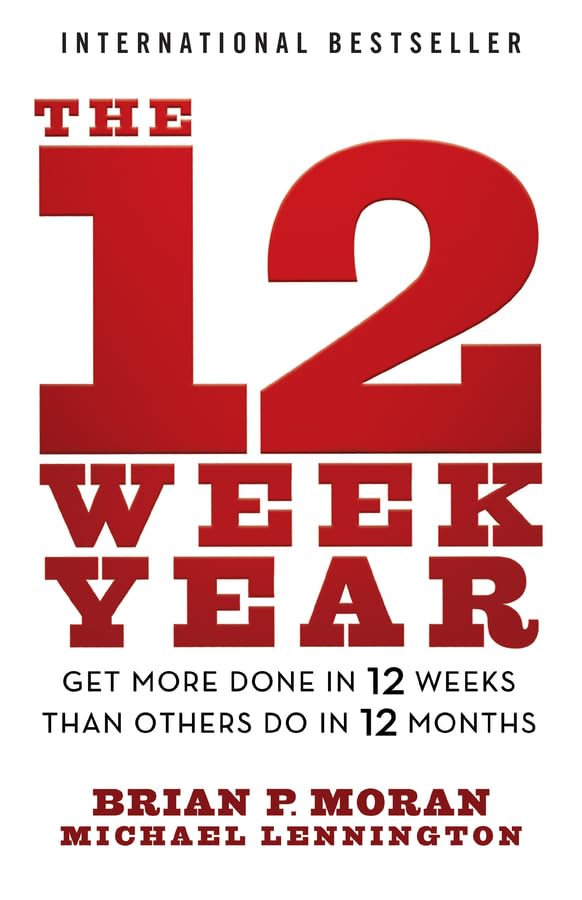
The 12 Week Year: Get More Done in 12 Weeks than Others Do in 12 Months
About This Book
The 12 Week Year argues that the main barrier to better results is not knowledge, talent, or effort, but poor execution. Its central idea is simple: stop thinking in annual cycles and instead treat every 12 weeks as a full year. That shorter horizon creates urgency, reduces procrastination, and forces attention onto the few actions that matter most.
The book begins with vision. Readers repeatedly highlighted the claim that high performance starts with a compelling personal vision before business goals. Moran and Lennington insist that career goals should support a broader life vision across areas like family, health, income, relationships, and community. That emotional connection matters because execution is uncomfortable, and without a strong reason why, people default to short-term comfort.
From there, the book moves into planning. Rather than building bloated annual plans, it recommends choosing one to three meaningful 12-week goals and breaking them into specific tactics with deadlines and ownership. The emphasis is on being great at a few things instead of mediocre at many.
A large share of the highlights focus on the weekly operating system:
- Review the previous week and plan the next one for 15 to 20 minutes at the start of each week.
- Review the weekly plan daily for about five minutes.
- Measure execution, not just outcomes, with a weekly scorecard.
- Aim for about 85 percent completion of planned tactics rather than perfection.
- Use structured time blocks: strategic blocks for deep work, buffer blocks for interruptions, and breakout blocks for recovery.
The book also reframes accountability as ownership, not punishment. Results lag, but actions are visible now, so scorekeeping becomes the reality check. Overall, the book presents a practical system for aligning vision, goals, weekly plans, and daily behavior so consistent action compounds into outsized results.
Key Takeaways
- 1.Execution beats knowledge: most underperformance comes from failing to implement what you already know.
- 2.A compelling personal vision should come before business goals, because it gives effort meaning and helps you endure discomfort.
- 3.Twelve weeks is long enough to achieve meaningful progress and short enough to maintain urgency.
- 4.Your weekly plan should contain the strategic actions that drive results, not every task competing for your attention.
- 5.Measuring lead indicators and weekly execution gives faster feedback than waiting for final results.
- 6.Time should be structured intentionally through strategic, buffer, and breakout blocks rather than managed reactively.
- 7.Accountability works best as personal ownership of choices and outcomes, not as external punishment.
Top Highlights
execution happens daily and weekly, not monthly or quarterly.
Highlighted by 12 people
To use your weekly plan effectively, you will need to spend the first 15 or 20 minutes at the
Highlighted by 12 people
Execution is the single greatest
Highlighted by 11 people
You create things twice; first mentally, then physically.
Highlighted by 10 people
Consistent action on the critical tasks needed to reach your goal is the key to getting what you want in life.
Highlighted by 9 people
The secret to living your life to its potential is to value the important stuff above your own comfort.
Highlighted by 8 people
An effective breakout block is at least three-hours long and spent on things other than work.
Highlighted by 8 people
Results are not the attainment of greatness, but simply confirmation of it. You become great long before the results show it. It happens in an instant, the moment you choose to do the things you need to do to be great.
Highlighted by 8 people
“We are what we repeatedly do. Excellence then is not an act, but a habit.”
Highlighted by 7 people
Without a compelling vision, you will discover there is no reason to go through the pain of change.
Highlighted by 7 people
AI Review
Glasp's AI analysis of 23 reader highlights suggests a strongly resonant productivity book with unusually consistent interest around execution, weekly planning, and vision-driven goal setting. The highlight patterns show readers found the framework practical, memorable, and immediately applicable, with only minor signs of repetition and motivational overstatement.
Pros
- +Execution-first approach rather than abstract motivation
- +Strong emphasis on weekly planning and daily review
- +Clear link between personal vision and business goals
- +Practical tools like scorecards, time blocks, and tactic planning
- +Memorable focus on lead indicators over lag results
- +Encouraging standard of excellence over perfection
Cons
- −Core message can feel repetitive across chapters
- −Some claims about performance gains may feel overstated
- −Framework may seem rigid for readers in highly unpredictable roles
Glasp AI analysis based on highlights from 23 readers.
Who Should Read This
This book is best for entrepreneurs, salespeople, managers, consultants, and self-directed professionals who feel busy but underperforming. It is especially useful for readers who set annual goals and then lose urgency by midyear.
It also fits anyone trying to improve execution in business, fitness, or personal life through a clearer system. No advanced background is required, but it helps if you are willing to track actions, plan weekly, and confront where follow-through breaks down.
Frequently Asked Questions
What is the book about?
Who is the book for?
What are the key lessons from the book?
How does the 12 Week Year differ from annual planning?
Why does the book emphasize vision so much?
What is the Weekly Scorecard?
Is it worth reading?
How to Apply What You Read
- 1.Write a personal vision covering health, relationships, income, lifestyle, and contribution.
- 2.Choose one to three goals for the next 12 weeks and define success in specific, measurable terms.
- 3.Build a weekly plan by listing the highest-impact tactics, assigning due weeks, and reviewing it at the start of each day.
- 4.Track your weekly execution score and look for whether missed results come from poor tactics or poor follow-through.
- 5.Schedule one strategic block, buffer blocks for interruptions, and a breakout block for recovery every week.
Discussion Questions
- Q1.Why does shortening the planning horizon from 12 months to 12 weeks create more urgency for some people and more pressure for others?
- Q2.How convincing is the book's claim that most performance problems are execution problems rather than knowledge problems?
- Q3.What makes a personal vision genuinely motivating instead of vague or performative?
- Q4.How should someone adapt the 12 Week Year system in a job with frequent interruptions and unpredictable demands?
- Q5.Is measuring execution more useful than measuring results, or can it create a false sense of progress?
- Q6.What is the difference between accountability as ownership and accountability as consequences in real workplaces?
- Q7.Which part of the system would create the biggest improvement in your life right now: vision, weekly planning, scorekeeping, or time blocking?
Recommended Books



Revisit Your Highlights, Deepen Your Understanding
Import your Kindle highlights to review, organize, and share the ideas that matter most to you.
Get the free browser extension