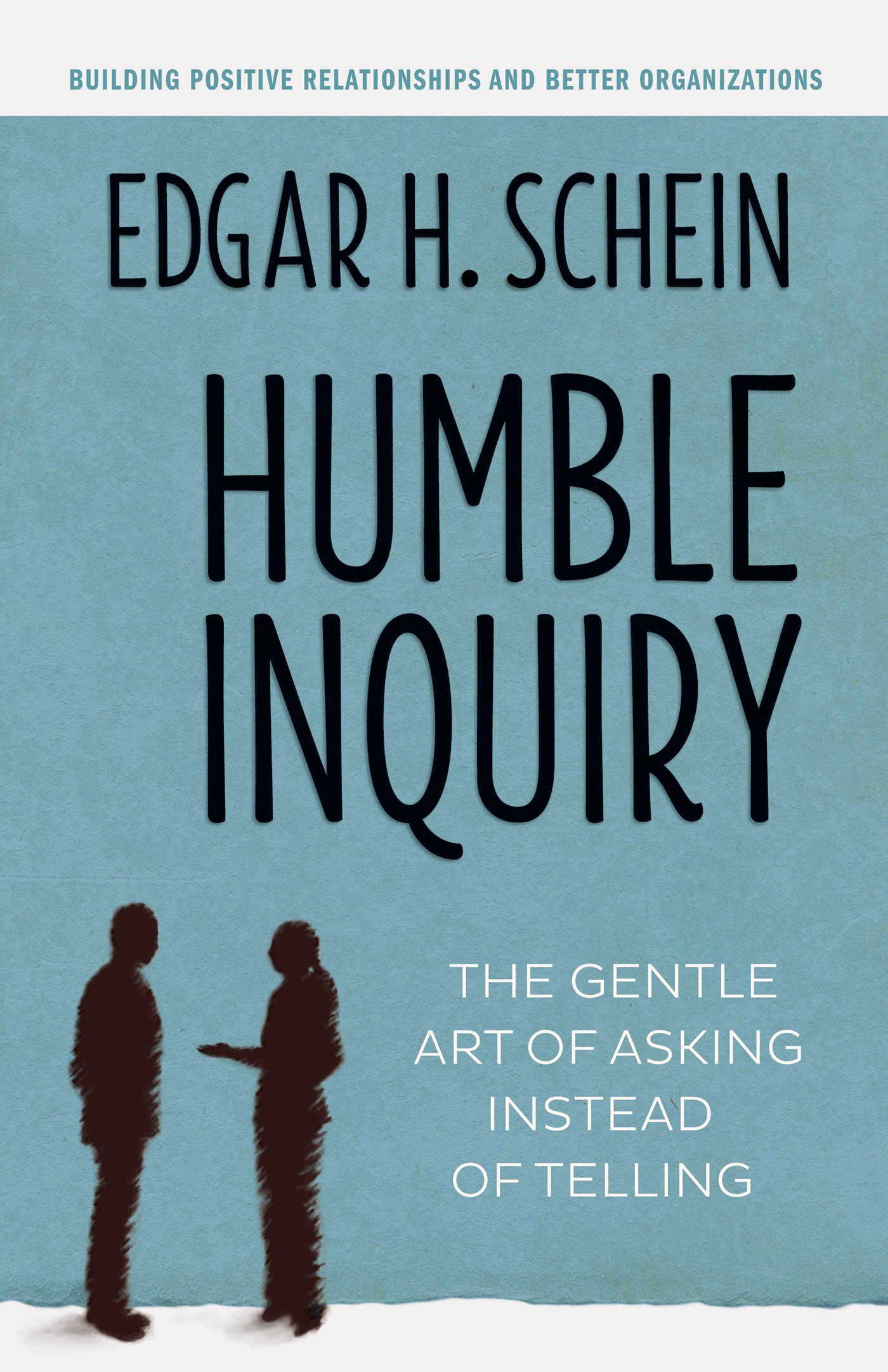
Humble Inquiry: The Gentle Art of Asking Instead of Telling
About This Book
Humble Inquiry argues that we live in a culture that overvalues telling and undervalues asking, and that this bias quietly undermines our relationships, our problem-solving, and even safety in high-stakes work. Edgar Schein's core claim is that good communication is the foundation of successful task accomplishment, relationships are the foundation of good communication, and Humble Inquiry is the key to building those relationships.
Schein defines Humble Inquiry as "the fine art of drawing someone out, of asking questions to which you do not already know the answer, of building a relationship based on curiosity and interest in the other person." He distinguishes it sharply from rhetorical, leading, or testing questions that are really telling in disguise.
Central to the book is the concept of Here-and-now Humility — the recognition that, in a given moment, I am dependent on you because you know or can do something I need. Asking temporarily empowers the other person and makes me vulnerable, and it is precisely this vulnerability that builds trust and psychological safety.
The book traces our resistance to asking back to cultural assumptions:
- Task accomplishment is valued over relationship building.
- Having to ask signals weakness or ignorance.
- Subordinates ask while bosses tell.
Schein insists these scripts must change as work becomes more interdependent, complex, and culturally diverse. He offers practical guidance: slow down, reflect, ask open questions, ask for examples, examine your own motives before asking, and use the Observation–Reaction–Judgment–Intervention cycle to act mindfully. He even encourages engaging the "artist within" to break cultural scripts and see more. For leaders, the toughest relearning is discovering their dependence on subordinates and building trust with them through genuine curiosity rather than control.
Key Takeaways
- 1.We are culturally biased toward telling, which subtly puts others down and implies they should already know what we are saying.
- 2.Humble Inquiry means asking questions to which you genuinely do not know the answer, driven by curiosity rather than agenda.
- 3.Here-and-now Humility — accepting your moment-to-moment dependence on others — is the emotional foundation of asking.
- 4.Asking makes you temporarily vulnerable, and that vulnerability is precisely what creates psychological safety and builds trust.
- 5.A culture that values task accomplishment over relationship building undermines communication, especially across hierarchies and cultures.
- 6.Relationships drive good communication, good communication drives successful task accomplishment, so relationship-building is not soft — it is essential.
- 7.Slowing down, reflecting, and checking your own motives before asking prevent the mindless hurrying that causes the biggest mistakes.
Top Highlights
The missing ingredients in most conversations are curiosity and willingness to ask questions to which we do not already know the answer.
Highlighted by 3 people
we fail to notice how often even our questions are just another form of telling—rhetorical or just testing whether what we think is right.
Highlighted by 3 people
Humble Inquiry is the fine art of drawing someone out, of asking questions to which you do not already know the answer, of building a relationship based on curiosity and interest in the other person.
Highlighted by 2 people
we must become better at asking and do less telling in a culture that overvalues telling.
Highlighted by 2 people
asking temporarily empowers the other person in the conversation and temporarily makes me vulnerable.
Highlighted by 2 people
THE MAIN PROBLEM–A CULTURE THAT VALUES TASK ACCOMPLISHMENT MORE THAN RELATIONSHIP BUILDING
Highlighted by 2 people
AI Review
Based on highlights from 5 readers, this is a concise, widely resonant book whose core idea — asking instead of telling — clearly struck readers as both novel and practical.
Pros
- +Clear, memorable central concept of Here-and-now Humility
- +Strong consensus among readers on the cultural critique of telling over asking
- +Practical guidance on motives, open questions, and slowing down
- +Connects communication, trust, and task accomplishment convincingly
- +Short and accessible without sacrificing depth
Cons
- −Some sections (e.g., engaging "the artist within") drew fewer highlights and feel more tangential
- −Light on extended, step-by-step techniques for actually changing ingrained habits
Glasp AI analysis based on highlights from 5 readers.
Who Should Read This
This book is for leaders, managers, and professionals who must coordinate across departments, cultures, and hierarchies, especially in high-stakes fields like healthcare, aviation, and engineering where speaking up prevents mistakes. It suits anyone who suspects they tell more than they ask, as well as coaches, consultants, teachers, and team facilitators. No prior background is required — Schein writes accessibly — but readers interested in organizational culture, psychological safety, and trust-building will gain the most.
Frequently Asked Questions
What is Humble Inquiry about?
Who is the book for?
What are the key lessons?
What is Here-and-now Humility?
How is Humble Inquiry different from ordinary questions?
Why don't we ask more often?
Is it worth reading?
How to Apply What You Read
- 1.Examine your motives before asking a question: are you genuinely curious, or just testing whether you are right?
- 2.Ask open questions that cannot be answered with yes or no, and ask for concrete examples to clarify vague statements.
- 3.Slow down and use the Observe–React–Judge–Intervene cycle before leaping to action or judgment.
- 4.Map your dependencies by asking who you depend on, who depends on you, and with whom you need to build a relationship.
- 5.As a leader, build trust with subordinates by acknowledging your reliance on them and inviting them to speak up and correct you.
Discussion Questions
- Q1.In what situations do you catch yourself telling when asking would serve better?
- Q2.How comfortable are you with admitting Here-and-now dependence on someone of lower status?
- Q3.Why does our culture treat having to ask as a sign of weakness, and how might that be changed?
- Q4.Can you recall a time when a genuine question built trust — or a disguised question damaged it?
- Q5.How do task-oriented versus person-oriented relationships shape communication in your workplace?
- Q6.What cultural assumptions about authority make it hard for people to speak up or correct a superior?
- Q7.What small change in your conversational habits could open more honest communication on your team?
Recommended Books


Revisit Your Highlights, Deepen Your Understanding
Import your Kindle highlights to review, organize, and share the ideas that matter most to you.
Get the free browser extension