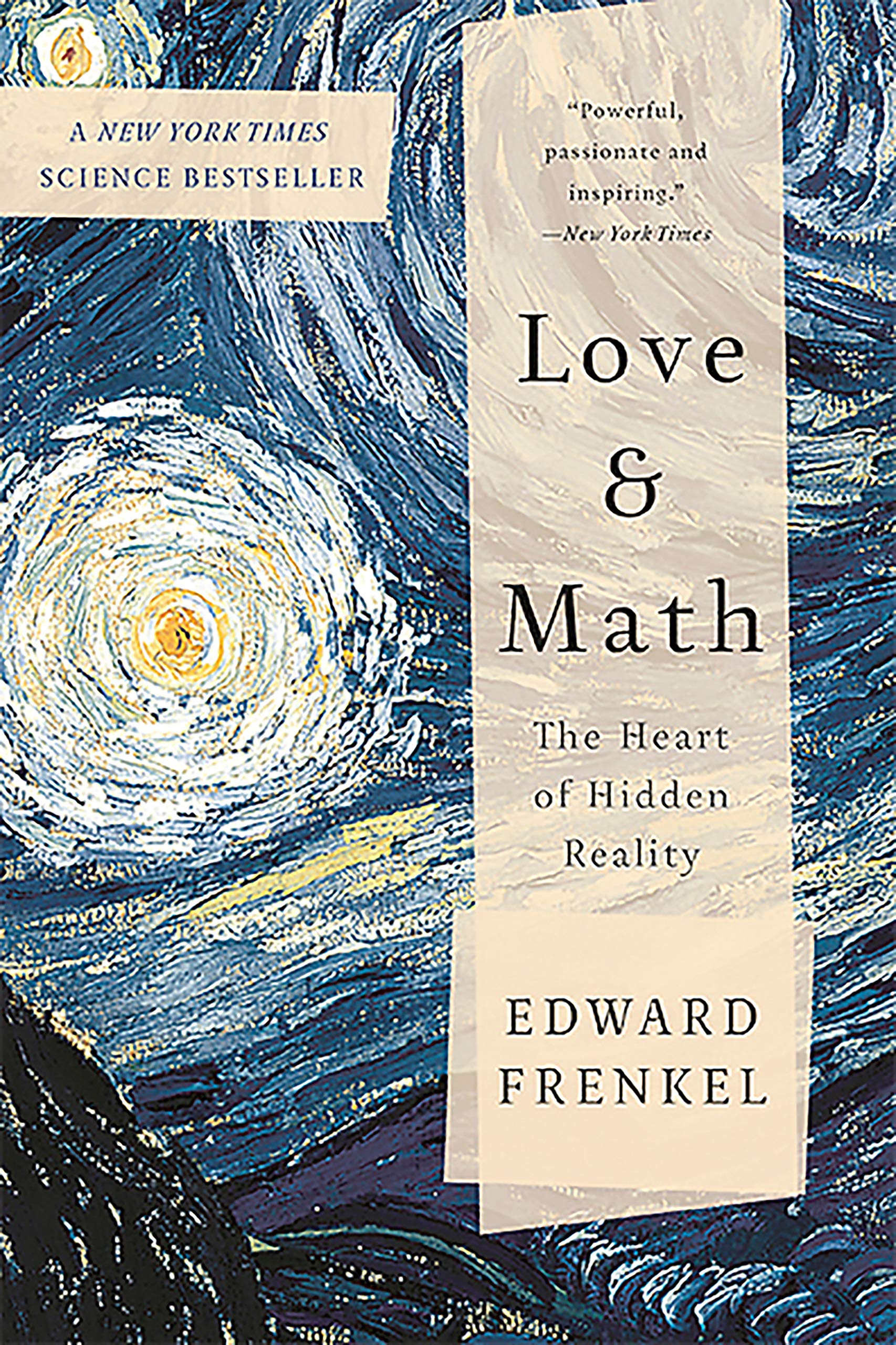
Love and Math: The Heart of Hidden Reality
About This Book
Love and Math is mathematician Edward Frenkel's invitation to discover what he calls "a secret world out there"—a hidden parallel universe of beauty and elegance intertwined with our own, yet invisible to most. The book's central conviction is that mathematics is not an elite discipline reserved for specialists but a fundamental part of our cultural heritage, as much as art, literature, and music.
Frenkel pushes back hard against what he calls a "common fallacy": the idea that one must study math for years, or possesses some innate gift, to appreciate it. He argues that just as ordinary people grasp the solar system, atoms, and the double helix without formal training, anyone can understand key mathematical ideas when they are explained well—often by cutting straight to the point and skipping tedious steps.
Woven through the highlights are two intertwined threads. The first is the philosophical claim, echoing Galileo, that "the laws of Nature are written in the language of mathematics"—a universal language that has become the gold standard of truth and, increasingly, the source of power, wealth, and progress. The second is a more personal, almost spiritual reverence, reinforced by quotations from Einstein and Newton, who described himself as a boy on the seashore before the great ocean of undiscovered truth.
Drawing on cutting-edge research (including the structure of hadrons and elementary particles), Frenkel blends memoir, history, and exposition to convey both the intellectual substance and the emotional pull of mathematics. His dream, stated plainly, is that readers will come to see, appreciate, and marvel at the magic beauty and harmony of these ideas, finding in them more meaning for our love of the world and of one another.
Key Takeaways
- 1.The belief that you need years of study to appreciate math is a fallacy—key ideas can be grasped when explained the right way.
- 2.Mathematics is cultural heritage, deserving the same place in our collective consciousness as art, literature, and music.
- 3."The laws of Nature are written in the language of mathematics"—math describes and governs physical reality.
- 4.Fluency in mathematics is increasingly a source of power, wealth, and progress in a science-driven world.
- 5.Great scientists like Einstein and Newton approached the universe with humility and awe before its hidden order.
- 6.Mathematics offers timeless, profound knowledge that unites people across cultures, continents, and centuries.
- 7.Appreciating mathematical beauty can give more meaning to our love for the world and for one another.
AI Review
Based on Glasp's analysis of highlights from 3 readers, this is a passionately argued invitation to mathematics that resonates most for its big-picture vision rather than technical depth. Readers gravitate to its core claim that math is accessible cultural heritage.
Pros
- +Compelling argument that mathematical ideas are accessible to anyone, not just specialists
- +Frames math as cultural heritage alongside art, literature, and music
- +Evocative quotations from Einstein and Newton that convey awe and humility
- +Connects abstract math to physical reality and the laws of nature
Cons
- −Highlight signal is thin (only 3 readers), suggesting limited shared consensus
- −Reader notes hint that the inspirational framing may feel idealistic against real classroom experience
Glasp AI analysis based on highlights from 3 readers.
Who Should Read This
Curious general readers who feel they were "robbed" by uninspiring math education and want to glimpse the subject's beauty without prerequisites. Ideal for lifelong learners, science and culture enthusiasts, and anyone drawn to the philosophical link between mathematics and physical reality. Students disillusioned with rote schooling will find encouragement here. Those wanting rigorous technical instruction or a textbook should look elsewhere—this is an invitation and a love letter, not a course.
Frequently Asked Questions
What is Love and Math about?
Who is the book for?
What are the key lessons?
Is it worth reading?
Does the book require a math background?
Why does Frenkel call math a hidden world?
How to Apply What You Read
- 1.Revisit a mathematical concept you found intimidating in school and seek an explanation that cuts to its core idea.
- 2.Treat math as culture—read about it the way you would explore art or music, for appreciation rather than testing.
- 3.Reflect on the link between mathematical structures and the physical universe described in the book.
- 4.Share an elegant mathematical idea with someone who believes they are "bad at math."
Discussion Questions
- Q1.Do you agree that anyone can grasp key mathematical ideas, or is some background truly necessary?
- Q2.How does framing math as cultural heritage, like art and music, change the way you view the subject?
- Q3.What did your own math education get right or wrong, and were you "robbed" of its beauty?
- Q4.What does it mean to say the laws of Nature are written in the language of mathematics?
- Q5.Why do you think great scientists like Einstein and Newton expressed humility before the universe?
- Q6.Can mathematics genuinely give more meaning to our love for the world and each other, as Frenkel hopes?
- Q7.Is mathematics primarily valuable for its practical power, its beauty, or both?
Recommended Books


Revisit Your Highlights, Deepen Your Understanding
Import your Kindle highlights to review, organize, and share the ideas that matter most to you.
Get the free browser extension