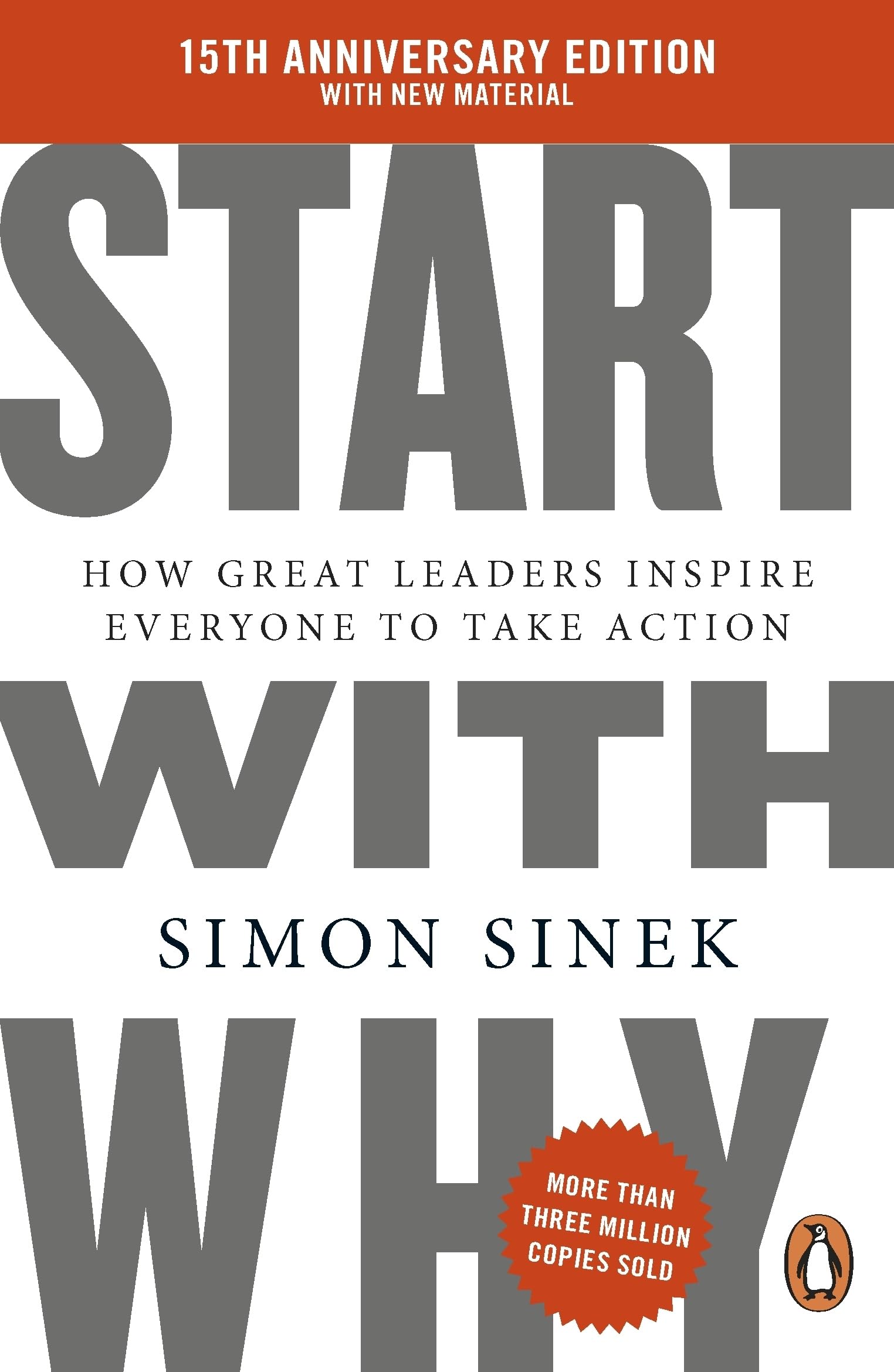
Start With Why: How Great Leaders Inspire Everyone to Take Action
About This Book
Start With Why argues that the most influential leaders and organizations—Apple, Martin Luther King Jr., the Wright brothers—all think, act, and communicate in the same way, and it is the opposite of everyone else. Simon Sinek's central framework is The Golden Circle: three concentric rings of WHAT, HOW, and WHY.
- WHAT: every company knows the products or services it sells.
- HOW: some know their differentiating processes or value propositions.
- WHY: very few can articulate their purpose, cause, or belief—the reason the organization exists beyond making money.
Most organizations communicate from the outside in (WHAT to WHY), leading with features and facts. Inspiring ones reverse this, starting with WHY. Sinek grounds this in biology: the limbic brain governs feelings, trust, and decision-making but has no capacity for language, which is why gut decisions feel right yet are hard to explain. People, he insists, don't buy WHAT you do, they buy WHY you do it.
The book contrasts two ways to drive behavior: manipulation (price, promotions, fear, aspiration, novelty) and inspiration. Manipulations work but only produce transactions, never loyalty, and grow more expensive over time. Examples abound—Apple versus Creative and Dell, Southwest versus Ted and Song, the railroads that defined themselves by WHAT and missed the airplane.
Sinek extends WHY to organizational design: values must be verbs, leaders supply the WHY while HOW-types execute, and companies should hire people who believe what they believe (Shackleton's crew, Continental's Bethune). The closing argument: clarity of WHY, discipline of HOW, and consistency of WHAT create authenticity, trust, and lasting loyalty. Finding WHY is a process of discovery, not invention.
Key Takeaways
- 1.Inspiring leaders communicate from the inside out: they start with WHY, then HOW, then WHAT, while most organizations do the reverse.
- 2.People don't buy WHAT you do, they buy WHY you do it—your WHAT serves as tangible proof of your purpose.
- 3.There are only two ways to influence behavior: manipulation (price, fear, promotions) or inspiration; only inspiration breeds lasting loyalty.
- 4.Decisions are made in the limbic brain, which governs feelings and trust but has no language, which is why gut choices feel right yet defy easy explanation.
- 5.Companies without a clear WHY become commodities, forced to compete endlessly on price, features, and service.
- 6.Great organizations hire believers, not just skilled people—Shackleton recruited for the cause, and Continental rebuilt around shared purpose.
- 7.Values must be expressed as verbs ("always do the right thing") rather than nouns ("integrity") to guide actual behavior.
Top Highlights
WHAT: Every single company and organization on the planet knows WHAT they do.
Highlighted by 6 people
WHY: Very few people or companies can clearly articulate WHY they do WHAT they do. When I say WHY, I don’t mean to make money—that’s a result. By WHY I mean what is your purpose, cause or belief? WHY does your company exist? WHY do you get out of bed every morning? And WHY should anyone care?
Highlighted by 5 people
We are drawn to leaders and organizations that are good at communicating what they believe. Their ability to make us feel like we belong, to make us feel special, safe and not alone is part of what gives them the ability to inspire us.
Highlighted by 4 people · 1 left a note
No matter how visionary or how brilliant, a great idea or a great product isn’t worth much if no one buys it.
Highlighted by 3 people
Great leaders, in contrast, are able to inspire people to act. Those who are able to inspire give people a sense of purpose or belonging that has little to do with any external incentive or benefit to be gained.
Highlighted by 3 people
our behavior is affected by our assumptions or our perceived truths. We make decisions based on what we think we know.
Highlighted by 3 people
There are only two ways to influence human behavior: you can manipulate it or you can inspire it.
Highlighted by 3 people · 1 left a note
I cannot dispute that manipulations work. Every one of them can indeed help influence behavior and every one of them can help a company become quite successful. But there are trade-offs. Not a single one of them breeds loyalty.
Highlighted by 3 people · 1 left a note
Manipulations Lead to Transactions, Not Loyalty
Highlighted by 3 people
The Golden Circle provides compelling evidence of how much more we can achieve if we remind ourselves to start everything we do by first asking why.
Highlighted by 3 people
AI Review
Across 14 readers' highlights, the WHAT/HOW/WHY framework and the line people don't buy WHAT you do, they buy WHY you do it drew the strongest consensus, marking this as a memorable, quotable book on purpose-driven leadership.
Pros
- +A single, memorable framework—The Golden Circle—that readers consistently highlighted
- +Vivid, repeated case studies (Apple, Southwest, the Wright brothers, Continental) that make abstract ideas concrete
- +Grounds its argument in biology of the limbic brain, explaining why purpose resonates emotionally
- +Strongly quotable core message about buying WHY, not WHAT
- +Practical extensions into hiring, culture, and manipulation versus inspiration
Cons
- −Heavy repetition of the same examples and phrases throughout
- −Apple-centric examples can feel over-relied upon and dated
Glasp AI analysis based on highlights from 14 readers.
Who Should Read This
Founders, CEOs, and managers who want to build a culture and brand around purpose rather than price will gain the most. It also suits marketers, salespeople, and product leaders trying to inspire loyalty instead of chasing transactions, plus politicians, nonprofit leaders, and anyone leading a team. No business background is needed—readers seeking a clear framework for articulating personal or organizational purpose, hiring believers, and communicating from the inside out will find it accessible and motivating.
Frequently Asked Questions
What is Start With Why about?
Who is the book for?
What are the key lessons?
What is the difference between manipulation and inspiration?
Why does the book use Apple so often?
Is Start With Why worth reading?
How to Apply What You Read
- 1.Articulate your organization's or your own WHY as a clear purpose, cause, or belief—not as a way to make money.
- 2.Reorder your messaging to lead with WHY, using products and features only as proof of that belief.
- 3.Audit your current tactics and replace manipulations like price cuts and fear-based appeals with genuine inspiration.
- 4.Hire for belief and cultural fit first, evaluating skills and experience only after confirming shared values.
- 5.Rewrite your stated values as verbs so employees know exactly how to act in any situation.
Discussion Questions
- Q1.Can you clearly state your own WHY—or your organization's—in a single sentence that has nothing to do with making money?
- Q2.Where in your work or buying decisions have you been driven by manipulation rather than inspiration?
- Q3.Is the claim that "people buy WHY you do it" fully convincing, or do price and quality matter more than Sinek admits?
- Q4.How does the Apple-heavy evidence affect your trust in the framework's universality?
- Q5.Think of a company you are loyal to—what is its WHY, and how does it show up in everything it does?
- Q6.If values should be verbs, how would you rewrite your team's stated values to guide real behavior?
- Q7.How can a founder's WHY survive and stay clear as an organization grows beyond their personal reach?
Recommended Books

Revisit Your Highlights, Deepen Your Understanding
Import your Kindle highlights to review, organize, and share the ideas that matter most to you.
Get the free browser extension