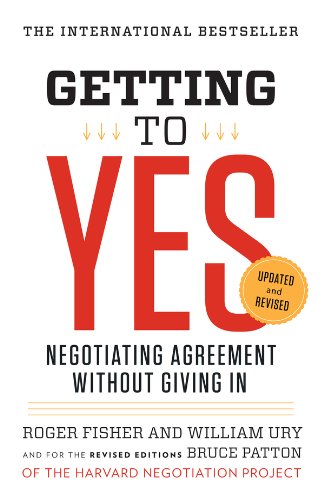
Getting to Yes: Negotiating Agreement Without Giving In
by Roger Fisher
About This Book
Getting to Yes presents the method of principled negotiation developed at the Harvard Negotiation Project—a way to reach agreements that is "neither hard nor soft, but both." The authors argue that conventional positional bargaining is flawed: it produces unwise outcomes, is inefficient, and damages relationships. The more negotiators clarify and defend positions, the more their egos become entangled with them, shifting attention away from the underlying concerns that actually matter.
Any negotiation method, the book contends, should be judged by three criteria: it should produce a wise agreement, be efficient, and improve or at least not damage the relationship between parties. To meet these, principled negotiation rests on four propositions:
- People: Separate the people from the problem.
- Interests: Focus on interests, not positions.
- Options: Invent multiple options for mutual gain before deciding.
- Criteria: Insist that the result rest on objective standards.
A large portion of the book addresses "people problems," which fall into three baskets: perception, emotion, and communication. Negotiators are human beings first—prone to bias, ego, and strong feelings. The authors urge readers to put themselves in the other side's shoes, acknowledge emotions, allow the other party to let off steam, and listen actively so people feel heard ("the cheapest concession you can make").
The method unfolds across three stages: analysis, planning, and discussion. Throughout, the goal is not to eliminate conflict—conflict is inevitable and useful—but to transform adversarial battling into side-by-side problem solving. By being hard on the merits and soft on the people, negotiators can protect their interests, preserve relationships, and craft durable, fair agreements.
Key Takeaways
- 1.Judge any negotiation method by three criteria: it should produce a wise agreement, be efficient, and protect the relationship.
- 2.Positional bargaining locks people into stances, ties ego to position, and shifts focus away from the real underlying interests.
- 3.The four pillars are people, interests, options, and criteria—be hard on the merits and soft on the people.
- 4.Most negotiation difficulties are people problems falling into three baskets: perception, emotion, and communication.
- 5.Understanding the other side's point of view is not the same as agreeing—it is a benefit that reduces conflict and advances your own interests.
- 6.Letting the other side feel heard and involved in the process is often what determines whether they accept a proposal.
- 7.The goal is not to eliminate conflict but to transform it from adversarial battling into side-by-side problem solving.
Top Highlights
the more attention that is paid to positions, the less attention is devoted to meeting the underlying concerns of the parties.
Highlighted by 8 people · 1 left a note
It should produce a wise agreement if agreement is possible. It should be efficient. And it should improve or at least not damage the relationship between the parties.
Highlighted by 7 people · 1 left a note
When negotiators bargain over positions, they tend to lock themselves into those positions.
Highlighted by 4 people · 1 left a note
Before trying to reach agreement, invent options for mutual gain.
Highlighted by 4 people
To find your way through the jungle of people problems, it is useful to think in terms of three basic categories: perception, emotion, and communication.
Highlighted by 4 people · 1 left a note
principled negotiation
Highlighted by 3 people
Arguing over positions endangers an ongoing relationship
Highlighted by 3 people · 1 left a note
People: Separate the people from the problem. Interests: Focus on interests, not positions. Options:
Highlighted by 3 people
Separate the people from the problem.
Highlighted by 3 people
Insist on using objective criteria.
Highlighted by 3 people
AI Review
Glasp's analysis of highlights from 12 readers shows strong consensus around the book's core framework, with the most-shared passages clustering tightly on positions versus interests and the people problem.
Pros
- +Clear, memorable four-point framework (people, interests, options, criteria) that readers repeatedly highlighted
- +Strong treatment of the people problem—perception, emotion, and communication
- +Offers a practical third path beyond hard and soft bargaining
- +Concrete, quotable advice such as separating people from the problem and letting the other side let off steam
- +Broadly applicable across business, diplomacy, and personal life
Cons
- −Some readers note that arguing over positions and other concepts are revisited repeatedly, which can feel redundant
- −Framework is easier to state than to apply against a determined hard bargainer
Glasp AI analysis based on highlights from 12 readers.
Who Should Read This
Anyone who negotiates—which is nearly everyone. The book is ideal for business professionals, managers, lawyers, diplomats, and salespeople, but its lessons apply equally to couples, parents, and everyday disputes over price, terms, or responsibilities. It suits readers who feel trapped between being too aggressive or too accommodating and want a third way. No prior negotiation training is required; the writing is a readable, practical primer. Particularly valuable for those who must preserve an ongoing relationship while still protecting their interests.
Frequently Asked Questions
What is Getting to Yes about?
Who is the book for?
What are the key lessons?
Is it worth reading?
How is principled negotiation different from haggling?
How does the book handle emotions in negotiation?
What are the three stages of negotiation in the book?
How to Apply What You Read
- 1.Separate the people from the problem: address relationship and emotional issues directly, distinct from the substantive merits.
- 2.Ask "why" behind each position to uncover the underlying interests, hopes, and fears that actually motivate the other side.
- 3.Invent multiple options for mutual gain in a dedicated brainstorming session before deciding, suspending premature judgment.
- 4.Insist on objective criteria—market value, expert opinion, custom, or law—so neither party has to give in to the other's will.
- 5.Involve the other side early and give them credit for ideas so they feel ownership of the final agreement.
Discussion Questions
- Q1.Think of a recent negotiation where you locked into a position—what underlying interest were you actually trying to protect?
- Q2.How do you balance being firm on substance while remaining respectful and soft toward the people involved?
- Q3.Which of the three people problems—perception, emotion, or communication—causes you the most difficulty, and why?
- Q4.When has letting someone feel fully heard changed the outcome of a disagreement for you?
- Q5.How might you respond when the other side refuses to abandon hard positional bargaining?
- Q6.What objective criteria could you bring to a negotiation you currently face to avoid a contest of wills?
- Q7.Do you agree that conflict is useful and should be transformed rather than eliminated? How does that change your approach?
What People Are Saying
“There’s a term I do recommend, if people read Getting the Yes – BATNA: Best Alternative to Negotiated Agreement, which is a really important concept to grasp.”
More Praise
Charlie Munger recommended 'Getting to Yes' in his book Poor Charlie's Almanack. Ann Miura-Ko: "Getting To Yes I thought was really good."
More Books in Business

Revisit Your Highlights, Deepen Your Understanding
Import your Kindle highlights to review, organize, and share the ideas that matter most to you.
Get the free browser extension