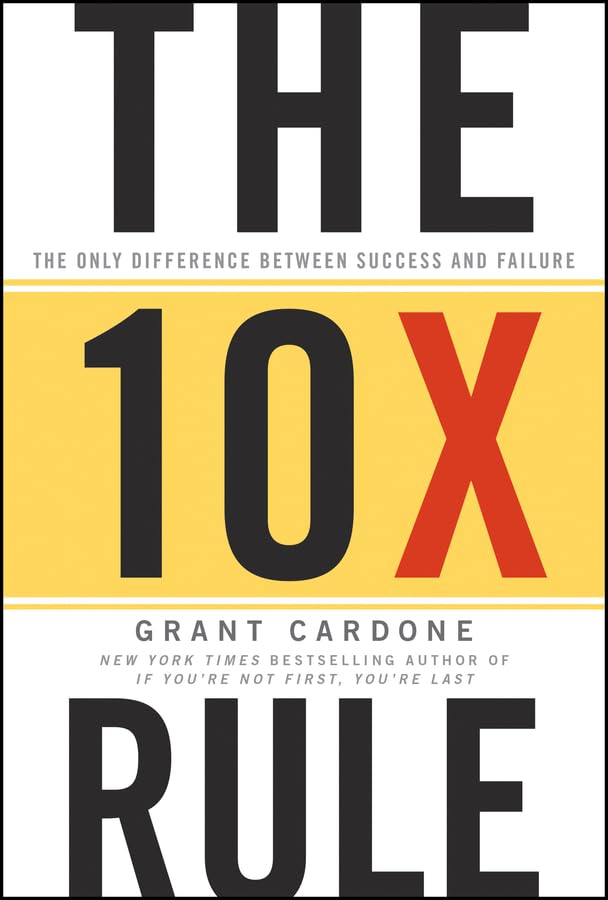
The 10X Rule: The Only Difference Between Success and Failure
About This Book
The 10X Rule argues that the gap between success and failure comes down to a single miscalculation: people set targets far too low and grossly underestimate the action required to reach them. Grant Cardone's central formula—the most highlighted idea in the book—is to set targets 10 times what you think you want, then take 10 times the action you think it will take. As he puts it, massive thoughts must be followed by massive actions.
The book builds on a few reinforcing claims. First, success is a duty, obligation, and responsibility, not an option—those who treat it casually spend their lives making excuses. Second, the target is never the problem: any goal attacked with the right actions in the right amounts, with persistence, is attainable. When you fall short, you should never reduce the target—only increase the action.
Cardone identifies four common mistakes: setting goals too low, underestimating the effort and resources needed, competing instead of dominating a sector, and underestimating the adversity ahead. He champions a domination mindset—doing what others refuse to do, taking "unreasonable" action, and treating obscurity as your biggest enemy.
Other threads include radical accountability (nothing happens to you; it happens because of you), reframing fear as a signal to act, embracing problems rather than avoiding them, and the idea that "massive action" is the level that actually creates new problems. He insists luck is manufactured through commitment and that success compounds into momentum and habit.
The practical core is simple: write 10X goals down daily, align them with your purpose, commit first and figure the rest out later, and stay uncomfortable. The book is less a tactical manual than a motivational reframe of ambition and effort.
Key Takeaways
- 1.Set targets that are 10 times what you think you want, then take 10 times the action you think it will take.
- 2.The target is never the problem—any goal attacked with the right action, in the right amount, with persistence is attainable.
- 3.Never reduce a goal; when you fall short, increase your action instead of lowering the finish line.
- 4.Treat success as a duty, obligation, and responsibility rather than an option, or you'll spend your life making excuses.
- 5.Accept total accountability: nothing happens to you—it happens because of you and the actions you take.
- 6.Fear is a signal that you are moving in the right direction; act on what you fear most to advance fastest.
- 7.Massive action is the level that creates new problems—if you aren't generating new problems, you aren't acting enough.
Top Highlights
Extremely successful people know that their efforts must continue in order for them to realize new achievements.
Highlighted by 5 people
When people start limiting the amount of success they desire, I assure you they will limit what will be required of them in order to achieve success and will fail miserably at doing what it takes to keep it.
Highlighted by 5 people
A person who limits his or her potential success will limit what he or she will do to create it and keep it.
Highlighted by 5 people
The 10X Rule assumes the target is never the problem. Any target attacked with the right actions in the right amounts with persistence is attainable.
Highlighted by 5 people
I see that the one thing that was most consistent with any success I've achieved was that I always put forth 10 times the amount of activity that others did.
Highlighted by 4 people
The 10X Rule is about pure domination mentality.
Highlighted by 4 people
When you start rethinking your targets, making up excuses, and letting yourself off the hook, you are giving up on your dreams!
Highlighted by 4 people
massive action;
Highlighted by 3 people
An interesting thing about success is that it's like a breath of air; although your last breath of air is important, it's not nearly as important as the next one.
Highlighted by 3 people
An interesting thing about success is that it's like a breath of air; although your last breath of air is important, it's not nearly as important as the next one.
Highlighted by 3 people
AI Review
Based on 14 readers' highlights, this is a highly resonant motivational manifesto whose single, repeatable formula—think 10X and act 10X—clearly stuck with its audience. Its power lies in mindset reframing rather than tactical depth.
Pros
- +A simple, memorable core formula—set 10X targets and take 10X action—that readers highlighted repeatedly
- +Strong emphasis on radical accountability and refusing to blame external forces
- +Practical reframe of fear as a signal to act rather than retreat
- +Persuasive case that success is a duty rather than an optional outcome
- +Identifies concrete goal-setting mistakes, especially the habit of reducing targets instead of increasing effort
Cons
- −Repetitive—the same handful of ideas are restated many times throughout
- −Light on detailed, step-by-step tactics; heavy on motivation and mindset
- −The "domination" and "take-no-prisoners" tone may feel aggressive or one-note to some readers
Glasp AI analysis based on highlights from 14 readers.
Who Should Read This
This book suits entrepreneurs, salespeople, and ambitious professionals who feel stuck at "normal" levels of effort and want a motivational jolt to think and act bigger. It's ideal for readers early in building a business or career who suspect they are underestimating what success demands. Those who prefer nuanced, evidence-based frameworks or detailed step-by-step tactics may find it thin. Best read by anyone ready to embrace an aggressive, take-no-prisoners mindset and willing to be uncomfortable in pursuit of outsized goals.
Frequently Asked Questions
What is The 10X Rule about?
Who is the book for?
What are the key lessons?
Is it worth reading?
What does '10X' actually mean in practice?
Why does the book say you should never reduce your targets?
What is the 'domination mindset' the book promotes?
How to Apply What You Read
- 1.Multiply your current goals by ten and rewrite them at that scale, refusing to shrink them as you write.
- 2.Write your 10X goals down every day—when you wake and before you sleep—and review them daily.
- 3.Take the action you fear most today, treating that fear as a signal to move rather than retreat.
- 4.Replace every excuse or blame with the question: what can I do to ensure this doesn't happen again?
- 5.Reach up in your relationships by surrounding yourself with people who are more successful, connected, and creative.
Discussion Questions
- Q1.Where in your own life have you set targets too low simply because they felt "realistic"?
- Q2.Do you agree that success is a duty and obligation rather than a personal choice? Why or why not?
- Q3.How does the advice to increase action rather than reduce a target conflict with conventional goal-setting wisdom?
- Q4.Is the book's "domination" and "take-no-prisoners" mindset healthy, or can it lead to burnout and damaged relationships?
- Q5.Can luck really be manufactured through commitment and massive action, as the book claims?
- Q6.Which of the four goal-setting mistakes—mistargeting, underestimating effort, competing instead of dominating, or underestimating adversity—do you fall into most?
- Q7.How would reframing fear as a signal to act change the decisions you're currently avoiding?
Recommended Books







Revisit Your Highlights, Deepen Your Understanding
Import your Kindle highlights to review, organize, and share the ideas that matter most to you.
Get the free browser extension