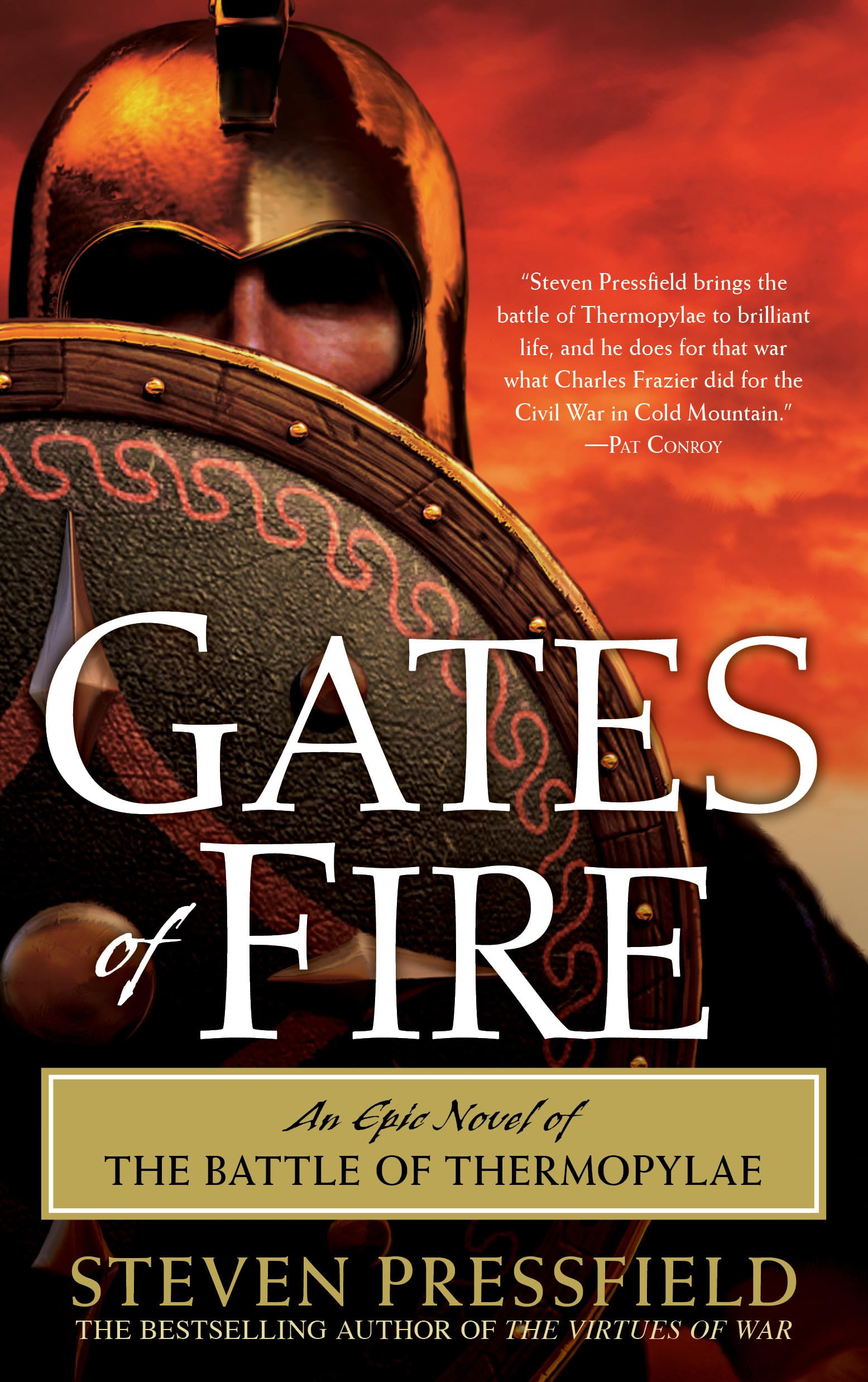
Gates of Fire: An Epic Novel of the Battle of Thermopylae
About This Book
Gates of Fire is Steven Pressfield's historical novel reimagining the Battle of Thermopylae, where 300 Spartans and their allies stood against the vast Persian army. Told through the eyes of Xeones, a squire and the battle's sole survivor, the book is far more than a war story — it is a meditation on courage, brotherhood, and what makes free men willing to die.
The highlights cluster around a coherent philosophy of warriorhood embodied by the Spartan officer Dienekes, who insists that heroism is not the superhuman feat of an Achilles but "just a man doing a job" defined by self-restraint and self-composure. The novel anatomizes fear and its opposite, repeatedly returning to the Spartan concept of katalepsis — "possession," the yielding to fear or anger that reduces an army to a rabble. Against this, the Spartans train the mind harder than the body, using ritual abuse (arosis) and brutal discipline to inoculate men against panic.
Several threads recur powerfully:
- The phalanx as a single organism, where each man's shield protects the man beside him.
- Leadership as service — a king lifts the heaviest burden first and sets it down last.
- The warrior's secret shame, the private knowledge of one's own small cowardices.
Ultimately the book lands on a striking inversion: Dienekes concludes that "the opposite of fear is love." Soldiers fight not for country or king but "for the man who stands at your shoulder." Pressfield grounds this in Spartan law, the academy of discipline and sacrifice that for twenty generations purchased liberty at full price. The result is a vivid, philosophically rich portrait of duty, sacrifice, and the bonds forged in the crucible of battle.
Key Takeaways
- 1.True heroism is self-restraint and composure, not superhuman invulnerability — "just a man doing a job" for those he leads by example.
- 2.The Spartans train the mind harder than the body; hardship and ritual abuse exist to harden the will against fear and rage.
- 3.Katalepsis — possession by fear or anger — is the warrior's true enemy, dissolving an army into a rabble.
- 4.The phalanx functions as a single organism, where each man's shield protects the whole line, not just himself.
- 5.A king serves his men rather than ruling them, earning loyalty through shared sacrifice instead of fear or gold.
- 6.Every warrior carries the secret shame of his own small cowardices, the private knowledge that he could have done more.
- 7.Dienekes concludes that the opposite of fear is love — men ultimately fight for the comrade beside them.
Top Highlights
His was not, I could see now, the heroism of an Achilles. He was not a superman who waded invulnerably into the slaughter, single-handedly slaying the foe by myriads. He was just a man doing a job. A job whose primary attribute was self-restraint and self-composure, not for his own sake, but for those whom he led by his example.
Highlighted by 2 people
AI Review
Based on Glasp's analysis of highlights from 4 readers, Gates of Fire resonates most for its quotable warrior-philosophy and its reframing of courage as discipline and love rather than fearlessness.
Pros
- +Profound meditation on fear and courage, anchored in the concept of katalepsis
- +Memorable, highly quotable passages on leadership as service
- +Vivid portrait of the phalanx as a single living organism
- +Emotional depth through the warrior's private shame and bonds of brotherhood
- +Educates readers on Spartan culture without sacrificing narrative drive
Cons
- −The relentless glorification of war and martial valor may not sit well with all readers
- −Dense classical terminology and Spartan concepts can demand patient reading
Glasp AI analysis based on highlights from 4 readers.
Who Should Read This
Readers drawn to historical fiction, military history, and the ancient world will find this gripping. It especially rewards anyone interested in the psychology of courage and fear — soldiers, veterans, athletes, and leaders seeking lessons on discipline, team cohesion, and service-based leadership. Fans of Pressfield's The War of Art will recognize his ideas about resistance and mastery here in narrative form. No prior knowledge of Spartan history is required; the novel teaches as it tells.
Frequently Asked Questions
What is Gates of Fire about?
Who is it for?
What are the key lessons?
Is it worth reading?
What is katalepsis in the book?
What does the book say about leadership?
Why do the Spartans fight, according to the novel?
How to Apply What You Read
- 1.Train your mind, not just your skills, to remain composed and find humor under pressure and insult.
- 2.Lead by example — turn your hand first to the hardest work and let those you lead see you unafraid.
- 3.Cultivate the bonds with those who stand beside you, recognizing that mutual loyalty outlasts abstract ideals.
- 4.Reframe fear by anchoring it in care for others rather than self-preservation.
- 5.Stay in action during anxious times, since idle talk turns to fear while purposeful work breeds courage.
Discussion Questions
- Q1.Do you accept Dienekes's claim that "the opposite of fear is love," or is fear's true opposite something else?
- Q2.Is the novel's exaltation of war as a producer of virtue persuasive, or a dangerous glorification?
- Q3.How does the Spartan model of leadership as service compare to leadership you have witnessed?
- Q4.What does the concept of the warrior's "secret shame" reveal about honor and self-judgment?
- Q5.Why might fighting "for the man at your shoulder" be more powerful than fighting for country or freedom?
- Q6.Can the Spartan training of the mind through hardship be applied ethically in modern life?
- Q7.How does narrating the story through a survivor shape its meaning about memory and sacrifice?
Recommended Books





Revisit Your Highlights, Deepen Your Understanding
Import your Kindle highlights to review, organize, and share the ideas that matter most to you.
Get the free browser extension