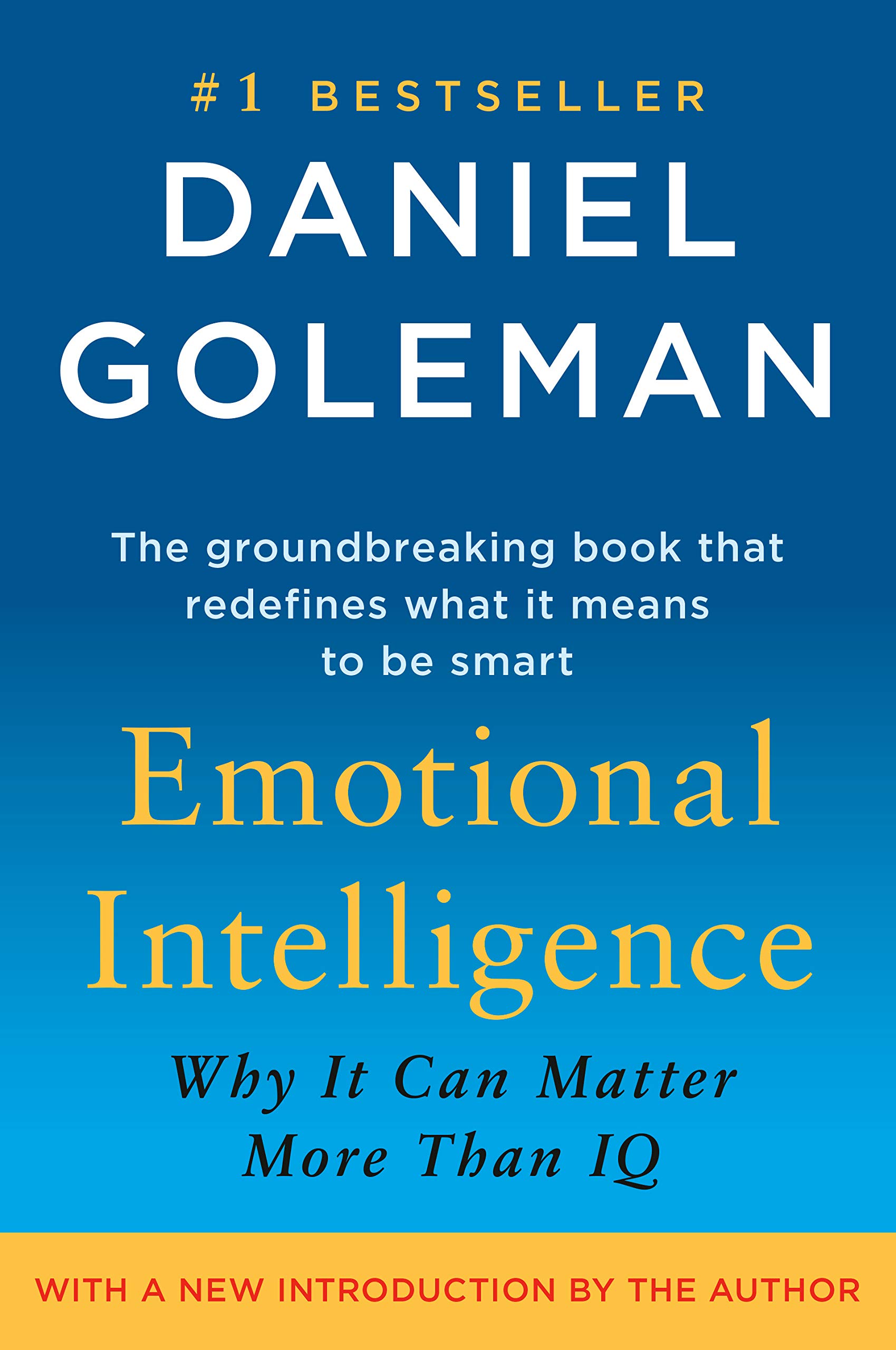
Emotional Intelligence: Why It Can Matter More Than IQ
About This Book
Daniel Goleman's Emotional Intelligence argues that the qualities we call emotional intelligence (EI)—self-awareness, self-control, motivation, empathy, and the ability to manage relationships—often matter more for a successful, meaningful life than raw IQ. Drawing on the emerging science of affective neuroscience, Goleman explains how the brain's emotional circuitry interacts with, and frequently overrides, its rational centers.
The book is grounded in evolutionary biology and neuroanatomy. Goleman traces how the brain grew "from the bottom up," with higher centers elaborating on more ancient, emotional structures—revealing that "there was an emotional brain long before there was a rational one." He describes the amygdala as a storehouse of emotional memory that can stage an emotional "hijacking," triggering fight-or-flight reactions before the thinking neocortex can intervene.
A central theme is that "temperament is not destiny." Although we inherit emotional set-points, the brain's circuitry is remarkably malleable through neuroplasticity. This makes EI teachable. Goleman champions Social and Emotional Learning (SEL) in schools, citing evidence that programs which help children label emotions, build empathy, and resolve conflicts improve not just behavior but academic achievement—by strengthening the prefrontal cortex's executive functions.
The book repeatedly returns to Aristotle's challenge: anyone can become angry, but to be angry "with the right person, to the right degree, at the right time, for the right purpose, and in the right way" is the rare skill. Goleman frames self-restraint and empathy as the foundations of character and the moral stances our times most need.
Ultimately, Goleman synthesizes scattered scientific findings into a coherent argument: emotions are impulses to act, essential to thought rather than opposed to it, and learning to bring intelligence to our emotional lives is a vital human competency.
Key Takeaways
- 1.Emotional intelligence can matter more than IQ, especially in domains where self-regulation and empathy outweigh purely cognitive ability.
- 2.The brain evolved from the bottom up—"there was an emotional brain long before there was a rational one"—so feeling and reason are deeply intertwined.
- 3.The amygdala acts as a neural tripwire, capable of hijacking our behavior before the thinking brain can respond.
- 4.Temperament is not destiny: thanks to neuroplasticity, our emotional circuitry is malleable and EI can be cultivated.
- 5.The ability to control impulse is the base of will and character, while empathy is the root of altruism and compassion.
- 6.All emotions are essentially impulses to act, each with a distinct biological signature shaped by evolution.
- 7.EI skills like managing emotions and resolving conflicts can be taught, with measurable benefits for children and workplaces alike.
Top Highlights
Mind Whispering: A New Map to Freedom from Self-defeating Habits.
Highlighted by 2 people
Anyone can become angry—that is easy. But to be angry with the right person, to the right degree, at the right time, for the right purpose, and in the right way—that is not easy. ARISTOTLE, The Nichomachean Ethics
Highlighted by 2 people
these minds are exquisitely coordinated; feelings are essential to thought, thought to feeling.
Highlighted by 2 people
AI Review
Based on Glasp's analysis of highlights from 4 readers, this is a foundational, science-grounded work whose core ideas about emotional self-regulation and the teachable nature of EI resonate strongly. Readers consistently flag its neuroscience and Aristotelian framing as memorable.
Pros
- +Synthesizes scattered research into a coherent theory of emotional intelligence
- +Clear, accessible explanation of brain structures like the amygdala and "emotional hijacking"
- +Hopeful, evidence-based message that temperament is not destiny
- +Practical relevance to education through Social and Emotional Learning (SEL)
- +Memorable framing via Aristotle's challenge of feeling "the right way"
Cons
- −More conceptual than prescriptive—light on concrete personal techniques
- −Some scientific claims have been revised since publication
Glasp AI analysis based on highlights from 4 readers.
Who Should Read This
This book suits educators and parents interested in Social and Emotional Learning, leaders and managers who recognize that EI shapes workplace success, and anyone curious about the science of emotion and the brain. Readers drawn to psychology, neuroscience, and personal development will benefit most. No technical background is required, though those wanting practical step-by-step techniques may find it more conceptual than prescriptive.
Frequently Asked Questions
What is the book about?
Who is it for?
What are the key lessons?
Is it worth reading?
What is an emotional hijacking?
Does the book say IQ doesn't matter?
Why does Goleman emphasize education and SEL?
How to Apply What You Read
- 1.Practice labeling your emotions accurately as they arise to build self-awareness and create space before reacting.
- 2.Pause during moments of anger or fear to let your thinking brain catch up before the amygdala drives your response.
- 3.Develop empathy by deliberately reading others' nonverbal cues to understand their feelings and needs.
- 4.Advocate for or apply Social and Emotional Learning principles in schools, teams, or family life.
- 5.Reframe conflicts toward win-win negotiation and listening rather than escalation.
Discussion Questions
- Q1.Do you agree that emotional intelligence can matter more than IQ? In what situations have you seen this play out?
- Q2.How have you experienced an "emotional hijacking," and what might have helped you respond differently?
- Q3.If temperament is not destiny, which emotional habits would you most want to reshape, and how?
- Q4.How does Aristotle's standard—being angry in "the right way"—change how you think about expressing emotion?
- Q5.Should schools formally teach self-awareness, empathy, and conflict resolution? Why or why not?
- Q6.What does Goleman's claim that empathy is the root of altruism imply for how we build moral character?
- Q7.How should the interplay between heart and head guide important decisions in your own life?
Recommended Books

Revisit Your Highlights, Deepen Your Understanding
Import your Kindle highlights to review, organize, and share the ideas that matter most to you.
Get the free browser extension