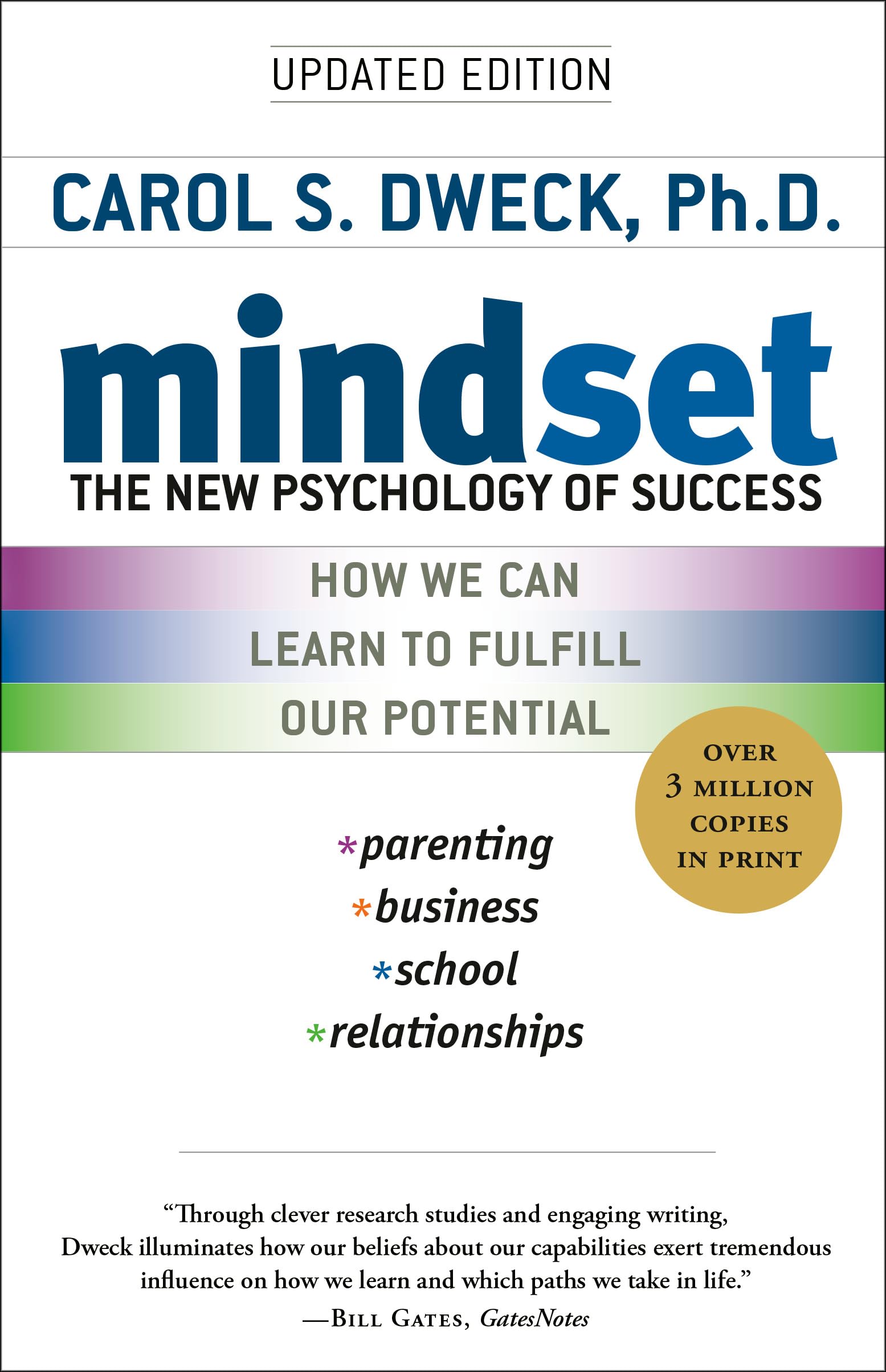
Mindset: The New Psychology of Success
About This Book
Carol S. Dweck’s Mindset argues that a simple belief about human qualities shapes how people interpret success, failure, effort, and relationships. Across the most-highlighted passages, readers consistently latched onto one core distinction: a fixed mindset treats intelligence, talent, and personality as largely set traits that must be proven, while a growth mindset sees those qualities as developable through effort, strategy, practice, and help from others.
The book’s central claim is not that everyone can become anything, but that potential is unknowable in advance and is often expanded by sustained learning. In a fixed mindset, people seek validation, avoid exposing deficiencies, fear effort because it seems to signal low ability, and may respond to setbacks with blame, excuses, withdrawal, or self-protection. In a growth mindset, people still feel disappointment and pain, but they are more likely to confront problems directly, persist through difficulty, and ask what can be learned.
Dweck builds this argument through examples from multiple domains:
- Education: Students praised for intelligence become more fragile, while praise for effort, strategy, and process supports challenge-seeking and better learning.
- Sports and performance: Figures like Michael Jordan and John Wooden illustrate that excellence is built through practice, resilience, and preparation rather than raw gift alone.
- Business and leadership: Strong leaders create cultures of feedback, self-examination, teamwork, and long-term development instead of ego protection.
- Relationships and parenting: Healthy partners and parents do not merely protect self-esteem; they challenge growth, address problems, and treat setbacks as opportunities to learn.
A recurring message throughout the highlights is that effort is not evidence of inadequacy; it is what turns ability into accomplishment. Mindsets are powerful, but they are still beliefs, and Dweck insists they can be recognized, challenged, and changed over time.
Key Takeaways
- 1.Mindset shapes behavior: what you believe about ability affects your response to challenge, criticism, and failure.
- 2.A fixed mindset pushes people to prove themselves, hide weaknesses, and treat setbacks as verdicts on identity.
- 3.A growth mindset treats setbacks as information, making it easier to persist, adjust strategy, and keep learning.
- 4.Effort is not a mark of low ability; it is what develops skill and turns potential into performance.
- 5.The kind of feedback people receive matters: praise for talent can increase fragility, while process-focused feedback supports resilience.
- 6.Growth-minded people seek environments, teammates, and partners who challenge them to improve, not just validate them.
- 7.Changing mindset is possible, but it is gradual; old self-protective beliefs may remain and need to be noticed and challenged repeatedly.
Top Highlights
This growth mindset is based on the belief that your basic qualities are things you can cultivate through your efforts, your strategies, and help from others.
Highlighted by 8 people
Why waste time proving over and over how great you are, when you could be getting better?
Highlighted by 8 people
the view you adopt for yourself profoundly affects the way you lead your life.
Highlighted by 7 people
people with the growth mindset were not labeling themselves and throwing up their hands.
Highlighted by 5 people · 1 left a note
“Becoming is better than being.”
Highlighted by 5 people
failure has been transformed from an action (I failed) to an identity (I am a failure).
Highlighted by 5 people
With practice, training, and above all, method, we manage to increase our attention, our memory, our judgment and literally to become more intelligent than we were before.
Highlighted by 4 people
The passion for stretching yourself and sticking to it, even (or especially) when it’s not going well, is the hallmark of the growth mindset.
Highlighted by 4 people
that needs to be proven, and a changeable ability that can be developed through learning.
Highlighted by 4 people
Robert Sternberg, the present-day guru of intelligence,
Highlighted by 3 people
AI Review
Glasp's AI analysis of 22 reader highlights suggests strong consensus that this book is highly actionable and memorable. The most-saved passages repeatedly emphasize challenge, effort, learning, and resilience, with reader notes reinforcing its practical value across school, work, and relationships.
Pros
- +Clear core framework that readers repeatedly highlighted
- +Highly quotable distinctions between fixed and growth mindset
- +Strong applicability to education, leadership, sports, and relationships
- +Reframes effort as a strength rather than a weakness
- +Useful guidance for responding to failure and criticism
- +Research-backed tone that readers found credible
Cons
- −Core ideas can feel repetitive because the same distinction is applied across many domains
- −Some examples simplify complex issues by centering mindset over other constraints
- −The growth mindset message can be misunderstood as effort alone being enough
Glasp AI analysis based on highlights from 22 readers.
Who Should Read This
This book is especially useful for students, teachers, parents, managers, coaches, and high achievers who struggle with failure, perfectionism, or the pressure to look talented. It also fits readers navigating career plateaus, academic stress, difficult feedback, or relationship patterns built on validation instead of growth. No psychology background is required. If you want a practical framework for responding better to setbacks and developing others more effectively, this is a strong entry point.
Frequently Asked Questions
What is the book about?
Who is it for?
What are the key lessons?
Is it worth reading?
Does the book say anyone can become anything?
What does the book say about praise?
How does the book connect mindset to relationships?
How to Apply What You Read
- 1.Notice one area where you are trying to prove ability instead of build it, and rewrite the goal in learning terms.
- 2.Reframe your last failure by asking what it taught you, what strategy was missing, and what you will try next.
- 3.Replace talent-based praise with process-based feedback focused on effort, preparation, strategy, and persistence.
- 4.Seek one person who gives constructive criticism rather than simple reassurance, and use that feedback to improve.
- 5.Plan a concrete growth step by deciding when, where, and how you will practice a difficult skill this week.
Discussion Questions
- Q1.Where in your life do you most often act from a fixed mindset: work, learning, relationships, or something else?
- Q2.Why does effort feel threatening to so many people, even when they claim to value growth?
- Q3.How should we balance the book’s emphasis on mindset with real differences in resources, opportunity, and support?
- Q4.What kinds of praise or labels shaped your attitude toward talent, mistakes, and challenge when you were younger?
- Q5.Is a relationship healthier when it protects self-esteem or when it challenges both people to grow?
- Q6.How can leaders or teachers set high standards without creating a culture of fear and judgment?
- Q7.What is one recurring setback in your life that might look different if you treated it as a learning problem rather than an identity problem?
Recommended Books







Revisit Your Highlights, Deepen Your Understanding
Import your Kindle highlights to review, organize, and share the ideas that matter most to you.
Get the free browser extension