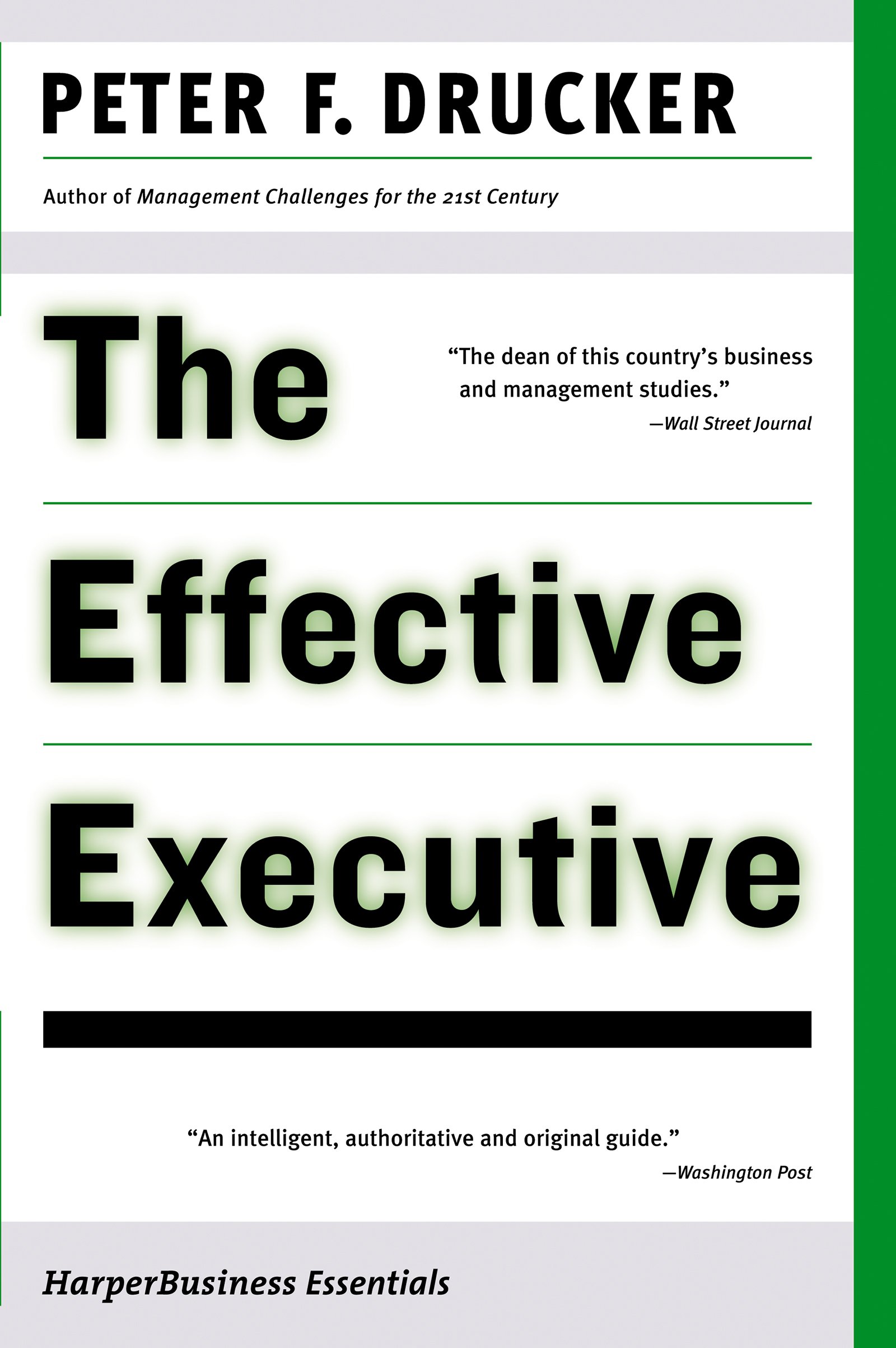
The Effective Executive: The Definitive Guide to Getting the Right Things Done (Harperbusiness Essentials)
About This Book
Peter Drucker's The Effective Executive argues that effectiveness — not intelligence, hard work, or knowledge — is what converts a knowledge worker's abilities into results. As the highlights stress repeatedly, "Intelligence, imagination, and knowledge are essential resources, but only effectiveness converts them into results." Drucker redefines the "executive" as any knowledge worker whose decisions materially affect organizational performance, regardless of rank or whether they manage people.
The book's spine is a set of five learnable practices that recur across the most-highlighted passages.
- Know where your time goes, and systematically manage the little of it you control
- Focus on outward contribution and results rather than on busywork
- Build on strengths — your own, your boss's, your colleagues' — never on weakness
- Concentrate on the few areas where superior performance produces outstanding results, doing first things first and second things not at all
- Make few, fundamental decisions based on dissenting opinions rather than premature consensus
Drucker frames effectiveness as a habit: simple to understand but hard to do well, acquired like scales by a musician. He emphasizes consolidating "discretionary time" into large continuous chunks, pruning recurrent crises into routines, and treating meetings as a symptom of poor organization. On decision-making, he insists one starts with opinions (untested hypotheses), defines boundary conditions, decides what is right before compromising, builds action into the decision, and creates feedback loops.
Throughout, examples — Marshall's people decisions, Sloan at GM, McNamara cultivating Congress — illustrate that strength, not the elimination of weakness, makes organizations productive. The closing message: executives are paid not for what they like doing but for getting the right things done.
Key Takeaways
- 1.Effectiveness, not intelligence or knowledge, is what converts ability into results — and it can be learned as a habit.
- 2.Effective executives focus on contribution and results, asking "What is expected of me?" rather than fixating on the work or their authority.
- 3.Time is the scarcest resource; record where it goes, prune the wasteful, and consolidate discretionary time into large continuous chunks.
- 4.Build on strengths — your own, your boss's, and your colleagues' — because staffing to minimize weakness produces only mediocrity.
- 5.Concentration means doing first things first and second things not at all; setting "posteriorities" (what not to do) is harder and more important than setting priorities.
- 6.Effective decisions are few and fundamental: start with opinions, define boundary conditions, decide what's right, build in action, and add feedback.
- 7.Recurrent crises signal a failure of system; convert them into routines so unskilled people can handle what once took near-genius.
Top Highlights
Neither is knowledge work defined by its costs. Knowledge work is defined by its results.
Highlighted by 4 people
Intelligence, imagination, and knowledge are essential resources, but only effectiveness converts them into results.
Highlighted by 3 people
The truly important events on the outside are not the trends. They are changes in the trends.
Highlighted by 3 people
These are essentially five such practices—five such habits of the mind that have to be acquired to be an effective executive:
Highlighted by 3 people
Working on the right things is what makes knowledge work effective.
Highlighted by 2 people
The knowledge worker cannot be supervised closely or in detail. He can only be helped. But he must direct himself, and he must direct himself toward performance and contribution, that is, toward effectiveness.
Highlighted by 2 people
If the executive lets the flow of events determine what he does, what he works on, and what he takes seriously, he will fritter himself away “operating.” He may be an excellent man. But he is certain to waste his knowledge and ability and to throw away what little effectiveness he might have achieved. What the executive needs are criteria which enable him to work on the truly important, that is, on contributions and results, even though the criteria are not found in the flow of events.
Highlighted by 2 people
Effective executives start out by estimating how much discretionary time they can realistically call their own.
Highlighted by 2 people
Effective executives do not make a great many decisions. They concentrate on the important ones. They try to think through what is strategic and generic, rather than “solve problems.”
Highlighted by 2 people
Most books on decision-making tell the reader: “First find the facts.” But executives who make effective decisions know that one does not start with facts. One starts with opinions.
Highlighted by 2 people
AI Review
Across 7 readers' highlights, Glasp's analysis finds unusually strong consensus around Drucker's core framework — the five practices and the contribution mindset were highlighted by multiple readers, signaling timeless, quotable substance.
Pros
- +A clear, memorable framework of five learnable practices that recur throughout the highlights
- +Powerful reframing of contribution over effort, downward authority, or job title
- +Durable, principle-level insight on decision-making and boundary conditions
- +Strong consensus among readers — many passages highlighted by 3-4 of 7
- +Concrete examples (Marshall, Sloan, McNamara) ground the abstractions
Cons
- −Mid-century examples and language can feel dated to modern readers
- −Concept-heavy and abstract rather than offering step-by-step tactics
Glasp AI analysis based on highlights from 7 readers.
Who Should Read This
Anyone whose decisions affect an organization's results: managers, executives, and individual knowledge professionals at any level. It suits new leaders seeking a durable framework, experienced executives drowning in operating tasks, and ambitious individual contributors who want to think like "top management" by owning their contribution. Readers comfortable with concept-driven prose rather than step-by-step tactics will get the most from it. No prerequisites beyond working inside an organization and wanting to convert effort into measurable results.
Frequently Asked Questions
What is The Effective Executive about?
Who is the book for?
What are the key lessons?
Is it worth reading?
What does Drucker mean by 'discretionary time'?
How does Drucker say effective decisions are made?
Why does Drucker emphasize building on strengths?
How to Apply What You Read
- 1.Log your time for three to four weeks, then identify and eliminate activities that contribute nothing and consolidate the rest into uninterrupted blocks.
- 2.Ask of every task and program, "If we did not already do this, would we start it now?" — and drop or sharply curtail anything that fails the test.
- 3.Define your contribution by answering "What can I contribute that will significantly affect the results of my organization?" and align your work to it.
- 4.Staff and self-assess for strengths, asking "What can this person do uncommonly well?" rather than cataloguing weaknesses.
- 5.Restructure your decisions: before acting, state the boundary conditions, decide what is right, build in the action steps, and set up feedback to test the outcome.
Discussion Questions
- Q1.Drucker says you are an "executive" if your decisions materially affect results, regardless of title — does that change how you see your own role?
- Q2.Which of the five practices do you find hardest, and why?
- Q3.How much of your working time is truly "discretionary," and what could you prune to expand it?
- Q4.Drucker argues we should build on strengths and ignore weaknesses — where might that approach break down in practice?
- Q5.Why does Drucker insist effective decisions start with opinions and dissent rather than facts and consensus?
- Q6.Setting "posteriorities" — deciding what not to do — requires courage more than analysis. What would you stop doing if you applied this?
- Q7.How well do Drucker's mid-century examples translate to today's knowledge work, and what holds up regardless of era?
Recommended Books
Revisit Your Highlights, Deepen Your Understanding
Import your Kindle highlights to review, organize, and share the ideas that matter most to you.
Get the free browser extension